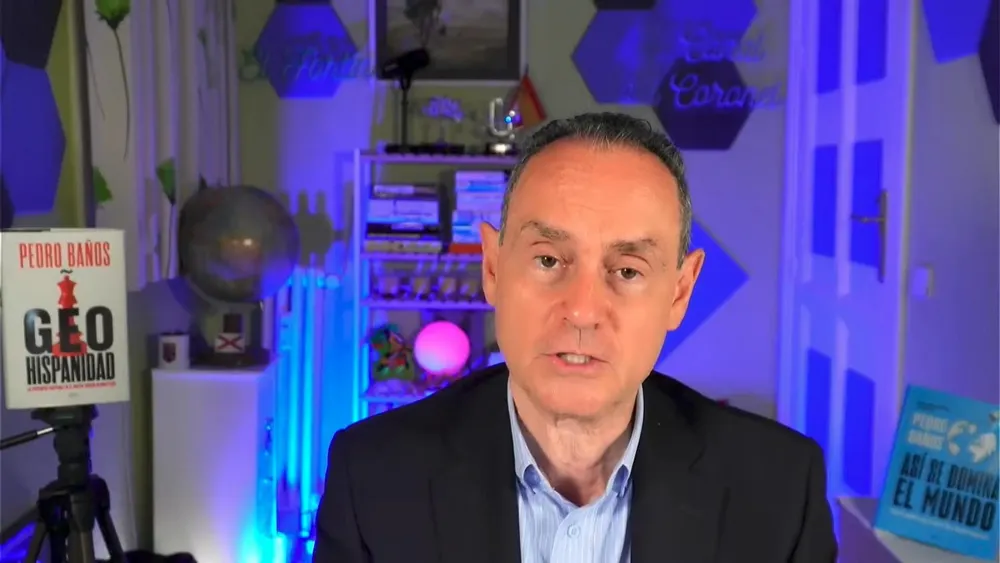
The following is an edited transcript of remarks by Col. (ret.) Pedro Baños to Panel 1 of the Sept. 4, 2026 EIR-IPC Roundtable, “An Alternative to War and Looting in the Americas.” Col. Baños is a geopolitical analyst in Spain. Subheads have been added. The video is available here.
Thank you very much. It is a pleasure to be here with all of you. Since you may not be very familiar with Spain’s situation as regards NATO, and in light of what is going on in Europe, I would like to start with some history regarding this entire situation.
First of all, during both world wars—World War I and World War II—Spain remained a neutral country, not a belligerent one. It is true that during World War II, the Blue Division was sent, but that was a division of volunteers, not an official unit of the Spanish Army.
I believe that right now, in this increasingly dangerous situation which we are entering—today’s news is truly alarming—what France, Germany, Finland, and Denmark are doing, clearly seems to be bringing us ever closer to war with Russia; a war that would make no sense at all, because it would be devastating. We would be talking about facing a nuclear power, which, if its very existence were threatened, would obviously not hesitate to use its nuclear arsenal.
I would therefore like to talk a little about Spain and NATO—Spain’s relationship with NATO. Let me begin by discussing—though I’m sure you’re all already aware of this—when NATO was created, and why it was created. NATO was founded in 1949 at the instigation of the United States and the United Kingdom to counter the Soviet Union and to counter the Soviet Union’s ideological and geopolitical expansion. We are talking about a context in which communism was a cause for concern in Europe; there were countries that were very close to falling under communist rule as well—such as Greece, Italy, France itself, or even the United Kingdom—and so NATO was created to counter that expansion, as I said, both geopolitical and ideological.
A few years later, in 1954, the Soviet Union created the Warsaw Pact. It is well known what happened during the Cold War, and that what this Anglo-Saxon world intended to do, was to unite a series of countries—that is, to convince a series of countries to join NATO so that it could stand up to the Soviet Union and all its allies and satellite states, starting with the Soviet Union’s European satellite states, with the greatest possible collective security.
In the particular case of Spain, after the coup attempt that took place on February 23, 1981, the government of the Union of the Democratic Center (UCD), at that time headed by President Calvo Sotelo, decided to join NATO.
Some understood it—we are talking about the height of the Cold War period—and interpreted it as having a double meaning. On the one hand, joining NATO was supposed to protect us from ever experiencing another coup d’état, since it meant that our NATO allies would come to our defense in the event of another coup attempt. On the other hand, it was also specifically intended to curb communism and gradually replace it in Spain with a more moderate form of socialism or social democracy.
Were Spaniards Misled on the NATO Referendum?
And indeed, President Felipe González [from the Socialist Party] took office, and specifically in 1986, he held a referendum to see if the Spanish people wanted to remain in NATO. That referendum was quite misleading. It is true that it had been one of Felipe González’s campaign promises, but there was something misleading about it.
Let us remember that the slogan [in Spanish] was “OTAN de entrada no,” but of course, depending on where the comma was placed, it meant something different in Spanish. It wasn’t the same to say “OTAN, de entrada no” (“NATO, no from the get-go”) as it was to say “OTAN de entrada, no” (“No to entry into NATO”). In other words, there was a slight difference.
In fact, that referendum was solely about whether Spain should or should not join NATO’s civilian structure—exclusively its civilian structure, not its military structure. And in fact, the Socialist Party itself apparently campaigned against joining NATO. For that matter, let us not forget that the man who would later become NATO Secretary General, Mr. Javier Solana, campaigned—and campaigned very hard—against Spain’s entry into NATO, and then went on to become its Secretary General.
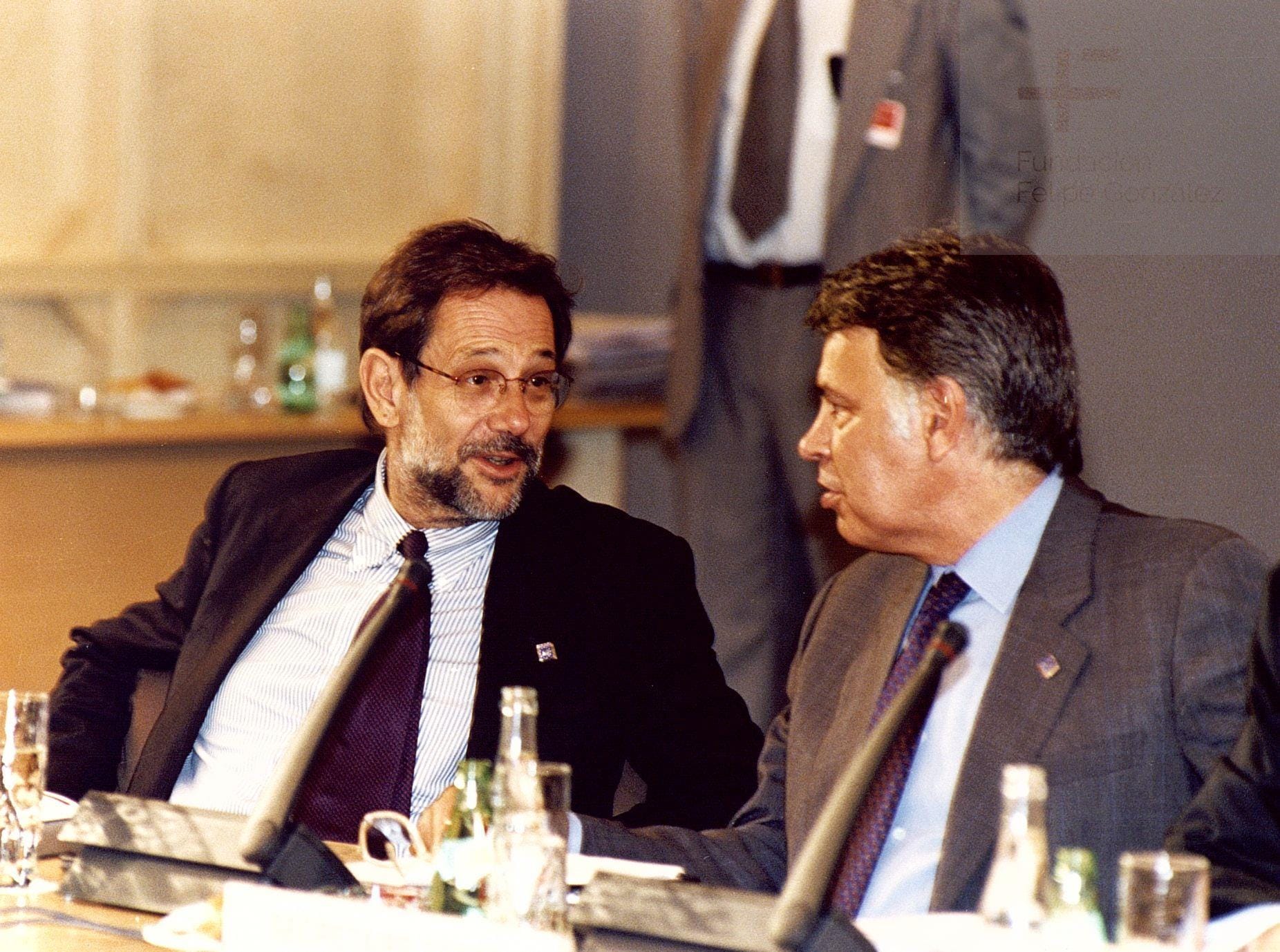
Clearly, Felipe González came under intense pressure from the United States—including calls from the U.S. Secretary of State at the time—to have Spain join NATO, and Spain ultimately did join. Well, as I said, this broke the Socialist Party’s campaign promise, but Spain joined with a set of conditions.
The first condition was that Spain would never join the military structure—this must be made very clear. The second condition was a ban on NATO deploying nuclear weapons in Spain, and the third was the gradual reduction of the U.S. military presence on Spanish soil. In other words, in a sense, gradually closing the U.S. military bases that existed at that time. This was only partially fulfilled, and in fact, the U.S. military presence in Spain continues to be renewed and expanded even now.
Then later, in another government, in this case that of José María Aznar of the People’s Party, specifically in 1997, Spain, without holding a referendum, without consulting the Spanish people, and in violation of what the Spanish people had previously voted for, joined the military structure of the alliance. It became a full member of NATO. It is true that it was not yet a full member at that point; Spain’s full accession to NATO wouldn’t be finalized until 1999.
NATO’s Deception of Russia
What is the situation with NATO? We are talking about 1991, when the Soviet Union and the Warsaw Pact were dissolved. In fact, we must remember that Gorbachev dissolved the Soviet Union in December 1991, but six months earlier, in June 1991, he had already dissolved the Warsaw Pact. And as Gorbachev maintained until the very end of his life, NATO had promised him that if he dissolved the Warsaw Pact, NATO would also gradually dissolve itself.
Well, that did not happen—quite the opposite, in fact. In 1991, NATO had 16 member states—16—and was 3,000 kilometers from the Russian border. Today, NATO has twice as many members, 32—32! And since 1996-1997, NATO has been right on Russia’s border; that is when the Baltic countries, among others, joined and established a presence on Russia’s border.
It’s very important to understand this because, obviously, we will never justify any invasion by anyone—not by the United States, not by Russia, nor by any other country—but it’s clear that Russia has its reasons for doing what it does, and we must understand that as well. And the truth is that right now there are many countries, many leaders in Europe who seem extremely interested in entering into a direct war against Russia as soon as possible.
We are seeing that right now with the latest news in the case of Germany, which is already manufacturing and delivering to Mr. Zelensky, the Acting President of Ukraine, huge quantities of drones. This means entering a direct war against Russia. We are talking about countries that are now significantly reducing the welfare state, simply to spend more on preparing to enter a war against Russia, and they are saying so openly.
We have the very striking case of Finland, a Finland which, since it entered NATO, has seen its economy plummet and the number of unemployed skyrocket, because a good part of the Finnish economy depended on the relations it maintained precisely with Russia and the many Russians who, especially during the weekends, went to Finland to buy all kinds of products.
And right now, Finland is already suffering in its own flesh from having entered NATO, but it is still committed to an aggression or, as they say, to a defense against an immediate attack from Russia, which they have been forecasting for four years now; that Europe at any time could be the subject of a massive attack by Russia that has not occurred and which has only led to a massive increase in military spending in all European countries.
In the case of Spain, if we were to meet Washington’s current demands—that is, to spend 5% of our GDP on defense, or rather, on weapons—it would mean increasing our defense spending fivefold over what we spend now. Moreover, this money would primarily go towards purchasing weapons from the United States; most of it would not even go to our domestic defense industry.
Implications of the Ceuta Migrant Invasion
But there’s another aspect to this. Right now, we’re in an extremely tense situation with Morocco because, as we understand it—or at least as some analysts understand it—Morocco has launched a full-scale invasion against one of the Spanish cities we have in North Africa, namely Ceuta. And as it happens, all Spanish territories in North Africa—Ceuta, Melilla, the Chafarinas Islands, the Rock of Alhucemas, the Rock of Vélez de la Gomera, and Perejil Island—are excluded from NATO’s protective umbrella. Efforts have been made to include them, but they are not. This means that if tomorrow Morocco decides once and for all not only to wage a hybrid, gray-zone war against us, but to launch as well an attack against those cities, NATO would not come to Spain’s defense.
And yet they are demanding that we be prepared to enter a war against Russia—a war that would be utterly senseless and devastating for all of Europe, in which Spain has absolutely nothing to gain and, on the contrary, has an enormous amount to lose. Right now, due to NATO’s demands, the Spanish Army’s main deployment is focused in Slovakia. A brigade deployed in Slovakia means it is on the front lines of combat.
Therefore, if—God forbid—a war against Russia were to finally break out tomorrow, Spain would be the first country to go to war against Russia. Because right now, our main military deployment is on the border with Russia. We also have another very important unit—including tanks, in addition to aircraft—deployed in the Baltic States.
It strikes me as utter nonsense that makes no sense at all; that causes enormous harm to Spain as a country—enormous harm—without any justification whatsoever. And I believe that all of us who know what war is—those of us who have experienced war; those of us who have been in wars—understand the horror it entails. The primary mission of a soldier in a democratic country is to ensure that his country does not get involved in wars in which it has nothing to gain and can only cause it immense harm. And therefore, that is one of the missions I have set for myself as a soldier—since I have been in wars and know them firsthand—specifically to seek that Spain, my country, my homeland, not follow in the footsteps of a NATO that seems increasingly interested in entering this war, a completely suicidal conflict against Russia, and that they leave us completely on the sidelines so that, just as we did in the two world wars, the First and Second World Wars, we remain neutral and non-belligerent.
Thank you very much for listening to me.