Editor’s Note: This article was first published in 21st Century Science & Technology, Vol. 13, No. 2, Summer 2000.
This is Part Two of a three part serialization of the above titled article. Part One is available here.
2. Science, Society, and Strategy
Since the exemplary reforms of Solon of Athens, the principles of strategy associated with the history of globally extended European civilization, have reduced the essential issues of statecraft, including warfare, to an axiomatic difference between two axiomatically incompatible notions of society.[[1]] The one, the Classical republican notion, expressing the Classical Greek tradition in science and art, has been the policy of promoting a truthful and just promotion of the general welfare of all persons and their posterity, that by means of mankind’s increased power over nature.[[2]] The opposing, so-called Romantic view in statecraft and art, that of ancient Babylon, Tyre, the Delphi cult of the Pythian Apollo, and pagan Rome, has been the rule of a relative few, an oligarchy and its attached retinues of lackeys, over a majority of a mankind degraded to the status of virtual human cattle.
The modern sovereign nation-state republic, as typified by the 1776 U.S. Declaration of Independence and the 1789 Preamble of the Federal Constitution, belongs to the first type; the British Empire since the accession of George I, has typified the second. The effort, typified by the Wells-Russell The Open Conspiracy, to bring world government and “globalization” into being, is the inevitable yearning for a return of the world to the idea of world empire of the figure which London opinion then regarded as the leading Venetian of late Eighteenth Century Britain, Lord Shelburne. Shelburne, the British East India Company’s chief controller and sponsor of the careers of Adam Smith, Edward Gibbon, and Jeremy Bentham, and many other British notables of the time, led in causing this imperial perspective to be adopted by the British monarchy. This created the imperial model, continued by the British monarchy to this day, adopted out of the British East India Company’s envy of the example of ancient pagan Rome.[[3]]
That low-comedy, music-hall spectacle, the 1989 capture of President George “Trilby” Bush by Prime Minister Margaret “Svengali” Thatcher, illustrates the point. That 1989-1991 capture of the U.S. government, under circumstances of the fall of the Warsaw Pact system, as a virtual “free trade” lackey of the London financial center, was used, as Bush himself described this, to establish a “new world order.” This was intended to become a Romantic world empire, implicitly modelled upon that of pagan Rome, and based upon a symbiotic condominium of the tattered military power of the U.S.A. and the decadent financial and political power of the British Commonwealth.
Under this post-1989 arrangement, the other nations and peoples of the world, including those of continental Europe and the United Nations Organization generally, have been degraded since to the status of either mere auxiliaries, or simply hapless victims, of an overreaching, Roman-style, Anglo-American imperial overlord. Since then, like the Roman arena under the Claudian emperors, this has become a global farce turned gruesome.
This state of affairs, brought into being over decades, chiefly by aid of the Wells-Russell use of nuclear arsenals to bring world government into being, identifies the crucial change which underlies the difference between President Reagan’s original proposal of SDI, and the lunatic follies of the U.S. missile-defense proposals of today. The former, Reagan’s SDI, appears to have been the last attempt, from the U.S.A., to save that system of sovereign nation-states which the United States had been founded to establish. The latter is a nakedly geopolitical attempt, to enforce the total rule over all of this planet, by an Anglo-American financier oligarchy’s “new Roman Empire.”
The best way in which to demonstrate the follies inhering in both Mrs. Albright’s and kindred bestialities, is to examine the matter from the standpoint of a rational, republican view of the same strategic issues. To that purpose, we can not avoid summarizing the most crucial issue separating the Classical republican view of man, society, and nature, from that of today’s “globalizing” apostles of the financier-oligarchical imperialism, as expressed by creatures such as Mrs. Albright, her Vice President Gore, the caretakers of Governor George W. Bush, and Britain’s Mussolini-lookalike Tony Blair.
This brings into focus the crucial relevancies of physical science for modern republican strategy.[[4]]
Science and Culture
From the experimental standpoint of animal ecology, the functionally defined difference between mankind and the beasts, is that ours is the only species of living creature which is capable of willfully increasing its specific, potential relative population-density. The exemplary expression of this specific capability, is the way in which individual members of our species are capable of generating, not deductively, but cognitively, as individuals, experimentally validatable, original discoveries, and rediscoveries, of universal physical principles.[[5]] Primarily, it is through the application of such experimentally demonstrable universal physical principles, as new technologies, to the effect of transforming mankind’s relationship to the physical universe, that mankind’s power in and over the universe, is increased, as measurable per capita, and per square kilometer of the Earth’s surface area.

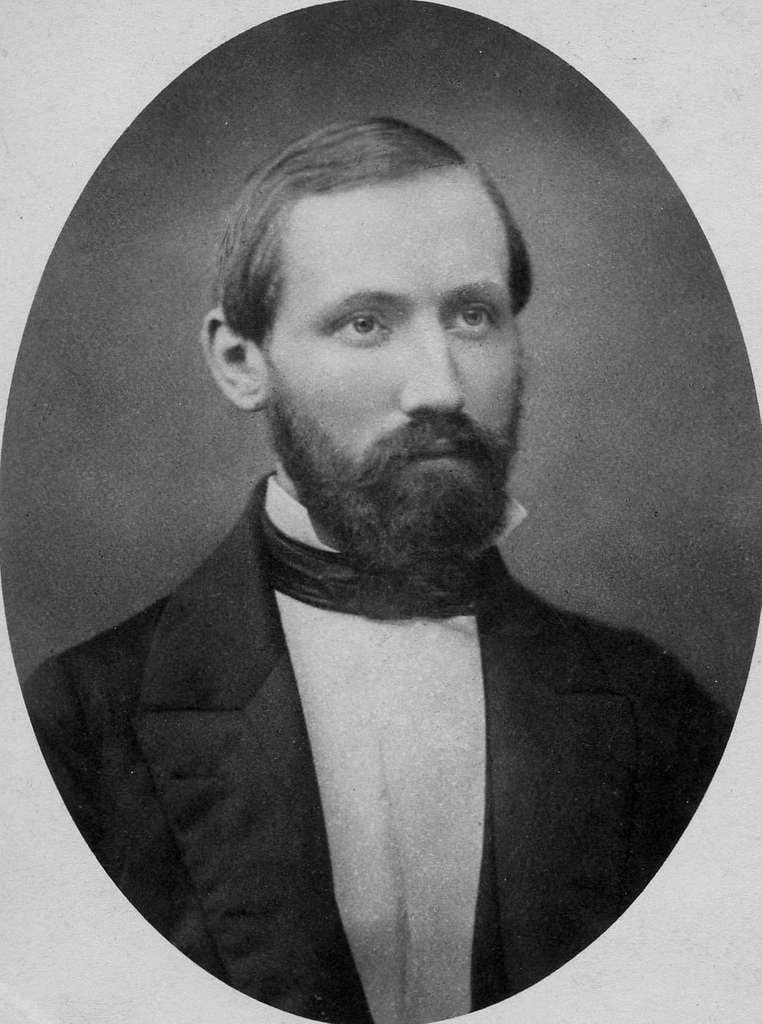
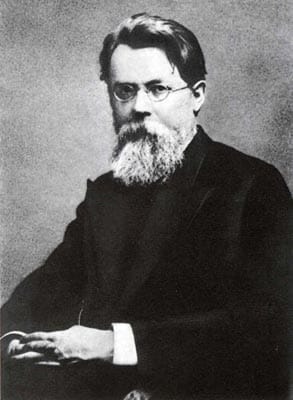
Left to right: Gottfried Leibniz, Bernhard Riemann, Vladimir Vernadsky. “What makes a truly creative scientist, is not the accumulation of what he or she has learned. Rather our concern should be, what will he be able to discover when faced with the challenge of the unknown?” LaRouche contrasts the Leibnizian approach to science, exemplified by Riemann and Vernadsky, to the “fanatically empiricist” approach of Russell.
This explicitly physical expression of our species’ uniqueness, has an essential, cognitive complement. The ability to replicate the cognitive action of experimentally validatable discoveries of universal physical principles, requires a similar, cognitive, mode of discovery for those also validatable, universal principles which we associate with Classical artistic modes of composition. The latter are typified by Classical Greek tragedy, the revolution in painting by Leonardo da Vinci and Raphael Sanzio, and the revolution in musical composition and performance by J. S. Bach and such followers of his anti-Romantic, polyphonic method, as Haydn, Mozart, Beethoven, and Brahms. Under Classical artistic composition, we must include related forms of study of the principles of history and of the related practice of statecraft. The latter include modern Classical military strategy as a combined product of Classical methods in science and artistic composition.
Today’s public opinion has been brainwashed into belief in an axiomatically irrationalist, hermetic separation of science from art, as that separation was decreed by the empiricists, the existentialists, and by the similarly avowed pathological liars Immanuel Kant and Karl Savigny. Against that induced, popular delusion, the multiply-connected integrity of Classical science and art must be emphasized here.
In order that society might cooperate to enjoy the benefits of discovered universal physical principles, it is not sufficient to bring individual persons into merely deductively logical forms of cooperation. It is essential to engage cooperation among the higher, cognitive processes of individual persons. The methods of Classical humanistic education, typify the cultivation of such higher forms of functional literacy. Such methods are opposed to the inherently stultifying mere learning of so-called “information.”
It is not the competent educational practice of civilized societies, to train the majority of individual persons as if they were merely a subhuman form of life. We must despise, as bestialized, an educational policy which emphasizes the conditioning of the victim to repeat a learned procedure, or derive theorems, as if at the blackboard, only by formalists’ deductive methods. The essential superiority of the human being to the lower living species, is demonstrated clearly, only when the individual mind is prompted to reenact, successively, the cognitive processes by means of which mankind earlier had generated each among its existing accumulation of experimentally validatable discoveries of universal principles.
The principles which the individual must rediscover, are both known universal physical principles, and also the Classical artistic principles associated with Classical forms of artistic composition. We must include, under Classical artistic composition, the mastery of history and statecraft from the standpoint provided by broad and deep education and experience in both Classical forms of science education and also Classical forms of artistic composition. Otherwise, the student can not become literate in either science or history and statecraft. The essential form of republican education of the citizen, is not mere learning, but, rather, the cultivation and refinement of the individual’s cognitive powers for generating and validating universal discoveries of principle, either as original discoveries, or, more often, as replications of earlier original discoveries.
From these and related evidence, we derive a functional notion of the existence of man within the universe, a notion of man’s specific, unique nature, as a living creature which has the essential self-interest, and also the means, to increase its power within and over that universe willfully, and to transmit that increased power to future generations. It is from this standpoint, so just described, that the essential axioms of Classical strategy are derived. It is from this standpoint, that we are able to show the absolute differences setting the March 23, 1983, SDI policy into total and irreconcilable opposition to the folly of that pathetic parody of SDI which President Clinton recently presented to Russia’s President Vladimir Putin.
“My proposal to shift the approach to strategic defense, to the forced-draft realization of revolutionary physical-economic breakthroughs along known pathways, proffered a solution to a problem which was axiomatically insoluble within the characteristic curvature of then presently accepted definitions of the problem.”
Economy and Strategy
In contrast to Mr. Clinton’s recent blunders in Moscow, my own 1977-1983 development of the case for what President Reagan presented as SDI, was pivoted, upon my preceding original discoveries within that branch of physical science known, since Gottfried Leibniz’s work of 1671-1716, as that science of physical economy upon which Benjamin Franklin et al. premised the American System of political-economy. The only meaning of that term, American System, among literate persons world-wide, still today, is the usage employed by U.S. Treasury Secretary Alexander Hamilton, Mathew and Henry C. Carey, and Friedrich List.
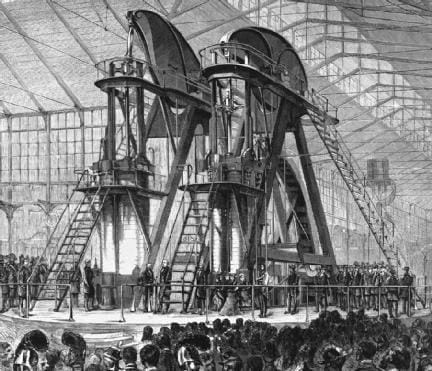
This is the same anti-British “free trade” system, the American System adopted extensively in Germany, Russia, Japan, the Americas, and elsewhere following the gathering of international admirers at Philadelphia’s 1876 Centennial Exposition. This is the American System which the circles of pre-candidates Bush and Gore, for example, are fanatically committed to suppressing and eradicating, not only inside the U.S.A., but throughout the world.
My own original discoveries within this branch of science, made use of the work of Bernhard Riemann, although I went far beyond Riemann in a relevant, crucial feature. This incorporation of Riemann’s work as a way of situating my own earlier original discoveries, is, with an eye cast toward a crucial observation by Russia’s great, polymathic physical chemist Vernadsky, the key to understanding my extensive crucial contribution to what became the original SDI proffer, and to defining the continuing relevance of the March 23, 1983, announcement for today.[[6]]
The result of my part in shaping that initiative, was the use of certain critical features of modern physical science, to define a method for out-flanking a strategic scale of thermonuclear ballistic-missile salvoes. This was the kernel of my published work on the subject of strategic ballistic-missile defense, over the interval 1977-1983 and beyond.
It is indispensable that I now put a certain technical point on the record, even if the significance of those terms is not yet fully clear to most readers at this stage of the report. The point I now introduce is sophisticated, but crucial. It is more than well worth the added, continuing effort required to understand it.
To address the challenge of thermonuclear barrages, it was, and is necessary to introduce a certain shift in the conception of the so-called principle of the flank, as that had been previously defined, for example, by the Classical work of General Field Marshal Graf von Schlieffen.[[7]]
On the level of physical science as customarily defined, the solution to the problem of ballistic missile defense, was implied by Bernhard Riemann’s revolution in physics, as an application of what is known as his principle of multiply-connected manifolds.[[8]] Yet it was indispensable to carry these considerations to a still higher level, the level of “psychology,” as the science of physical economy defines “psychology.” This means psychology as defined and ruled by the same principle of cognition expressed by valid discoveries of universal physical principles, and also associated with Classical artistic metaphor. It was that higher appreciation of the strategically relevant implications of Riemann’s work, which defined my approach to the problem. I shall make the significance of those terms clearer at the proper stages of discussion below.
Contrary to what British imperial political geographer Halford Mackinder et al. termed “geopolitics,” geography as such is not the pivot of history, but only its animal environment. The famous, commonplace point of military doctrine, respecting the ability to dispose forces to control terrain with relatively greater efficiency, is important for animals and for the animal side of military behavior, but, for human affairs, is a subordinate issue, not the primary one.
For example: The way in which Alexander the Great defeated the Persian Empire at Issus, in Cyrenaica, at Tyre, and on the plains outside Arbela, anticipated the celebrated actions of Hannibal against the Romans at Cannae. In all the great flanking actions of history, including Gaugamela, Cannae, Lazare Carnot’s transforming inevitable defeat into absolute victory during 1792-1794, von Schlieffen’s example of the victory of Frederick over the Austrians at Leuthen, von Wolzogen’s historically researched design for the successful defeat of Napoleon in Russia, the vast superiority of General MacArthur’s performance as a theater commander during World War II, and President Franklin Roosevelt’s relatively awesome strategic genius as Commander in Chief, the higher principle of the strategic flank, is to be found, not in the terrain, but only within the domain of the sovereign cognitive powers of the individual mind.
It could not be otherwise. The proof lies in the characteristic feature of the human species’ unique relationship to all “geography,” man’s functional, not simply geographic relationship to the physical universe. That relationship is not one of “action at a distance,” but the way in which man’s form of action upon the universe may be transformed to such effects as nullifying what have seemed to have been tried and true, conventional ways of acting.
The crucial point is, as already stated here, that only the human species is capable of willfully increasing its characteristic potential relative population-density. The key to defining the principle of the strategic flank for the nuclear age, is, therefore, man’s capability of “outwitting,” for example, a threatened strategic salvo by flotillas of thermonuclear-armed ballistic missiles. The term “outwitting” as used here, has the same essential connotations as in Alexander outwitting the Persians, and Frederick as outwitting the Austrians at Leuthen. The “wit” in such “outwitting,” is located in changing what Riemann’s work defines as physical dimensions: not as geography defines dimensions, but as a Riemannian geometry redefines the meaning of physical dimensions. One outflanks the problem, by appropriately redefining the physical dimensions of the apparent problem posed for a plan of action.
For this purpose, we must focus upon the issue of the need to redefine radically the meaning of the word “action,” getting beyond the silly but popular notions associated with usages such as “action at a distance.” Instead of asking what the textbook teaches us on the use of this term, ask, what should the word “action” signify, not for the empiricists and kindred mathematical formalists, but for the experimental physicist engaged in the discovery and validation of universal physical principles?[[9]]
If we were to accept a naive, but widely taught and popular misconception of Euclidean geometry, such as those of the typical empiricists Galileo and Newton, for example, or Descartes, then the universe we inhabit is for us a fixed universe, in which “action” is defined by the belief in a fixed set of simply linear dimensions according to aprioristic notions of extension in space and time. Such, for example, is the notion of “action” employed by Galileo, and, later, by Leonhard Euler’s factional ally, the celebrated hoaxster Maupertuis. From the standpoint of Riemann’s elaboration of a Gauss-Riemann multiply-connected manifold, a very clear alternative presents itself. Add my additional qualification, and the relevant notion of a strategy of “action” appears.
Ask yourself: What is the form of action upon the universe, by means of which mankind increases qualitatively our species’ potential relative population-density? How does that notion of action differ from the commonplace use of the same term, action, by the ideological followers of empiricists such as Galileo and Newton? What do the successive contributions of Gauss and Riemann show respecting Leibniz’s notion of a principle of universal least action?[[10]]
In terms of the usages of Riemann, the increase of mankind’s potential relative population-density, occurs solely through the validatable discovery of a new universal physical principle. This discovery generates a new physical space-time manifold, n + 1, superseding manifold n (of n universal physical principles).[[11]] The result of the practice of such a discovery, in the experimentally derived form of technology, changes the nature of man’s generalized action upon the universe; this change is expressible as a change in the characteristic curvature of the relevant physical-space-time of practice.[[12]] Thus, within this framework, the notion of a universal principle of action—such as Leibniz’s notion of a universal principle of least action—signifies such a physically measurable change in characteristic curvature, as Riemann defined this problem of experimental physics.[[13]] That is the deeper physical meaning of the way in which valid discoveries of new universal physical principles lead to an increase of mankind’s potential relative population-density.
This notion of the proper definition of the term action, implicitly defines a strategic flanking action, as I applied such a notion to the problem of defeating a threat of a strategic ballistic-missile salvo. It means, as it does implicitly in Riemann’s posing of the problem of characteristic curvatures, that instead of acting within a physical space-time of a fixed curvature overall, we act to change the universe (that is, multiply-connected manifold) to such effect that the characteristic curvature in which the task is situated, is radically changed.[[14]] That fundamental progress in science, out-flanks the problems it solves. The same applies, in a cohering way, with the need to flank the technological challenges of a military strategic situation.
So, my proposal to shift the approach to strategic defense, to the forced-draft realization of revolutionary physical-economic breakthroughs along known pathways, proffered a solution to a problem which was otherwise axiomatically insoluble within the characteristic curvature of then presently accepted definitions of the problem.
Physical Economy Was Crucial
The crucial test of validity of a proposed strategic ballistic missile defense, had to be based on those principles of physical economy which are banned from all those classrooms which are devoted to apologies for so-called “free trade” doctrines, systems analysis, and so on. The test of the validity of any proposed such defense was: Is the effective cost of producing and deploying countermeasures less than that of expanding the assault against the “defensive screen”—supersaturating the defense? This is not, as some misguided fellows proposed, a matter of financial accounting; it is the type of problem of policy-shaping which can be competently addressed only within the province of a science of physical economy.
Therefore, the definition of physical space-time curvature applicable to this problem, can not be situated competently within the narrower phase-space of physics as ordinarily defined in today’s classroom. The definition of curvature must be situated within the domain of physical economy as such.
A crucial point must be stated again, at this specific juncture.
Many of the most important problems of policy confronting mankind, reflect the popular delusion, that living processes are, in the worst view of this matter, epiphenomena of physical processes, as today’s conventional mathematical physics usually views this topic. In other words, the currently conventional doctrine is, that, ultimately, we must justify the existence of life at the blackboard, so to speak. This means, to advocates of that view, that we must discover the mechanisms by which living processes are generated entirely from non-living ones. The analogy is the increasing popular, tabloid-style delusion, that digital computer techniques are leading to the replacement of the human individual by robots with “artificial intelligence.”
One contrary view, the Classical Greek view adopted in a modern form by Vernadsky, is the so-called hylozoic view: that the universe already contained a principle of life from the outset, as from whatever might be assumed to be “the beginning,” and that non-living processes are, in effect, subsumed by those superior, more universal processes, which correspond to the general characteristic of living organisms.[[15]]
It was the central feature of my original discoveries, decades ago, that I had taken this same issue a step further. The fact, that only the human species, among living species, is capable of willfully increasing its potential relative population-density, places living processes categorically into the same position, relative to human cognition, in which the hylozoic view places non-living processes. The fact, that whereas mankind obeys the universe’s known laws, in one case, but is also able to command the universe to change its lawful response to human intervention, as through validation of newly discovered universal principles, indicates, that cognition is not an epiphenomenon of living processes in general, but is a functionally higher, therefore more elementary form of existence, than merely living processes as such. (That is, of course, to put this profoundly important point of all scientific method, in terms as relatively simple as possible, but not in error.)[[16]]
By the standards of experimental method, this higher function of cognition can be conclusively demonstrated in but one way: within the domain of the science of physical economy. Thus, it was necessary to pose the issues of ballistic missile defense within the relevant terms of that science.[[17]]
The answer provided by this approach produced answers on two successively higher levels.
On the relatively lower, simpler level, the question took two forms of successive approximation. Can the method elected for proposing to neutralize a ballistic missile salvo, effectively “kill” the warhead’s function more cheaply, as measured in physical-economic terms, than the cost of deploying increments of the attacking system, that latter in the effort to overwhelm (“supersaturate”) the defense? Second, we must also factor in the effects (“cost”—human and other losses) of every failure to prevent an attacking warhead from completing the function assigned to its mission.
On the relatively higher level, I shifted the emphasis, to the impact of the ongoing process of continued, evolutionary development of the respective attacking and defensive systems. That aspect of the study became meaningful, if and when we abandoned the proposal to develop a fixed design of defense, in favor of a “crash program” of forced-draft, successive scientific discovery of principles. In this latter case, the “spill-over effect,” from experimental validation of a continuing generation of newly discovered physical principles, reached, relatively soon, a level at which the superiority of the defense would emerge as absolute.
Why should the Soviet Union have accepted that proposition, as stated to it, by me, during the period of approximately a year of U.S.-Soviet back-channel discussions, between February 1982 and February 1983? My point was, that on the condition that the United States and others viewed such a process of rendering MAD obsolete, as a science-driver for raising the standard of productivity and physical income in and among the developing nations, through spill-overs of technological by-products, both the U.S. and Soviet economy, among others, would undergo a revolutionary technological upshift in their internal technological composition of employment, production, and related foreign trade.
In other words, the benefits to the people and economy of the Soviet Union, would include a unique solution for an increasingly deadly internal problem of physical economy which that state was otherwise unlikely to overcome. Peace must always be conceived as of great advantage to each and all among the participating nations. The advantage from the non-military, spill-over features of SDI, as originally proposed, would have been earthshaking, and would not become available in any other available way.
The only influence which could effectively prevent the thermonuclear missiles from flying, would be the overriding common interest in the benefits of cooperation in such a program for effectively freeing mankind from the continued threat of MAD. We would, in due course, reach the breakeven point, at which new systems of defense would be able to overwhelm the threat of MAD. However, it was my expressed belief then, as now, that the shift of relations among the nations of NATO and the Warsaw Pact, by replacing the institutions of MAD established since approximately 1962-1963, would generate a political-economic factor which would prevent nuclear warfare, by uprooting the issues which might prompt it, and that this happier state of affairs would be already in effect years before the desired mode of strategic ballistic missile defense had been perfected.
This confidence is reinforced in an elementary way, by noting that the British monarchy’s motive for orchestrating what became World War I, was to set the 1877-1901 admirers and partners of the Lincoln-Carey American System at one another’s throat. It was a war, launched by the British monarchy, to prevent a global coalition of Eurasian and American admirers of that Lincoln-Carey model, from becoming the securely hegemonic determinant of general relations among the peoples of the world. The British monarchy acted to organize World War I, because, had it not succeeded in causing that war to occur in that way, the impact of the American System would have led, as President Franklin Roosevelt had later intended, to the eradication of the last vestiges of Portuguese, Dutch, British, and French imperialism from this planet.
The style of American republican model associated with the Lincoln Whig legacy, was and is, the historically defined, model precondition for realizing a general exit of the planet to peace under conditions of modern times. The additional reason for this optimistic view is supplied at a later point, below.
Look at this same matter of physical economy, from the standard of the fanatical faith which a typical dupe of Galileo’s empiricism, applies to the notion of laws operating within a physical universe which is everywhere assumed to be simply Euclidean in its fixed (a priori—“ivory tower”) definitions of space and time. The misguided, anti-Leibniz fanatic Leonhard Euler, for example, looked at the universe in this pathetic, empiricist’s way. In such an imaginary universe as that of the empiricists, the universe is run under the regulation of fixed laws, governing both percussive interactions, and also action at a distance. In such an empiricist’s perverted state of mind, the definitions of both “action” and of “physical laws” are congruently misdefined in common.
However, once we recognize that a valid discovery of a new universal physical principle, changes the curvature of our action within the universe, as such curvature defines “action,” we must assign an entirely new meaning to not only the term “action,” but also the connotations of the term “physical law.”
Most elementary: since it is only through the valid discoveries of universal physical principle, that mankind is able to change his species’ relationship to the physical universe, it is only the manifestly successful such qualitative—for example, Riemannian—changes which can be regarded as efficiently expressing universal physical laws.[[18]] It is only those forms of action, which define a new such conception of a manifold of such laws, which deserve the name of action. As I have emphasized above, the nature of human existence requires, that the measurement of that action, that change of curvature, must be located in the terms of physical economy.
The notion of physical lawfulness then becomes the following. From this vantage point, discoveries of universal physical principle cease to be regarded as isolated individual discoveries. Instead, we must proceed in a way specifically contrary to the central sophistry of Kant’s series of Critiques. From close examination of the way in which students, as in a well-arranged Classical-humanist education, re-experience, successively, original acts of past discoveries of validated universal physical principles, we should become aware of the existence of an attainable, well defined, “synthetic” method of cognitive action, which underlies such an ordering of successive educational and analogous experiences. Directly contrary to the avowed enemy of truthfulness, Immanuel Kant, for example, we recognize that such qualities of education bring forth in the student a qualified cognitive, “synthetic-geometric,” rather than deductive, “algebraic,” way of thinking about the way in which successive such discoveries of universal principle are ordered with respect to one another.[[19]]
What makes a truly creative scientist, for example, is not the accumulation of what he or she has learned. Rather, our concern should be, not what has he learned, but what will he be able to discover when faced with the challenge of the unknown? In other words, by taking this approach, the issue is transformed from the simplistic notion of valid individual discoveries of principle, to the discovery and mastery of a reliable “synthetic” method for generating an ensuing series of valid discoveries of new universal principles. This “synthetic” method is a method of “change,” in the ontological sense of the use of the notion of “change” by both Heraclitus and in Plato’s Parmenides. For which of two different qualities of such graduates, the pedantic formalist (Kantian) or the cognitive thinker, such as Leonardo, Kepler, Leibniz, Gauss, Wilhelm Weber, and Riemann, would you choose to employ a person to solve the need for a yet-undiscovered universal physical principle?[[20]]
It is the same in matters of education in Classical artistic composition and performance. A recent set of conference presentations on the subject of the method of composition represented by J.S. Bach’s The Art of the Fugue, is an appropriate reference.[[21]] It is by reliving the discoveries of principle, as these permeate and underlie the compositions of the greatest Classical composers, notably Bach and such successors as Haydn, Mozart, Beethoven, et al., that, through years of maturing experience, the greatest performers move closer to the ability to replicate the intent embedded within such works.
Thus, rather than interpreting the notes of the score, they perform that music for which the score serves merely as a mnemonic device for the aid of the literate musician. It is not simply a matter of getting the notes right, in a pedant’s sense of the matter; it is a matter of discovering the ideas lurking among the lawful contrapuntal “dissonances”—the Classical metaphors—of the heard chorus of polyphony. It is a matter of hearing the ideas which are there, but would be otherwise lost from the performance, without breaking free of the stultifying habits of feigned, grumpy “seriousness” of all entrenched overtone-eavesdroppers and kindred Romantic formalists.
These Classical, cognitive approaches, define the specifically anti-Kantian, anti-empiricist, Classical humanist methods in science and art, the same methods of education employed, in combination, for competent education in history, and in military science as other arts of statecraft. What such methods accomplish, is a relatively high rate of cultivation of those creative (non-deductive, cognitive) powers of mind, by means of which validatable original discoveries of universal principle are fostered within the affected population.
These methods of study and education typify the method of education and general practice appropriate for a society with a mission-orientation toward scientific and related progress. The more immediate military implication of such a mission-orientation, is that such a society has a relatively high rate of potential for being mobilized for great, even perilous, but often successful, otherwise impossible undertakings.
My emphasis on the proper definitions of “action” and “physical law” here, is to be considered as a way of conceptualizing the development of such a mission-orientation potential. This itself, is a crucial military-strategic potential, under appropriate circumstances; it is also the standpoint from which to conceptualize the principle underlying what President Reagan presented as an SDI task-orientation, in his March 23, 1983, address.
Ironically, but not accidentally, this deep and fundamental philosophical difference between my Leibnizian use of the term action, and Russell’s fanatically empiricist misdefinition of the same term, is classic.
Russell’s Mind in the Very Small
By his nature, Bertrand Russell, for example, would have denied, with the kind of hysteria typical of him, even the scientific possibility of what President Reagan introduced as SDI. Russell would have shuddered with nervous embarrassment at the crude 1976-1983 anti-SDI ravings of the former U.S. Defense Intelligence Agency (DIA) chief, the Heritage Foundation’s Lt. Gen. (ret.) Daniel Graham; but the gist of their arguments was common.[[22]] The so-called scientific issue was Russell’s hysterical defense of his thesis, that physics could and must be created by formalist mathematicians, as if at the blackboard, the same view adopted—variously, explicitly or implicitly—by such Russell devotees and hoaxsters as information theory’s Norbert Wiener and systems analysis’s John von Neumann.[[23]] If we discount the crude defense-contractor-style greed permeating Graham’s rhetoric, the whole crew of the defenders of the notion of “the exclusive primacy of kinetic interception,” can be efficiently characterized as impassioned foes of the very idea of the existence of those creative powers of mind—those powers of ontological “change”—by means of which validatable new discoveries of universal physical principle are generated.
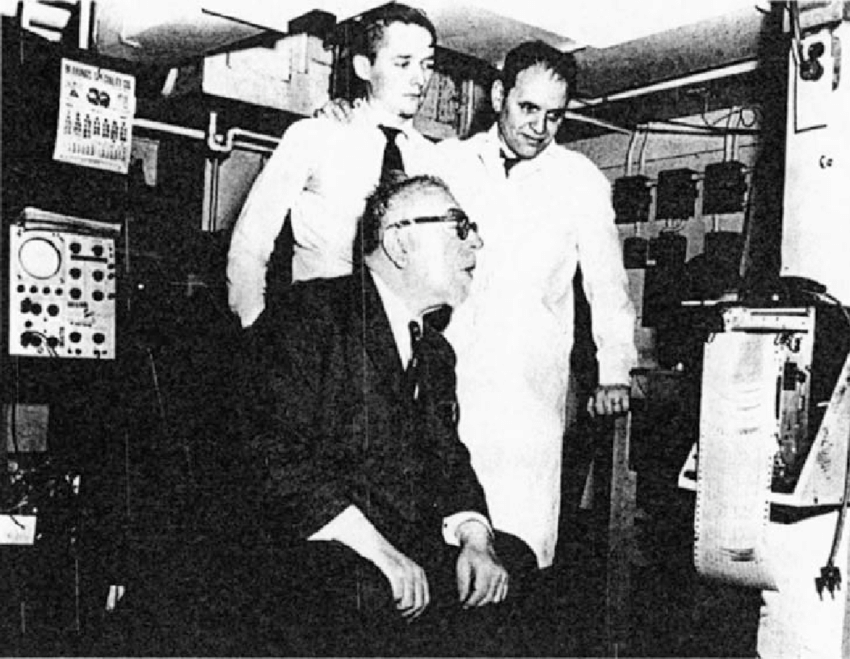
In other words, the common stand of the empiricists, was their insistence that, axiomatically, there is no quality of the human individual which sets our species apart from and above the beasts. They insisted, that no physical principle could exist which could not, and should not be constructed, by deductive methods, at the blackboard—or, as so-called virtual reality, on today’s digital computer. Russell’s, Wiener’s and von Neumann’s argument to this effect, can be reduced to Russell’s insistence that nothing existed in this universe which could not be explained, if but ultimately, as the product of a universe which is “Euclidean in the very small.” That was Wiener’s axiomatic premise for “information theory,” and von Neuman’s for his hatred against Kurt Gödel’s 1930 demolition of the central thesis of Russell’s Principia Mathematica.[[24]]
In the history of today’s globally extended European civilization, the issue of this quarrel with impassioned hoaxsters like Russell, is very old. Take the case of Plato’s Timaeus, for example.
Not only had Plato’s Academy at Athens shown, that only five fully regular solids could be generated by action within a spherical universe. The fact that the Golden Section so determined, is characteristic of living processes, pointed, inclusively, to the fact, that a universe containing living processes could not be “Euclidean in the very small.”[[25]]
This argument formed the kernel of the founding of modern experimental physical science, by Nicholas of Cusa and his successors Luca Pacioli and Leonardo da Vinci. The same conception was central to the founding and initial development of astrophysics by Johannes Kepler. The work of Fermat, in discovering a principle of least time, rather than least distance, underlying the refraction of light, led to the work of Huygens and Leibniz on light, isochronism, and Leibniz’s principle of universal least action.
The work of Abraham Kästner’s pupil Carl Gauss, in proving Kepler’s thesis for a missing planet located between Mars and Jupiter, and the refutations of Newton by Fresnel, Arago, and Ampère, among others, pointed to the mounting evidence, that not only was it impossible to derive universal physical principles by deductive methods at the blackboard, but, as Riemann insisted, that it is mathematics which must adapt itself to experimental physics, rather than the other way around.[[26]]
Despite this evidence, various mathematicians, including Helmholtz, Rayleigh, and Russell, insisted, that physical principles must be implicitly derivable at the blackboard, that according to the arbitrary, “ivory tower” assumption, that the universe is “Euclidean in the very small.” All of the products of Russell’s devious mind, like those of his devotees, are reducible to a mentality which is itself “Euclidean in the very small.” Indeed, in all of his published writings on science and mathematics, Russell himself, like his acolytes Wiener and von Neumann, insisted on that point.[[27]]
The deductive-inductive method of all empiricists, Russell notably, is based implicitly upon the fatally vulnerable presumption, that existence is limited, in effect, to objects which are, in and of themselves, echoes of human sense perception.
As Galileo’s mathematics pupil Thomas Hobbes emphasized, in his proposal to ban the existence of metaphor, the dogma of the empiricist does not wear well when compared with what is, in fact, human experience as a whole. Hence, Hobbes proposed to outlaw metaphor, thus to suppress the evidence that such uncomfortable ontological paradoxes existed.
There are certain kinds of experiences, whose efficient existence can not be denied, but which reflect conditions which do not conform to the empiricists’ and materialists’ definitions of sense phenomena as such. Such troublesome evidence includes the non-trivial distinction between living and dead persons, the subtleties of astronomy,[[28]] and those controllable processes, reaching even beyond the microscope, which, by their nature, are beyond the direct reach of the senses. It is not sense perceptions as such which define reality, but rather the power of the mind to impose willful choices of new orderings upon the domain reflected by sense perception, especially as the new orderings represent the validation of a discovered universal physical principle. Man’s certainty of knowledge lies not in his observation of nature, but his increase of his power to master it.
Most important of all, are experimentally validatable conceptions generated by individual cognition, cognition being a process lying entirely beyond the control of mere deductive operations. Hence, the empiricist’s efforts either to ban metaphor, or to degrade it to the intellectually inert quality of mere symbol-mindedness.
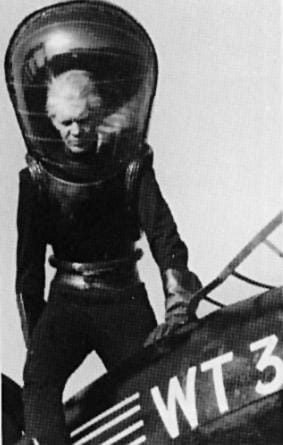
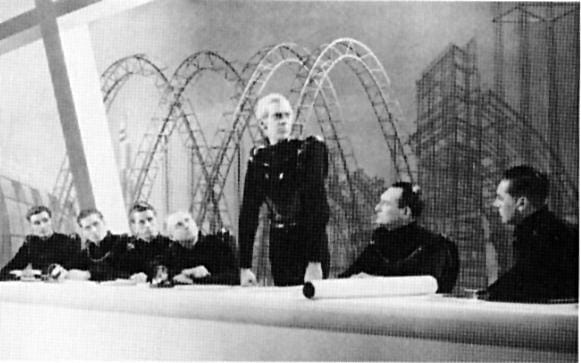
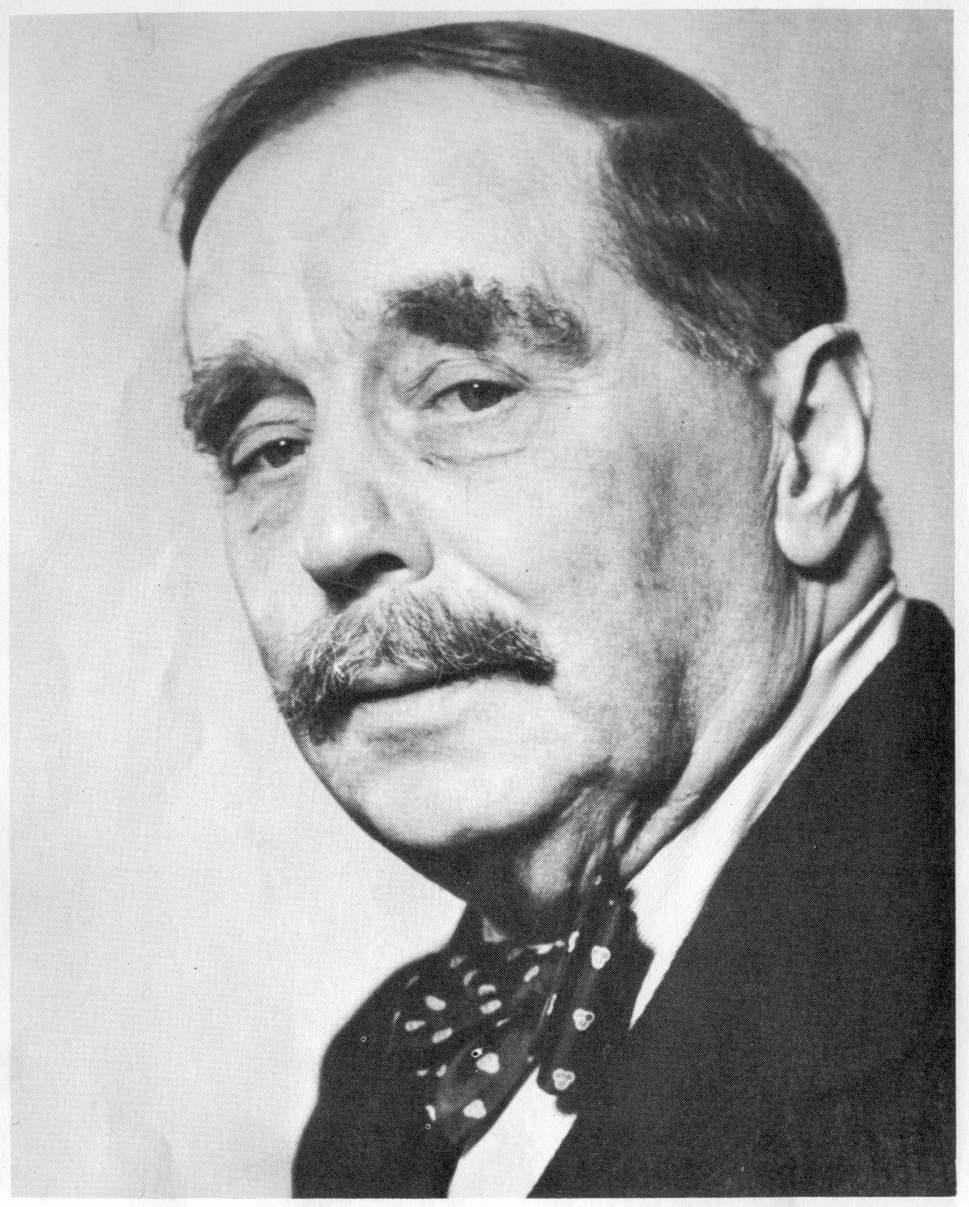
The oligarchical view of mankind, expressed by Russell, Wells, and their modern cothinkers, is that human beings are cattle, to be herded and culled like beasts, and that science exists to assist in herd management. Here, H.G. Wells (right), shown with some stills from his 1936 film, Things to Come. The film, based on his book The Shape of Things to Come, portrays a future world at war, with pestilence raging. The world is later rescued by the “Great Air Dictator,” (left) who arrives in a modern airplane from the “World Council” at Basra, to demand an end to national sovereignty and submission to the international force. Credit: Library of Congress
Despite those pro-empiricist hysterics by both the empiricists and the Kantians, the evidence is, that validatable new discoveries of universal physical principles do occur, as willful productions of individual human cognitive processes. I think it important to repeat the point, that, as Riemann insisted upon the implications of Leibniz’s and Gauss’s discoveries, in Riemann’s 1854 habilitation dissertation, and in his additional work on Leibniz’s (and Abel’s) posing of the challenge of Analysis Situs, it is deductive mathematics which must adapt itself to the implications of such experimental demonstrations, not the other way around.[[29]]
At root, on this point, the source of energy expressed in the hysterical outbursts by Russell and such devotees as Wiener and von Neumann, lies not within the practice of science, but, rather, as Wiener emphasized in his The Human Use of Human Beings,[[30]] in the insistence that the definition of science must be limited by the view adopted by the oligarch and his lackeys, that the purpose of science is to assist in managing the generality of the human herd in the same sense that a farmer breeds, uses, and culls herds of cattle. The idea that mere “human cattle,” the mere subjects of oligarchical rule over the human herd, might have a quality which sets each person above the beasts, is anathema to an oligarch such as Russell, or mere oligarch’s lackeys: such Leporellos as H.G. Wells, Wiener, or von Neumann. H.G. Wells’s 1896 The Island of Dr. Moreau, already typifies that lackey’s view of humanity in general which he continues to the end of his miserable life.[[31]] The promotion of psychedelic practices by such Theosophy-linked cronies of Aleister Crowley, H.G. Wells, and Russell, as Aldous Huxley, and the related role of the circles of Russell acolytes Gregory Bateson and Margaret Mead, typify this satanic view of people as merely human cattle.
[[[INSERT GALLERY HERE]]]
The oligarchical view of mankind, expressed by Russell, Wells, and their modern cothinkers, is that human beings are cattle, to be herded and culled like beasts, and that science exists to assist in herd management. Here, H.G. Wells, shown with some stills from his 1936 film, Things to Come. The film, based on his book The Shape of Things to Come, portrays a future world at war, with pestilence raging. The world is later rescued by the “Great Air Dictator,” who arrives in a modern airplane from the “World Council” at Basra, to demand an end to national sovereignty and submission to the international force. Credit: Library of Congress
The question is: Is humanity created to exert dominion within, and over the universe, or, on the contrary, as Adam Smith argues, is man assigned a more modest place, the administration of the many human cattle by the few?[[32]] Russell’s 1931 and 1951 published utterances on policies for culling the undesirably intelligent specimens of the lower common herd, are blatant, and express exactly the root of Mrs. Albright’s pro-genocidal policies toward sub-Saharan Africa and elsewhere.[[33]]
Once we take into account the fact that the universe is obliged to obey commands expressed as validatable discoveries of universal physical principles, the significance of the distinction in definition of the two qualities of action comes more clearly into view. The cognitive action which enables man to increase our species’ power in and over the universe, through discovery of a new universal principle (for example, Leibniz’s principle of universal least action), is to be distinguished from the lower quality of action expressed by applying previously established principles as if mechanically, deductively. The latter expresses the curvature of physical space-time in terms of a deductive view of previously known universal principles; the former represents the action of generating a new principle, resulting in a change in the effective physical-space-time curvature within our action upon the universe.
Consider the March 23, 1983, SDI announcement in these terms. In terms of the principle of the flank, as viewed from this higher standpoint, can the discovery of an unending series of new universal physical principles, enable us to attack the essential principles of strategic thermonuclear ballistic salvoes from the flank of a higher order of physical space-time?
Such questions typify the difference between mere rhyme, and metaphor-driven Classical poetry, the difference between a silly Rameau and a genius such as J.S. Bach. Such, as a matter of cognitive principle, was the difference between the Roman generals commanding a physically superior military force against Hannibal, at Cannae, and Hannibal’s virtual obliteration of the Roman force by his double-flanking assault, or, the way in which Frederick the Great, with vastly inferior numbers, doubly outflanked an attempted double-flanking operation by the Austrians at Leuthen. Hannibal, as Frederick at Leuthen, outflanked the minds of the opposing commanders.
In the case of my proposal for the SDI, our flanking attack, for which Reagan and I sought the cooperation of the Soviet leadership, was against the scientific bankruptcy of Bertrand Russell and his world-government policy. Our proposed line of march—our action—was, like Hannibal’s double-flanking of the foolish, ram-like deployment of the doomed Roman forces, through dimensions of physical space-time which our adversary, Russell and his accomplices, could not bring themselves to admit existed.
To summarize the crucial point made thus far:
The action by means of which the human species is enabled to increase its potential relative population-density willfully, is the higher form of action, that corresponding to Leibniz’s notion of a universal principle of least action. This notion is specifically distinct from the action taken according to a pre-existing manifold: cognitive actions, as distinct from, and superior to action according to a deductive form.
In this view of the subject matter of physical science, the principal features of universal action are, in descending order, first, the cognitive powers of action associated with the human mind; second, the superiority of the principle of living processes over the non-living (as Vernadsky argued for this); third, and lowest in rank, non-living processes. The cognitive power of the human mind, is the only means by which man is enabled to cause the universe to submit increasingly to the human will. Thus, there, in cognition, lies the highest known expression of lawfulness. For reasons ably identified by Vernadsky, the universe of living creatures is, as some notable ancient Greeks insisted, hylozoic. It is a universe in which the principle of life reigns over non-living processes, rather than being an epiphenomenon of non-living processes. The evidence on these accounts, is elementary; only self-blinding hysteria, such as empiricism, denies such evidence.
In this configuration, what we are accustomed to regard as physical science, corresponds to those forms of universal action corresponding to validatable universal physical principles: man’s mastery over nature, as implicitly measurable in demographic characteristics of populations, per capita and per square kilometer of the Earth’s surface.
However, in order to share and apply this knowledge, we must bring the individual cognitive processes of the members of society to that degree of development of socialized cognitive relations, that the cognitive processes of discovery of principle are themselves efficiently engaged as the primary form of social relations. This condition can be realized only through those modes of cognitive relations associated with Classical forms of artistic composition, and with those studies of the principles of history and statecraft which are, in fact, the natural extensions of valid forms of Classical artistic composition and performance.
End of Part 2.
Notes
[[1]]: . LaRouche, op. cit. (See footnote 20 in Part 1 of this series.)
[[2]]: . “Truthful and just” signifies the use of agape in Plato’s The Republic, and the Apostle Paul’s I Corinthians 13. This is in direct opposition to the denial of the existence of truth by the empiricists, Immanuel Kant’s Critiques, and such neo-Kantian existentialists as Adorno, Jaspers, Arendt, and sometime Arendt intimate and Nazi philosopher, Martin Heidegger. The denial of truthfulness, as Kant, Jaspers, and IIE’s Frankfurt School existentialists militantly denounced truthfulness, is key to understanding the mindset of Secretary Albright and her confederates today.
[[3]]: . The conflict between the Classical and Romantic traditions, is the central feature of Eighteenth Century European politics and art. It was the Classical faction, as typified for Germany by Leibniz and Bach defenders Abraham Kästner, Gotthold Lessing, and Moses Mendelssohn, who rallied for the cause of the independence of the U.S. republic. It was the Romantic tradition, typified by the so-called British and French Enlightenment, who formed the hard-core of the pro-British faction. Thus, followers of the Classical faction of Lessing and Mendelssohn, such as Goethe, Schiller, and the Humboldts, like Keats and Shelley for England, typify the pro-American faction, whereas the Romantic current formed the hard core of the pro-British faction in late Eighteenth and Nineteenth Century Europe.
[[4]]: . The term “republican,” as used in the Classical Greek sense here, is equivalent to “American Whig.” This signifies the Carey-Clay-Quincy Adams-Lincoln legacy, and the revival of the American Whig legacy by President Franklin Roosevelt. Today, and since 1976, the present writer is the leading political representation of that legacy inside the U.S.A.
[[5]]: . That is to emphasize the difference between reductionist methods of mere deduction and induction, and cognition, otherwise fairly described as the difference between mere logic, which can be performed by a digital computer, and actual human reason, of which a digital computer is axiomatically incapable.
[[6]]: . Vernadsky’s rebuttal of those who proposed to derive the existence of living processes from the chemistry of non-living processes, was that life represented a higher order of existence in the universe than non-living processes as such. To this I agreed; but, I added, that, similarly, cognitive processes are of a higher order than can be adduced from living processes other than mankind. My argument is consistent with that of Nicholas of Cusa, that inferior species may participate in higher orders, as a dog participates in a child’s life through a common play-drive, but that the existence of the higher order is not to be deduced from the principles which are apparently sufficient to explain the internal dynamics of the lower.
[[7]]: . Alfred von Schlieffen, The Theory of the Flank (Leavenworth, U.S. Army translation). Also, Generalfeldmarschall Graf von Schlieffen: Die taktisch-strategischen Aufgaben aus den Jahren 1891-1905 (Berlin: Siegfried Mittler und Sohn, 1937). The extensive collection of maps included in the latter work is of notable interest.
[[8]]: . Op. cit.
[[9]]: . The question, posed in that form, was not original to Bernhard Riemann; Gottfried Leibniz’s unique definition of a universal principle of least action had already posed the problem to followers such as Lazare Carnot and Carl Gauss. Riemann’s revolution in the definition of physical geometry, simply posed the question afresh, in the needed way. I had come to this matter of defining “action” years before I considered Riemann’s work, led to that conception as an adolescent student of the work of Leibniz on this account.
[[10]]: . For reference of those who might consider themselves, mistakenly, as critics of my statements respecting least action: The modern chain of developments, which resulted in the validation of the work of Kepler by Gauss, Riemann, et al., is customarily traced from Fermat’s discovery of a principle of “least time,” thus refuting Kepler opponent Galileo’s concoction of the arbitrary notion of “action at a distance.” The issues of isochronicity, especially as associated with the development of the refutation of Newton’s false views on light by Fresnel, Arago, et al., lead into those notions of electrodynamics which present us a Riemannian universe, rather than a universe which might be supposed to be “Euclidean in the infinitesimally small.” Leibniz’s reflections on the work of Leonardo da Vinci, Kepler, Fermat, Pascal, Huyghens, et al., led him from the simple notion of “shortest time,” to a more adequate appreciation of a principle of universal least action.
[[11]]: . For example, Wilhelm Weber’s proof of the existence of the electrodynamic principle of the Ampère “angular force,” an addition which revolutionizes electrodynamics otherwise defined.
[[12]]: . “Experiment,” in this case, does not mean a mere classroom demonstration experiment. To prove a universal physical principle, one must show, by measurement, that the principle is indispensable to accounting for crucial behavior within a manifold within which that principle is considered to reside.
[[13]]: . Op. cit.
[[14]]: . Typical is, once again, the case of Wilhelm Weber’s experimental proof, of the “angular force” principle of electrodynamics—as Weber was encouraged and advised in this success by Gauss and assisted by Riemann. The deeper significance of this is made clear by recognizing the nature of the collaboration among those, Fresnel, Arago, and Ampère, who disproved absolutely Newton’s foolish presumptions respecting the propagation of light. The essential point here, is to recognize the common, Leibnizian conception of physical geometry which subsumes under a single conception, Fresnel’s discovery for light, and Ampère’s for electrodynamics.
[[15]]: . Hence the axiomatic differences in definition of physical principles as such, among biophysicists such as Chicago’s Rashevsky, Russia’s Oparin, and Vernadsky.
[[16]]: . This agrees with strong Christian theology, but, having noted that fact so, we may move on.
[[17]]: . This means that the physical universe, otherwise defined, is axiomatically a sub-phase-space of the inclusive, higher, living domain, and that that living domain is a sub-phase-space of the cognitive domain.
[[18]]: . This signifies an ontological definition of “change,” a definition consistent with both the famous aphorism of Heracleitus, and the crucial ontological paradox of Plato’s Parmenides dialogue.
[[19]]: . “Synthetic geometry,” as employed in connection with Gauss’s work on the notions of general principles of curvature, and Riemannian geometry, has the connotations of “anti-Euclidean geometry,” rather than “non-Euclidean,” as this distinction was emphasized by Gauss’s teacher Kästner. This is, of course, closely related to the work of Gaspard Monge, as well as Riemann’s geometry teacher Jakob Steiner.
[[20]]: . The difference between the pedant and the creative personality is most commonly expressed as the latter’s wont for a certain, almost compulsive type of playfulness. This playfulness, expressed in a cognitive form, is the mode of human individual creativity. Thus, stodgy “professionalism” often proves to be a cloak of relative intellectual sterility.
[[21]]: . The referenced speeches from the Bad Schwalbach, Germany, conference of the Schiller Institute are transcribed in “Cognition vs. Information, Panel I and II,” Executive Intelligence Review, June 23, 2000, pp. 5-52.
[[22]]: . Graham had opposed the idea of a ballistic missile defense based on new physical principles already during the mid-1970s. Later, during the Summer of 1982, he launched a nationwide campaign of personal venom against me, and then also against Dr. Edward Teller, on this same matter. After President Reagan’s announcement of SDI, Graham switched positions, pretending to support SDI, on the condition that it be limited to simplistic “kinematic” systems which could be purchased off the shelf of existing Wall Street-owned defense contractors. Graham's role was key in turning the SDI program into a double-dipper’s boondoggle.
[[23]]: . Both Wiener and von Neumann, were expelled from David Hilbert’s Göttingen University on charges ranging from incompetence to fraud. In von Neumann’s case, there was a charge of plagiarism involved, but the scientific issues of the expulsion involved Wiener’s and von Neumann’s stubbornly fanatical adherence to the radical conceptions and method they had adopted under Russell’s influence.
[[24]]: . See Kurt Gödel’s 1930-1931 works “On Formally Undecidable Propositions of Principia Mathematica and Related Systems” and “Discussion on Providing a Foundation for Mathematics,” Kurt Gödel: Collected Works, Vol. I (New York: Oxford University Press, 1986). This is also the formal axiomatic presumption underlying the interrelated, currently popular lunacies of “artificial intelligence” and “information economy.” Axiomatically, both fads depend upon blind faith in the dogma that the physical universe is mathematically Euclidean in the infinitesimally small.
[[25]]: . Note, respecting the account of these solids within Euclid’s Elements, that Euclidean geometry itself was created by the mind of a living creature.
[[26]]: . Bernhard Riemann, op. cit.
[[27]]: . Sometimes, after the publication of his Principia Mathematica, Russell made evasive concessions to physicists on the matter of Leibniz’s notion of an Analysis Situs existing in physical reality outside the domain of mathematical analysis, but never actually confessed his own error on this point.
[[28]]: . For example, the altogether anomalous Crab Nebula and its apparent role as the source of Earth’s receipt of cosmic-ray showers.
[[29]]: . Bernhard Riemann, op. cit.
[[30]]: . Norbert Wiener, The Human Use of Human Beings (Boston: Houghton Mifflin Co., 1950).
[[31]]: . New York: Berkeley Publishing Co., 1973.
[[32]]: . Adam Smith, The Theory of the Moral Sentiments (1759).
[[33]]: . See, for example, Bertrand Russell, The Prospects of Industrial Civilization (London: George Allen & Unwin, 1923), p. 273: “Socialism, especially international socialism, is only possible as a stable system if the population is stationary or nearly so. A slow increase might be coped with by improvement in agricultural methods, but a rapid increase must in the end reduce the whole population to penury … the white population of the world will soon cease to increase. The Asiatic races will be longer, and the negroes still longer, before their birthrate falls sufficiently to make their numbers stable without help of war and pestilence…. Until that happens, the benefits aimed at by socialism can only be partially realized, and the less prolific races will have to defend themselves against the more prolific by methods which are disgusting even if they are necessary.” See also, Bertrand Russell, The Impact of Science on Society (New York: Simon and Schuster, 1953), pp. 102-104.