Editor’s Note: This article was first published in 21st Century Science & Technology, Vol. 13, No. 2, Summer 2000.
This is Part One of a three part serialization of the above titled article.
In order that society might enjoy the benefits of discovered universal physical principles, it is essential to engage cooperation among the higher, cognitive processes of individual persons. The modern concept of “information,” embedded in today’s educational and scientific practice, makes such further advancement of cognition, and therefore of science, impossible. Such are the kind of underlying matters which must be addressed, to grasp the flaw in the arguments surrounding today’s missile-defense debate.
U.S. President Bill Clinton’s recent proposals on missile defense, were delivered in Moscow slightly more than seventeen years after the March 23, 1983, announcement of the Strategic Defense Initiative (SDI). I focus upon certain crucial, current strategic issues of physical science posed by those U.S. proposals.
For reasons I shall explain, I shall relegate the core of my treatment of those scientific issues, to the closing portion of this report. I must first situate those issues of science itself, that at some unavoidable length, within the relevant political-strategic domain: the form of strategic defense specific to the need to preserve the institution of the modern sovereign nation-state.
If we limit attention to the appearance presented by the list of usual suspects from the precincts of the New York Council on Foreign Relations, the current crop of putative leading U.S. professional strategists, might be judged, as a whole, as worse than merely incompetent, even seemingly mentally and morally deranged. Fortunately, contrary to that general appearance, we should recognize, from other evidence, that the general situation is not quite that disastrous—not yet!
Behind the scenes, usually overlooked in the accounts of the leading news media, there are, among leading military and other professionals, significant numbers, in the U.S.A. and other nations, who, aside from their accustomed lack of willingness to risk taking controversial leading positions on the public record, can not only think, but are otherwise sane, essentially well-informed, morally sound, and competent, at least within the bounds of their areas of specialization. The related fact is, that on evidence of performance, the leading news media currently prefer to mislead public opinion into believing that such a relatively less known stratum of competence, with its morality, and its opinion, does not exist.[[1]]
Despite the false appearances created by government and the major media, the good news, which I wish to convey here, is, that were we to supply our less-heralded, competent specialists with the quality of leadership they require, leaders in the tradition of Abraham Lincoln or Franklin Roosevelt, the world has the chance—if no more than a good chance—to pull together the team needed to solve the most deadly threats menacing us now, thus to survive the present, global, economic and strategic crisis.
On this present occasion, as it happened to the little boy from Hans Christian Andersen’s fable, “The Emperor’s New Clothes,” it has fallen to me to take the personal risk, of making the important, necessary, leading statements, such as that little boy’s “But, he has nothing on”: statements which, otherwise, were not likely to be said publicly. As now, on the subject of strategic ballistic-missile defense, as in most among the relevant subjects in which I qualify as expert, I bridge what Britain’s C.P. Snow described, several decades ago, as the gulf of separation between physical science and culture, which has been adopted by our badly mistaken, current, all-too-credulous public opinion.[[2]] In this report, I bridge that division once again.
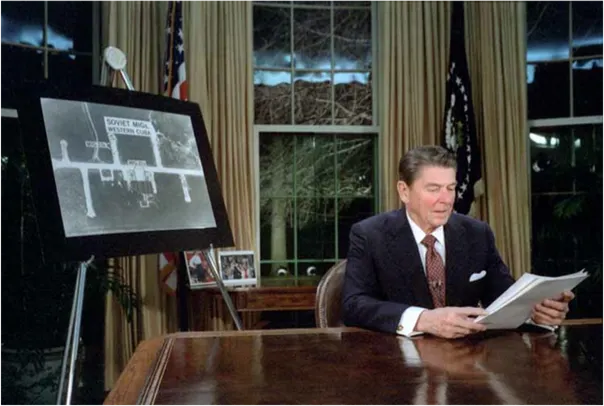
Specifically, beginning 1977, I came to play a leading international role in developing and proposing what President Ronald Reagan presented as his Strategic Defense Initiative, in his televised address of March 23, 1983. It should be recalled here, that the Fusion Energy Foundation (FEF), of which I had been the leading co-founder, played a key part in those matters. During the past decade, 21st Century Science & Technology has continued aspects of that work of FEF, as also the weekly Executive Intelligence Review (EIR).[[3]] Then and now, all competent statements on the subject of missile defense, bridge the conventional, misguided separations of physical science from Classical culture.
Unfortunately, today, seventeen years after the March 1983 announcement, only a few among the leading, currently active political and military professionals, in any part of the world, choose to remember what President Reagan actually said. The voices in the world’s mass media which are usually heard from among the spokesmen of today’s U.S. Congress, the Bush campaign, and the Administration, thus find a credulous audience among an ill-informed, easily and readily duped public opinion, a public opinion which, so far, lacks any visible competence in judging the strategic and scientific issues posed by the subject of strategic defense.
Thus, what is being currently proposed on the subject of missile defense, from official Washington, is, in fact, medicine more dangerous than the disease it proposes to remedy. Among the large amount of evidence to support my characterization, there is little which could better demonstrate the childish incompetence of today’s official Washington’s missile-defense policy as simply and clearly, as the combined ignorance and turpitude with which today’s major media establishment equates those current concoctions in the name of missile-defense, falsely, with the original SDI policy of March 23, 1983.

Seventeen years after President Reagan’s announcement, today’s currently popularized official delusions on this subject, reflect an utter disregard for the actual history of modern warfare. I mean “modern” in the sense of the history dating from the time since the mid-Fifteenth-Century recovery of Europe from a mid-Fourteenth Century “New Dark Age.”[[4]] Current U.S. officials usually show a corresponding, and related, and frankly utopian ignorance of, and indifference to, the elementary features of the history of progress of what actual missile-defense requirements underscore as being the strategically relevant features of modern physical science.
Consider the increasing numbers, both from the Republican Party’s side, and in the Administration, who are presently proposing schemes and devices for missile defense. Examined closely, none of these are consistent with the SDI policy announced by President Reagan’s March 23, 1983, address. It is merely indicative, that some among the most energetic proponents of current schemes, are on record as having been opponents of the original SDI proposal back then. Today, much is heard through the major news media, as proposals for the early production and sale of the military hardware recommended. None among the voices generally recorded by those accounts, seems to be seriously concerned to show whether any of these expensive toys might actually work, or whether those proposed systems, whether they work or not, would actually accomplish any worthwhile purpose.
The present incompetence of both U.S. strategy, and NATO policy in general, is no less than systemic.[[5]] To those who say, “Give us a chance, and, within five years, we will develop technologies which satisfy our requirements,” our answer to such statements should be, that, even on bare scientific grounds, axiomatic grounds, there is no technology of that form, which could ever be discovered and developed, to meet the net performance requirements for the specific kinds of system which current Washington proposals outline.[[6]]
We must take into account the fact, that there is also a large amount of witting fraud behind the kind of missile-defense proposals which the United States has currently proposed, allegedly only against “rogue states.” Behind such proposals for dealing “only with rogue states,” there is the stated, geopolitical intent of some, such as that wild-eyed utopian Zbigniew Brzezinski and his associates, to bring about a military conflict in the Central Asia region adjoining the Caspian Sea,[[7]] not with some “rogue states,” but between NATO and a Russia which is still a real, if badly tattered nuclear superpower. At that level of the Anglo-American establishment, the proposals for missile-defense systems, are predominantly, even wildly dishonest. Nonetheless, it is important and otherwise useful to examine the proposed schemes as if they had been sincere, if foolishly mistaken proposals. That I do, as much as facts permit, in the following pages.
1. The Treaty of Westphalia
The crucial issue posed by today’s discussion of missile defense, is the following.
The history of European civilization since Charlemagne, has been hammered into shape by wars and other catastrophes caused by the recurring efforts of the would-be “globalizers,” such as imperialist Venice’s Thirteenth-Century Guelph League, which were intended either to prevent the emergence of the modern nation-state, or, as today, to destroy it.[[8]] After more than a century of religious and related warfare, over the interval 1513-1648, the adoption of the 1648 Treaty of Westphalia, established those agreements on which all issues of strategy, and related matters of statecraft, had been centered, until such Twentieth-Century catastrophes as Ku Klux Klan fanatic Woodrow Wilson’s Versailles Treaty, and U.S. President Harry Truman’s folly in ordering the militarily unnecessary, August 1945 nuclear bombing of an already defeated Japan.[[9]]

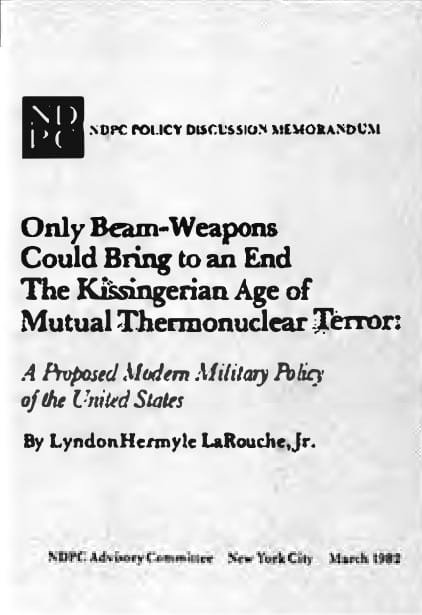
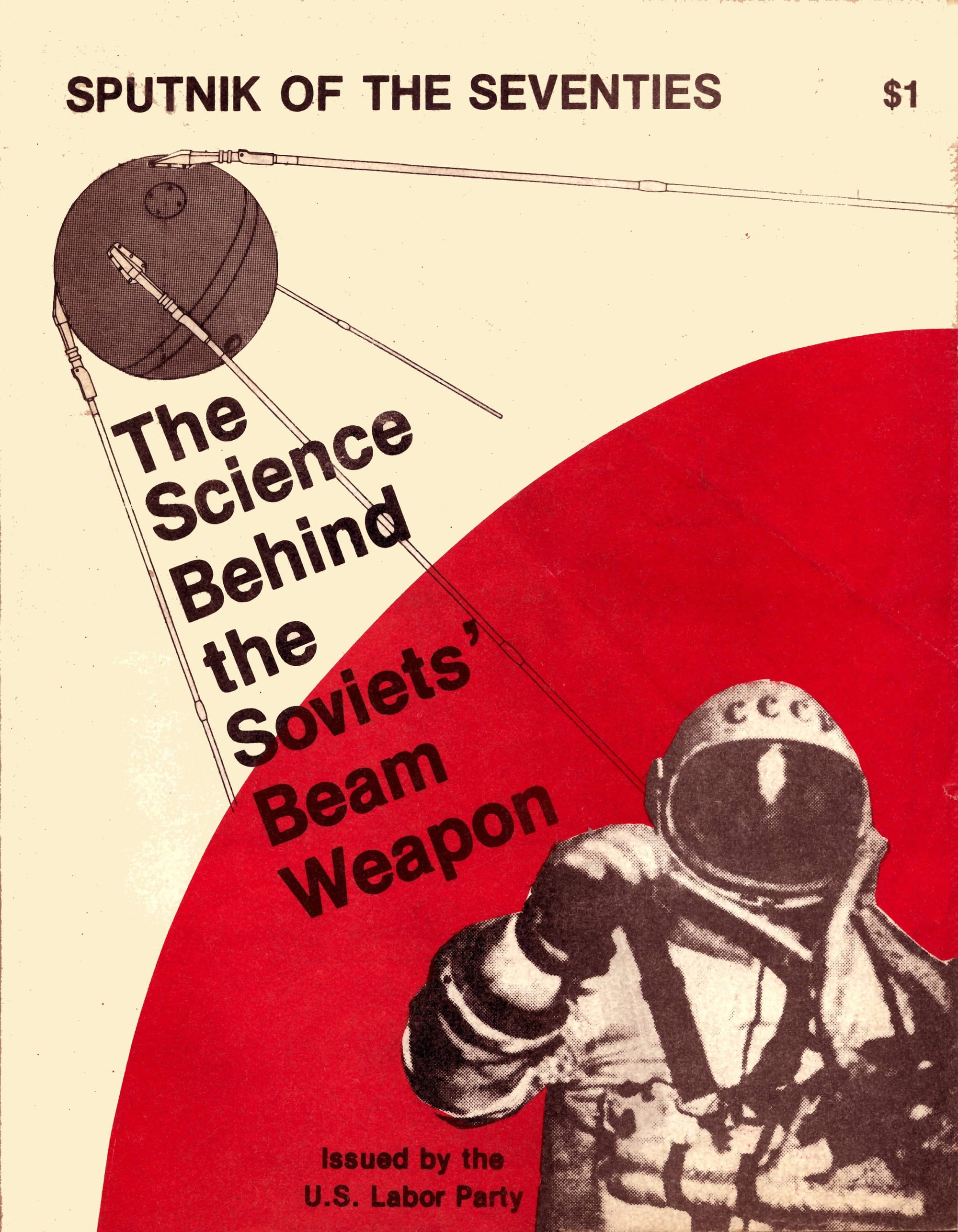
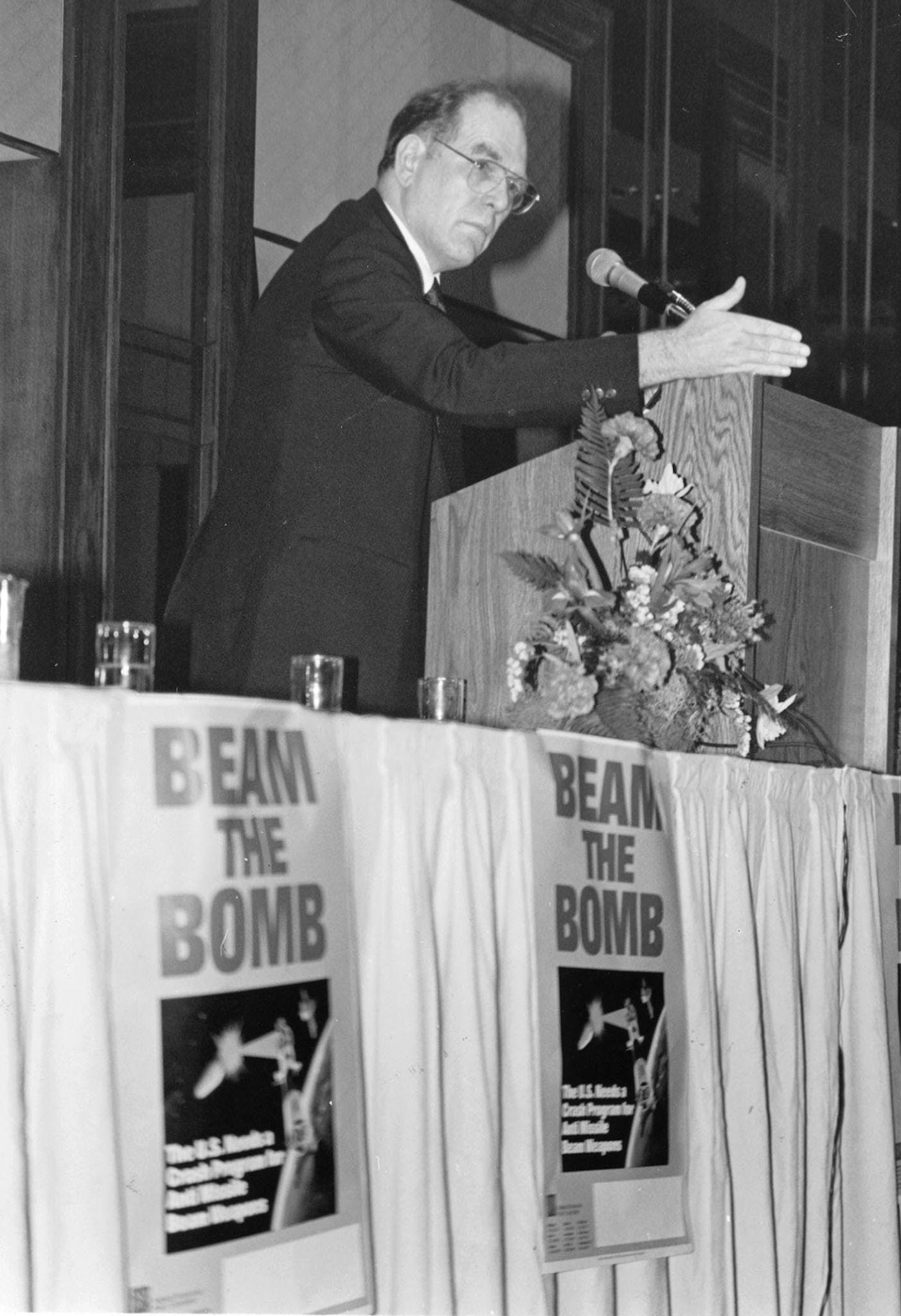
President Reagan’s SDI proposal intended to free the world from the grip of “revenge weapons,” by cooperative scientific research to develop technologies which would end the terrifying age of Mutually Assured Destruction; it was premised on a strategic proposal advanced by LaRouche. Among the relevant documents are the 1982 pamphlet authored by LaRouche, “Only Beam-Weapons Could Bring to an End the Kissingerian Age of Mutual Thermonuclear Terror,” and the 1977 pamphlet, put out under LaRouche’s guidance by the U.S. Labor Party, “Sputnik of the Seventies: The Science Behind the Soviets’ Beam Weapon.” The illustration is of a chemical laser beam defense weapon. Credit for illustration: Christopher Sloan.
So, with the collapse of the Soviet system, beginning during 1989, the principal three occupying powers with continued authority over Germany—Thatcher’s Britain, Mitterrand’s France, and Bush’s U.S.A.—launched the imposition of a neo-feudal, imperial, “new world order,” called “globalization,” based upon the stated goals of “free trade” and “world government.” This latter has been, in effect, an attempt to return to not only the state of European civilization prior to the 1648 Treaty of Westphalia, but to return, in spirit, to those Guelph League policies of the Thirteenth and Fourteenth Century, the which had collapsed the number of parishes and population of Europe by approximately one-half. That latter was the greatest catastrophe experienced by Western Europe since the collapse of the Latin Roman Empire, the Fourteenth Century’s so-called “New Dark Age.”
Thus, the crucial issue of strategic defense, as I have posed it, and as President Reagan’s March 23, 1983, address did, is not a matter of pure and simple military countermeasures, but, rather, is the issue of the choice between military “balance of power”-style countermeasures, in the sense of feudal warfare, on the one side, and defense of the continuation and further development of the institution of the sovereign nation-state, on the opposing side.[[10]]
To refresh your memories: In the simplest terms, the essence of what President Reagan announced as SDI, was a proposal, as directed to the Soviet government, as also to our own nation and its allies, with the intent simply to free the world from the grip of “revenge weapons.” He proposed, that science, aided by cooperative efforts among nations, could develop technologies which would save the world from a situation in which thermonuclear ballistic-missile barrages were the virtual ultimate weapon, a purely terrorist weapon, which held the politics of the world hostage to its threat.
In effect, what the President thus proposed, was a commitment to return the practice of statecraft to a saner time prior to the 1945 nuclear bombing of Hiroshima and Nagasaki, and thus return world politics and strategy to the President Franklin Roosevelt standard of the pre-August 1945 domain of rational behavior.
The hard kernel of President Reagan’s March 23, 1983, announcement, was, in effect, the intent to undo that terrible threat to civilization as whole, which was represented by the policy set forth in the doctrine of nuclear-terrorist Bertrand Russell’s Sept. 1946 issue of The Bulletin of the Atomic Scientists. Mr. Reagan’s clearly implied argument, as delivered directly to the Soviet government during those weeks, was that if we can cooperate to bring “revenge weapons” under control, we may be able to find that pathway back to rationality, in which peaceful solutions to leading strategic issues could be negotiated and adopted.
The first thing to consider, in studying any among the current U.S. proposals for missile defense, is the fact, that President Reagan’s proposal then, was directly and plainly opposite in purpose, in the deepest sense, to everything which is presently being proposed by the current advocates of missile defense as an instrument of “globalization.”
However, since 1983, especially since the close of 1989, the world has changed radically. Then, in 1983, President Reagan, as typical of one who had been, politically, an ordinary patriotic veteran during the course of time of the Great Depression and World War II, typified thus a generation whose views of U.S. strategic interest were still based upon the conception of the United States as a perfectly sovereign nation-state republic.
Now, since the 1989-1991 process of disintegration of the Soviet system, a new era, which President George Bush dubbed “a new world order,” has been declared by many voices of the Anglo-American establishment, as the allegedly inevitable and irreversible overturning of the age of the sovereign nation-state, establishing a radically new age of “free trade,” “globalization,” and the rule of “supranational” institutions of radically positivist, and capricious forms of imperial law.
Unlike the Reagan of 1983, and, rather, like the Bush Republicans, and the Carter-Mondale Democrats, who had opposed SDI in 1983,[[11]] the Bush Republicans moved, in 1989-1992, to avow their intent to destroy the institution of the sovereign nation-state. Thus, the present advocates of missile-defense are, in fact, like former Carter National Security Advisor Zbigniew Brzezinski, demanding a return to the state of affairs which ought to be remembered from the Thirty Years’ War, or, earlier, the so-called Fourteenth Century New Dark Age.
What has been clearly intended by such circles, since 1989, and what is said with ever more shameless openness today, is a commitment to what Bertrand Russell’s nuclear-weapons policy intended, the eradication of the sovereign nation-state, to make way for what Russell termed plainly, and repeatedly, “world government.”
Thus, to restate and summarize the crucial point: where President Reagan’s SDI proposal was intended to save the form of civilized relations among sovereign nation-states, as the 1648 Treaty of Westphalia defines such relations, the current draft proposals for limited ballistic-missile defense, are premised upon the directly opposite purpose. There, in blurring that fundamental difference in purpose, lies the kernel of confusion underlying all current proposals for missile defense. The present proposals express a determination to impose “world government” by aid of the Roman-empire-style police-force of the “new NATO”: a return of the world to that century of catastrophe known as the Guelph League’s plunge of European civilization into the Fourteenth Century’s “New Dark Age.”
Albright and the Wells of Doom
In contrast to the Reagan SDI of March 1983, the opposing missile-defense strategies of today’s Governor George W. Bush, Vice President Al Gore, and U.S. Secretary of State Madeleine Albright, reflect a different generation’s political base than that of Presidents Kennedy, Johnson, Ford, and Reagan. Since Reagan’s 1984 re-election, our governments have found their new political base chiefly in a shrinking ration of the population, constituted chiefly of social strata “likely to vote,” which are representative of a class of persons harking back to the ultra-decadent “flapper” ideology of the Coolidge 1920s, who are vicious opponents of the American intellectual tradition. In fact, political figures such as Governor George Bush, Vice President Gore, and U.S. Secretary of State Madeleine Albright, represent, axiomatically, the peculiar interest of a species alien to our own.
Secretary Madeleine Albright is by no means the author of this state of affairs, but she typifies the currently leading, implicitly treasonous threat to the sovereignty of the U.S.A. Perhaps, she does not intend to be treasonous; but, perhaps, “treasonous” is not a choice of term strong enough to express the depravity of her folly. Perhaps, there are extenuating circumstances for her case. Perhaps, for reasons of family upbringing, and related influences, she simply knows no better; perhaps, speaking clinically, she is incurable on this account.
She typifies that utopian concert of efforts to establish world government, as that current is also found among all too many of today’s spokesmen for both the present Administration and the U.S. Congress. To appreciate the sheer lunacy of the more popular variety of current versions of efforts to abolish the sovereignty of nations such as the U.S.A., it is convenient to focus upon the coincidence of the policies of Mrs. Albright and Vice President Al Gore. Focussing upon this side of the matter, also clarifies the same utopian tendency, expressed under different trade-marks, as the policies of certain of the caretakers for Republican pre-candidate George W. Bush, Jr.
On this account, Mrs. Albright exposed herself most flagrantly, in an address she delivered, on October 14, 1999, in New York City, to an organization known as the Institute of International Education (IIE).[[12]] Not only did she identify the roots of her policy, as those of utopian fanatic and Bertrand Russell confederate Herbert George Wells, but the organization before which she chose to unbutton herself in this fashion, the IIE, had been founded, in 1919, as an habituated, key promoter of policies such as those of Wells and Russell inside the U.S.A.[[13]] On that same occasion, she identified her U.S. career, and that of her father, former Central European diplomat Joseph Korbel, as a notable beneficiary of the IIE’s support, both for her and for those views of Wells.[[14]]
These policies of Wells identified by Albright in that address, are fairly summed up in two typical Wells locations, his The Outline of History[[15]] and his famous, 1928 The Open Conspiracy: Blueprints for a World Revolution.[[16]] There is no part of the policies attributable to the personal influence of Mrs. Albright, inside the Clinton Administration, nor those of Vice President Al Gore, which are not coherent with the most disgusting elements of the policies which Wells and Russell adopted in common, as their schemes for eliminating the sovereign nation-state and establishing world government.

Nor is there anything inconsistent between those Wells policies and the impact of the IIE in U.S. life since its founding. Nor are there truly significant points of difference between the political philosophy of IIE-sponsored Albright and such IIE-sponsored, existentialist, avowed haters of the American patriotic intellectual tradition, as systemic irrationalists Max Horkheimer, Theodore Adorno, and Hannah Arendt.[[17]]
Nor should anyone be astonished by the fact that the views attributed to George W. Bush, Jr.’s pre-candidacy, are consistent, like candidate Gore’s, with that commitment to a Wellsian form of world government, as expressed by former President George Bush’s proclamation of “world government,” as a “new world order.”[[18]] Between the policies of Governor George W. Bush’s present pre-candidacy, and those of Albright and Gore, there are secondary differences in matters of style, but not in ultimately implied goals.
On these and related matters, as Russell wrote in 1928, there are no important differences between the “Open Conspiracy” policies of Wells and Russell, on the one hand, and those of such present-day followers of President Theodore Roosevelt, President Woodrow Wilson, Wells, and Walter Lippmann, as Al Gore and Albright. The genetic heritage is the same axiomatically; the differences aggregated by processes of mutation over successively intervening generations and degenerations, are essentially slight; the differences are merely stylistic, and the novelties chiefly psychedelic.
In addressing the matter of ballistic-missile defense, we are obliged to emphasize the role in which reports of British Empire scientists Rutherford’s and Soddy’s work on nuclear fission, led Wells, in 1913.[[19]] It is from that standpoint, that Wells, already in 1913, was able to foresee the development of weapons based upon nuclear-fission principles, as sufficiently terrible to force existing nations to capitulate to a return to the intended kinds of world government, forms of world government which we might remember from ancient Babylon, Rome, and European feudalism.
As Wells himself, from 1928 on, situated the combined work of the world-wide confederates of himself and Russell, he conceived of this role of nuclear terror as a second phase of the Fabian conspiracy from the pre-World War I decades, which he identified by his choice of title for his manifesto: The Open Conspiracy. It was under Wells crony Russell’s political direction, that the development of nuclear-fission weapons occurred, and it was through the policies of Russell and such Russell devotees as Leo Szilard, John J. McCloy, McGeorge Bundy, Henry Kissinger, et al., that the diplomatic architecture of today’s drive for a world government modelled upon the tradition of pagan Rome, has been launched.
I have documented elsewhere the leading features of the development of the Wells-Russell doctrine of nuclear weapons, as a means for abolishing the sovereign nation-state and establishing a neo-Roman Empire of world government.[[20]] Therefore, here, I need but summarize the crucial, relevant points of that development.
Fabian Society figures Wells and Russell had both been key figures of Lord Alfred Milner’s Coefficients (for example, Round Table) organization, the association which contributed a key role in the British monarchy’s planning of what became World War I. Russell had walked out of the Coefficients in a petulant aristocrat’s temperamental fit, whereas plebeian Wells remained with King Edward VII’s Lord Cecil, Milner, Mackinder, et al., and became a leading political-intelligence figure of the British imperial establishment for that war.
Later, during the 1920s, Wells and Russell patched up their war-time differences, consolidating their not inconsiderable world-wide political-intelligence resources, in support of what Wells’s defined as “The Open Conspiracy.” The larger portion of the general naughtiness and nastiness of the recent century, can be put to the account, directly or indirectly, of the included, leading contributions of this pair and their accomplices. At the center of that business, was the Wells-Russell plot to bring about world government through the development of nuclear arsenals, a policy which Russell continued to the end of his wretched existence.
America-hating, British aristocrat Russell, using such among his acquired devotees and lackeys as physicists Leo Szilard and Eugene Wigner, actually authored the U.S. development of the nuclear bomb, and effectively directed British and U.S.A. nuclear-weapons and nuclear-arms-control policies throughout the entirety of his life thereafter.

It was, for example, the Russell-Wells policy of world-government, as established through the threat of nuclear arsenals, which prompted the nuclear bombing of Japan by President Truman, and which guided Arms Control and Disarmament Agency (ACDA) chief John J. McCloy and such McCloy clones and Golems as McGeorge Bundy and Henry A. Kissinger. It was the same Russell who had demanded, publicly and repeatedly, a preparation for nuclear attack upon the Soviet Union, beginning 1946, who opened the mid-1950s channel to Stalin successor N.S. Khrushchev, leading to the establishment of the Pugwash Conference and to the Cuban Missiles Crisis of 1962. It was the sequence of developments marked by Russell’s role in mediating between Moscow and Washington during the Missiles Crisis, and the assassination of President John F. Kennedy, which locked London, Washington, and Moscow, into the “detente” track of Kissinger’s 1972 negotiations of SALT l and the Russell-designed Anti-Ballistic Missile (ABM) treaties.
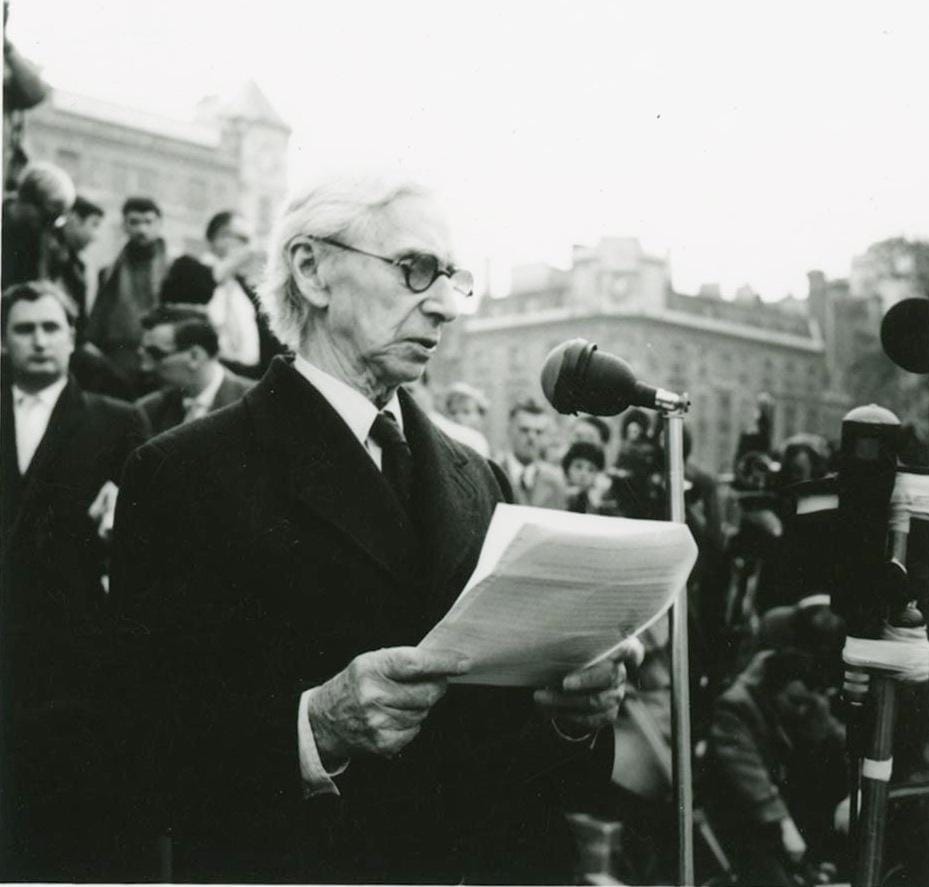

The long drive toward world government, came proximate to its goal, with the collapse of the Soviet system, over the interval 1989-1991. The virtual elimination of the chief military challenge, that of the Warsaw Pact alliance, to the combined powers of the NATO forces, was taken by the London and New York backers of this, the then-deceased Russell’s design, as the occasion for brushing aside most among the pre-1989 allies of London and New York, such as continental Europe’s NATO members, and establishing a form of world government, representing rentier-financier interests, since then run, jointly, and more or less exclusively, by the Anglo-American powers. Thus, President George Bush proclaimed a Roman imperial style in Anglo-American world government: his, rather than Adolf Hitler’s “new world order.” The final assessment of the actual differences between the two schemes has yet to be made.[[21]]
As a lapsed-time portrait would help us to see clearly the result of this drive toward world government through nuclear terror, over the span of the past fifty years—especially since the untimely death of President Franklin Roosevelt—the characteristic feature of the efforts of those behind the Anglo-American domination of the world today, is nothing different than what Wells set forth in his 1928 The Open Conspiracy. Read Wells’s frankly satanic program from that book, and weep for today’s imperilled mankind:
1. The complete assertion, practical as well as theoretical, of the provisional nature of existing governments and our acquiescence to them;
2. The resolve to minimize by all available means the conflicts of these governments, their militant use of individuals and property and their interference with the establishment of a world economic system;
3. The determination to replace local or national ownership of at least credit, transport, and staple production by a responsible world directorate serving the common ends of the race;
4. The practical recognition of the necessity for world biological controls, for example, of population and disease;
5. The support of a minimum standard of individual freedom and welfare in the world;
6. The supreme duty of subordinating the personal life to the creation of a world directorate capable of these tasks and to the general advancement of human knowledge, capacity, and power.
If one assesses those six points against the background of Wells’s strongly argued social theories, before and after that 1928 publication, Wells and his proposals, and avowed Wells follower Albright, are to be regarded as a form of universal fascist dictatorship containing, axiomatically, all of the evil features of Hitler’s regime, and much more besides. This is precisely what Russell himself had proposed, independently of Wells, earlier, and later. This is the pedigree of the “Third Way” policies of London’s new Mussolini Tony Blair, today, and his leading U.S. devotee Al Gore. This is precisely what Secretary Albright’s perverse performance, “in service of democracy,” on record, as in Africa and South America, represents to date; that is precisely what is represented by those who deploy her on behalf of such policies.
This is what Secretary Albright, and her policies, represent. With declarations such as her October 14, 1999, New York address, she has placed herself on the public record, as consciously motivated by a passion, not only to wipe the sovereign nation-state permanently from the world’s map, but to sink all of civilization into the kind of doom prescribed by the wildly Romantic utopians Wells and Russell. The fault for this lies less with what she herself does, than with those in government who wittingly, and revealingly, tolerate or even encourage her song and dance.
End of Part 1.
Notes
[[1]]: To a citizen who denies the rumor that the Moon is made of green cheese, a relevant mass-media reporter, perhaps from The Washington Post, might snarl, “But, don't you realize that none of your neighbors agree with you?” In many instances of a similar type, the neighbors in question chiefly do.
[[2]]: C.P. Snow, Two Cultures and the Scientific Revolution (London and New York: Cambridge University Press, 1993 reprint).
[[3]]: During March 1973, I wrote a memorandum to a circle of my associates. This memorandum, which underscored such matters as Soviet Academician Vernadsky’s argument concerning the relationship between living and non-living processes, defined the mission assigned to what was then named “the science file” of our news service. Two multiply-connected special topics were set into motion by that memorandum: the economics-driven threat of a long-term global biological holocaust, and the need for accelerated research aimed at the mastery of controlled thermonuclear fusion. The subsequent founding of the Fusion Energy Foundation (FEF) was a direct outgrowth of those combined initiatives. 21st Century Science & Technology has continued the legacy of the FEF on these accounts.
[[4]]: Cf. Barbara Tuchman, A Distant Mirror: The Calamitous Fourteenth Century (New York: Alfred A. Knopf, 1978).
[[5]]: This author’s use of the term “systemic,” signifies an axiomatically determined characteristic of the inherent design of the system as a whole. This signifies the use of “characteristic” in the sense of Bernhard Riemann’s 1854 habilitation dissertation, [“Über die Hypothesen, welche der Geometrie zu Grunde liegen,” in Bernhard Riemann’s Gesammelte Mathematische Werke, H. Weber, ed. (1902): (New York: Dover Publications [reprint], 1953), or (Vaduz, Liechtenstein: Saendig Reprint Verlag, Hans R. Wohlend)], and of Riemann’s consequent definition of what Gottfried Leibniz defined as Analysis Situs.
[[6]]: Notably, the destruction of President Reagan’s SDI policy, from the inside, was done chiefly through the late Lt. Gen. (ret.) Daniel Graham, who insisted that only “kinetic” interception systems, essentially of “off-the-shelf” designs, be allowed. The current proposals are based chiefly on that same, “double dippers” Heritage Foundation dogma.
[[7]]: Zbigniew Brzezinski, The Grand Chess Board: American Primacy and Its Geostrategic Imperatives (New York: Basic Books, 1997). In this book, Brzezinski specifically revived British geopolitical theorist Halford Mackinder’s 1905 “Geographical Pivot of History” and his 1919 Democratic Ideals and Reality. In his 1997 book, Brzezinski referred to the Trans-Caucasus region as the “Eurasian Balkans,” which he envisioned as the flash point for conflicts that would, ultimately, lead to the break up of Russia, and the grabbing up of the petroleum and other strategic raw material reserves of Central Asia by Western cartels. These very same lunatic ideas are being aggressively promoted by a newly created Mackinder Forum, reviving the writings of the early 20th Century geopolitician. On June 30, 2000, a conference was held at Oxford University, launching the Mackinder Forum. In preparation for the event, two prominent Mackinder advocates, Geoffrey Sloan and Colin S. Gray, published an edition of Halford Mackinder’s core writings, under the title Geopolitics, Geography and Strategy. The essays they selected focused on the Russian landmass as the “fulcrum” of Eurasia. The editors echoed Brzezinski’s focus on Russia, and particularly the Trans-Caucasus region, reaching to the Caspian Sea, as the central point of conflict on the Eurasian land mass. All of this highly provocative gibberish, targeting Russia for break-up, ignores one fundamental reality: Russia’s nuclear ballistic-missile arsenal could still overwhelm the existing defenses of the U.S.A.
[[8]]: Venice’s Fourth-Crusade conquest of Byzantium, was a crucial part of its rise to imperial power during the early Thirteenth Century. Venice’s launching of the Guelph League campaign to destroy the Holy Roman Empire of Emperor Frederick II, and Charles of Anjou’s bestial occupation of Sicily, typify the Venice operations leading into the mid-Fourteenth-Century collapse of Europe into a New Dark Age.
[[9]]: The fairy-tale, that that bombing “saved a million U.S. lives,” is simply an outright lie woven into the litany of standard, hyperinflated utterances ever since. Absent Truman’s folly, U.S. strategy had been based upon earlier negotiations from Japan, through the Vatican; the policy was to wait out the effects of a highly successful U.S. naval and aerial blockade, until Japan’s recalcitrant generals were compelled to bend to the Emperor’s desire for peace. No U.S. forced invasion of Japan was required.
[[10]]: Had Wallentstein and Gustavus Adolphus been allowed to continue their efforts for peaceful solutions, what became the later, most ruinous phases of the 1618-1648 Thirty Years’ War, would have been prevented. The assassination of Wallenstein, by those determined to prevent the alternative offered by Wallenstein and Gustavus Adolphus, unleashed the preventable full horror of the assassins’ strategic folly. It is the establishment of stable and peaceful relations among sovereign nation-states, which has been, since 1618, the primary objective of modern civilized warfare. In other words, the proper object of war is durable peace; the sovereign nation-state, and its defense as an institution is an essential pre-condition for such peace, and is therefore that principle which warfare must defend.
[[11]]: For example, Vice President George H.W. Bush’s circles.
[[12]]: In her address to the IIE, Albright defended the very “public diplomacy” program of the State Department and other U.S. government agencies, that had caused such a proliferation of warfare, and the spread of illegal drugs and weapons, during the George Bush/Oliver North Iran-Contra fiasco. What is worse, she defended those criminal policies by invoking the name of H.G. Wells, one of Britain’s leading social engineers of the late 19th and 20th Centuries, who advocated a world government based on a scientific dictatorship. Albright told the audience, “About the time the IIE was founded, British author H.G. Wells wrote that ‘history [is] a race between education and catastrophe.’ Helping people to value democratic principles of tolerance and openness is a good way to aid us all in winning that race.” Albright singled out non-governmental organizations (NGOs) for special praise, in her speech, providing the audience with a laundry list of recent instances where her State Department backed NGOs in efforts to destabilize sovereign, nation-state governments all around the world.
[[13]]: IIE was founded in 1919 by Nicholas Murray Butler, the president of Columbia University; Elihu Root, the former Secretary of State; and Stephen Duggan, head of the Carnegie International Institute for Peace, ostensibly to foster international educational exchange programs. Prior to President Franklin Roosevelt establishing diplomatic relations with the Soviet Union, the IIE was one of the most prominent “back-channels” between the Wall Street and State Department circles and Moscow. Working with The New Republic’s Michael Straight, IIE was behind John Dewey’s lengthy trip to the Soviet Union in 1926, from which he published a series of glowing reports about the high quality of Soviet education. In the 1930s, the IIE formed the Emergency Committee for Displaced German Scholars, through which, the entire Frankfurt School apparatus of social revolutionaries and subversives was brought to the United States, and placed in American universities and research centers. The Emergency Committee was run by John Dewey and Egbert Roscoe Murrow (later known to the world as Edward R. Murrow), and was modelled on an earlier agency established in Britain, called the Academic Assistance Council, headed by one of H.G. Wells’s leading protégés, and world government fanatics, Leo Szilard. In the 1940s, Stephen Duggan was replaced, as head of the IIE by his son Laurence, who was later exposed as a member of the extended Anglo-Soviet espionage apparatus of Noel Field and H. Kim Philby.
[[14]]: Joseph Korbel, a former official of the Eduard Benes government of Czechoslovakia, served as the academic godfather of George W. Bush advisor Condoleezza Rice. Sometime Albright political godfather Zbigniew Brzezinski, is a son-in-law of the same Benes. Together, the Korbels and Brzezinskis represent outgrowths of the pro-feudalist bureaucracy of decadent and fallen Central European states, a species steeped in the same quality of cultural pessimism out of which Twentieth Century European fascist currents were spawned. Albright is redolent with that specific type of cultural pessimism.
[[15]]: H.G. Wells, The Outline of History: Being a Plain History of Life and Mankind (Garden City, N.Y.: Garden City Publishing Co., 1920, 1931, 1940).
[[16]]: H.G. Wells, The Open Conspiracy: Blueprints for a World Revolution (London: Victor Gollancz, 1928).
[[17]]: T.W. Adorno et al., The Authoritarian Personality (New York: Harper, 1950). All of these Frankfurt School followers of Georg Lukacs were, like Nazi Philosopher Martin Heidegger and Karl Jaspers, fanatical advocates of the policy that truth does not exist, only existentialist forms of opinion. Merely typical of this moral degeneracy is Hannah Arendt’s series of books on totalitarianism.
[[18]]: President Bush spoke to Congress Sept. 11, 1990. He gloated over the then-onrushing collapse of the Soviet Union, which removed any hindrance to “concerted United Nations action” so that the “crisis in the Persian Gulf … offers a rare opportunity to move toward … a new world order.” (Washington Post, Sept. 12, 1990).
[[19]]: See, Frederick Soddy, The Interpretation of Radium and the Structure of the Atom (New York: G.P. Putnam & Sons, 1922), and H.G. Wells, The World Set Free (London: Macmillan, 1914), dedicated to Soddy. Publicist Wells is the putative inventor of the term “atomic bomb.” Notably, although Wells had publicly acknowledged this debt to Soddy in his own 1914 The World Set Free, no suitable reference to a mailer so important appears in his own 1934 autobiography. Soddy, whose most significant apprenticeship, in study of the disintegration of radioactive elements, occurred under Ernest Rutherford at Montreal’s McGill University, is among the first known, during 1908-1914, to have proposed the feasibility, and prospective power of fission weaponry. After Soddy had received his 1921 Nobel Prize in chemistry for related discoveries, his 1908 lectures, on which Wells had relied chiefly for his 1914 proposal of a nuclear balance of power, were published as a book.
[[20]]: Lyndon H. LaRouche, Jr., “On The Subject of Strategic Method,” (Bad Schwalbach, Germany, address of May 26, 2000) Executive Intelligence Review, June 2, 2000, pp. 20-35. See also, Lyndon H. LaRouche, Jr., “The Becoming Death of Systems Analysis,” Executive Intelligence Review, March 31, 2000, pp. 10-73; LaRouche, “When Andropov Played Hamlet,” Executive Intelligence Review, April 21, 2000, pp. 14-31, and LaRouche, “Information Society: A Doomed Empire of Evil,” Executive Intelligence Review, April 28, 2000, pp. 36-55. On this subject of the Wells-Russell collaboration, see a book produced under my design and direction during the last years of the 1970s. Although I set forth the thesis and mapped the principal features of the book, the detailed work was done by a rather large number of my associates, and published as Carol White, The New Dark Ages Conspiracy (New York: New Benjamin Franklin Publishing House, 1980).
[[21]]: It should be emphasized, that it was President George Bush’s father, and Governor George W. Bush’s grandfather, Prescott Bush, who played a key role in funding Adolf Hitler’s appointment as Chancellor of Germany. See, Anton Chaitkin and Webster Tarpley, The Unauthorized Biography of George Bush, (Washington, D.C.: Executive Intelligence Review, 1992). None of those connections to Hitler’s regime are merely coincidental for the understanding of the history of the U.S.A. and the world during the current year and the next.