Editor’s Note: This article was first published in EIR, Vol. 9, No. 22, June 8, 1982, under the title, “Developing Nations Must Be Responsible for Economic Growth and War Avoidance.”
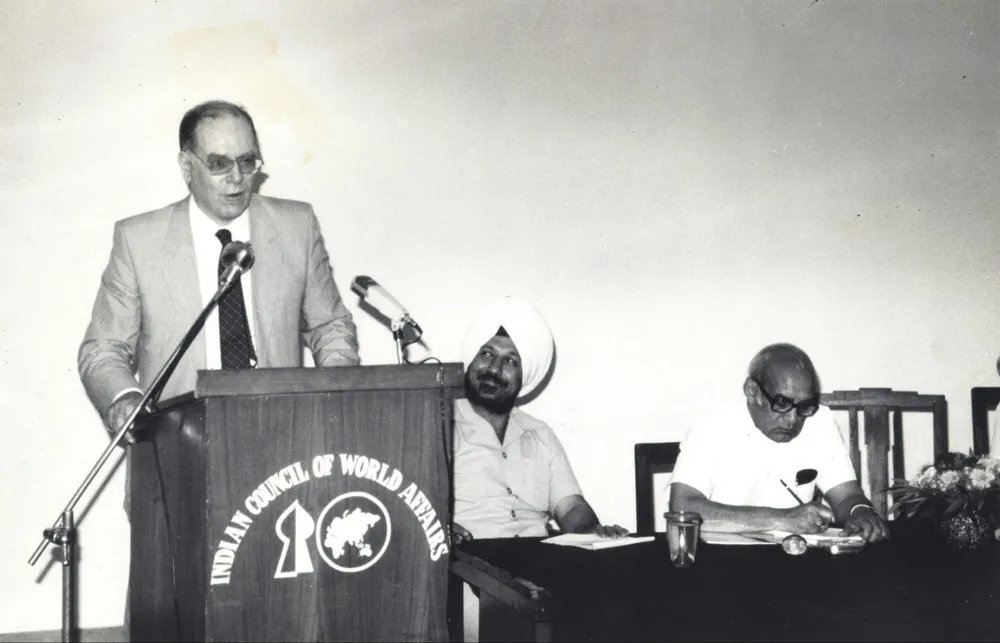
The following is an edited transcript of the April 23, 1982 address by Lyndon H. LaRouche, Jr., founder of the Executive Intelligence Review, to the Indian Council of World Affairs in New Delhi, during a two-week trip to India which brought the economist and statesman back to the subcontinent for the first time since his service in the U.S. Army 36 years ago. LaRouche was accompanied by his wife, Helga Zepp-LaRouche, chairwoman of the European Labor Party in West Germany. Their tour included stops at the Bhandarkar Oriental Research Institute in Pune, the National Institute for Science, Technology, and Development Studies, the Jawaharlal Nehru University School of International Studies, and a meeting with Indian Prime Minister Indira Gandhi.
Thank you, Mr. Chairman, members, and guests.
I have been involved in a significant way in the question of North-South economic development since approximately the beginning of 1974, with the aid of Helga Zepp-LaRouche, who has been my wife for the past three years. In 1974, Helga intervened in the Lower Saxony, Germany state elections campaign on behalf of the Social Democratic Party (SPD). She told the voters that despite everything—referring to the leadership of the Social Democratic Party—they should vote for the SPD. But the particular policy which she introduced, which has been our policy ever since, was to propose that Germany at that point take the leadership in developing what we called a “golden ruble.” The concept of the golden ruble was to establish cooperation between Western Europe and the Soviet Union along traditional world power lines, but this was to be somewhat differently defined than in past world-power efforts. The difference was that East-West relations had to be tied to North-South relations. That is, both Eastern nations and Western nations, and the so-called mythical divide—which is unreal, and indeed mythical—should not concentrate on cooperating among themselves economically as the basis for political security. Instead, they should bring into play questions of high-technology economic development to the developing sector.
What we argued in particular was this: The Soviet Union did not have at that point, and still does not have, largely because of its military expenditures, a significant export capability relative to the needs of the developing sector. Therefore, it was necessary that the United States, Western Europe, and Japan assist the Soviet Union in developing in the Urals and Siberia certain large industries, which fit the needs of the Soviet labor force and so forth, which would give them the capacity for capital goods production in excess of what they would require domestically. Then we could say to the Soviets: “You don’t have to pay us back directly for this. You can pay for some of the credits that you received from Japan, the United States, and Western Europe by delivering certain exports of capital goods to the developing nations for joint projects, creating a three-way trade.
What we’ve achieved is a general comprehensive agreement along broad policy planning lines, of project objectives, over a period of 25 to 50 years. We agree, North-South and East-West, that certain general things have to be accomplished in the way of economic development projects over the next two generations; that we will organize economic cooperation, both East-and-West and North-and-South, toward the point of fulfilling those objectives; that we will organize credit mechanisms to facilitate meeting those objectives; and that we predicate our political relations and the resolution of problems of military confrontation and other problems upon this combined East-West/North-South trade.
In this process I have made many efforts and have become, in Western Europe and in the United States at least, and in a few other places, perhaps the most controversial public figure in certain precincts. At the beginning of 1975, according to official U.S. government records, Henry Kissinger made himself my avowed personal enemy, and devoted a good deal of the time of persons assigned to his office to doing nasty things against me because of this. But apart from Henry Kissinger, and several fellows like Richard Hambros who approached us in 1975 and told us that he was going to do bad things to us, apart from this sort of thing, there are two basic problems that have so far prevented the success of either my own efforts or the efforts of anyone else in North-South relations. This lack of success will continue, as long as these two conditions exist. I submit to you that all new proposals on North-South cooperation are pointless insofar as these problems are not tackled.
The Anglo-American Stranglehold
First of all, the dominant institutions of Western Europe and the United States are controlled by what we might call Anglo-American forces centered around the Swiss Bank for International Settlements, the International Monetary Fund, etc. These forces are absolutely determined not only to crush the developing sector, but to significantly depopulate it, using economic means to facilitate the depopulation. Therefore, under no circumstances while these institutions have power—while they can determine the policies of the United States and Western European countries and can dominate the international monetary system—is there a peaceful means by which the developing sector could secure significant improvement in North-South relations. Any attempt to find a pathway under these conditions is merely the search for a pathway to failure.
These institutions apply brute force. The Rambouillet agreement of 1975 is exemplary. Henry Kissinger and the British got the OECD nations together at Rambouillet Palace outside of Paris, and they agreed to ignore any demands from the developing sector along the lines of those actually submitted and adopted the following Summer, in August 1976, at the Non-Aligned Nations summit in Colombo, Sri Lanka. What had been put together at Sri Lanka was probably the model, for the whole, or a large part, of the developing nations for development.
After this deployment of brute force, the other main obstacle to economic development is the economists themselves—the so-called professional economists. This is perhaps one of the most important things, because economists in the developing sector are often susceptible to the arguments of such paid traitors to the cause of humanity as Gamani Corea of UNCTAD, whom I know personally to be an enemy and saboteur of efforts to create rational North-South relations. According to the blandishments of the Oxbridge economists, the developing sector governments should be advised that economically sound proposals are in fact unworkable, and that therefore these governments should not make themselves “silly” in the eyes of enlightened Oxbridge politicians of the United States and Britain by submitting such silly proposals. In point of fact it is the case that many of these proposals, as typified by those included in the Sri Lanka agreement of 1976, are eminently sound.
Therefore, some special conditions must be created before we can talk seriously—except in ineffable rhetoric—about achieving any significant improvement in North-South economic relations. We have to somehow eliminate the factor of institutions of the kind that Henry Kissinger used to work for, and still does, in his deployments against North-South development. We also have to neutralize the professional economists of the Oxbridge and related London School of Economics varieties, whose doctrines shape the policies against development in the industrialized countries and poison the policy-making of the developing nations.
I shall address myself as summarily as possible to both of these propositions, and indicate how I propose we approach this.
1982 Deadline for East-West Showdown
Some months ago, some people of my own government talked to me about the coming East-West crisis, a crisis which is to be worse than the Cuban Missile Crisis of 1962. The crisis was scheduled to occur on the basis of the implanting of medium-range thermonuclear missiles, targeting the Urals and other parts of Russia, in West Germany, Britain, and elsewhere. This is a totally unacceptable proposition for the Soviet Union. The Soviets will not allow the emplacement of thermonuclear, i.e., strategic, missiles in Western Europe within a few minutes’ range of the major industrial and population centers of the U.S.S.R.—and any American who thinks otherwise is crazy.
Therefore, this means that we have the Cuban Missile Crisis in reverse, because of the present determination of the United States to carry out the Schlesinger counter-force doctrine by emplacing Pershing II missiles in West Germany. So everyone in the United States was assuming that the 1983 deadline for the missile emplacement would bring us into a crisis-management showdown situation against the Soviets.
I said, no, that is not when the crisis is going to come. The crisis is going to break out between April and May of 1982—as it is now breaking out. We will soon find out that the Malvinas crisis is not the only one set to explode. (The Falklands crisis is simply the result of the British trying to reclaim territory that they stole years ago, and which is the property of Argentina under U.S. law and international law. Lord Carrington deliberately manufactured this crisis.)
The Malvinas crisis is only part of a constellation of crises, which includes several crises in the Middle East. Israeli Prime Minister Menachem Begin is either resigning, or he is playing another trick. But according to my best information, Begin will be out within a matter of days. Lord Caradon’s protégé Ariel Sharon will be running Israel, and if Sharon is running Israel, we are going to have madness and bloodshed all over the Middle East.
The London press is already picking the bones of Iraq, before that nation is dead. Iraq holds the Gulf coast, but it will not for long if it loses its present war with Iran.
Greek Prime Minister Andreas Papandreou has a very strange notion of the proper way to run his government. He has organized a military coup against himself, which is now in preparation—a royalist military coup. The atmosphere is also beginning to be heated up for a confrontation between Turkey and Greece over Cyprus. All it takes is a bloody shirt on Cyprus and the entire Greece-Turkey-Cyprus conflict blows up, in which case the right-wing forces associated with Colonel Türkeş inside Turkey will tend to make a play for power as they have in past Cyprus crises.
Yugoslavia is marked for destruction. The entire Venetian-British-run Albanian operation is to be cranked up.
North-South Relations in Today’s Crisis
We are now in the middle of a depression which began during the period between October of 1981 and February of 1982. The depression is about to go into phases like the Kreditanstalt [bank in Austria in] Spring of 1931; we’re just waiting for a blowup, a structural collapse in some part of the U.S. economy which might be triggered in any number of ways. One that is most likely is a debt default, rolling out of war between Britain and South America; and Britain will be at war with most of South America if it shoots at Argentina. This is of course a rolling, chain-reaction of debt default, and the entire international monetary structure would collapse.
So, we’re in that kind of situation. We’re headed for a depression; in fact, we’re in it already; it’s just that the structural damage is not yet done. We’re headed toward war, we’re headed toward thermonuclear war—not because anybody is planning thermonuclear war, but because the conditions are developing in the world in which we’re going toward a point at which somebody will not be able to back down.
That’s the only way you can have a thermonuclear war: you create an aggravated situation of crisis, a crisis in which one party cannot back down. Particularly, nations cannot back down from war when they believe their political existence is in jeopardy. If you convince the United States or the Soviet Union that the political existence of the United States or of the Soviet Union is in jeopardy, then that nation will go to thermonuclear war. It has no other military option. Therefore, the trick is not to allow the condition to develop under which that can happen.
Now I’m going to come back to the question of North-South relations in this context. What we have to do is intervene in this process: a plunge toward confrontation, depression, and possible thermonuclear war. To prevent these things, then, we must situate the effort to achieve a new world economic order in the effort to avoid war. How do we propose to do that?
The Problem of Littleness
What does the fact that we are going into a depression mean to the average citizen in Western Europe and North America? It means that the institutions and policies which have governed the United States and Western Europe over the past decade have proven themselves incompetent. The problem is this: In society—as Plato correctly observed, as St. Augustine correctly observed, and as Dante Alighieri documents in his Commedia—we have three possible moral levels of development of the citizens of society, that is, qualitative moral development. We have, on the lowest level, the beast-like existentialist, the hedonist, irrationalist, the philosophical anarchist, who does as he pleases, who does not believe in the law of reason, who does not believe that the universe is lawfully ordered, or that if it is lawfully ordered it ought not to be, from his standpoint. With this sort, you can’t do much of anything. Morally, they’re very close to animals.

We have two other levels. We have a few people—well, we hope, at least a few—in society, who dedicate their lives to making some contribution to the condition of future generations, who see themselves as a positive instrument of history, using their mortal lives to contribute good. They understand that it’s absolutely critical that what has been given to them be passed on to other generations. These people who locate their identities so are only a handful in any society today.
The majority of citizens—who are decent citizens—are moral in their personal and family lives. They can’t go much beyond that, at least not realistically. They don’t wish to achieve anything which they consider immoral as an objective. They don’t want to achieve anything by what they would consider immoral means. But otherwise, their motivation is hedonism, in the broad sense of hedonism. That is, what they consider the material and related interests of their family and friends is paramount. They cannot think about politics on a national level; they cannot really think about politics on an international level; because their souls and stomachs just won’t allow them to grasp such ideas.
And therefore, in society, even the moral citizens of society, on whom we depend if we’re going to have anything but a dictatorship of the enlightened few, behave irrationally on large issues. They define their relationship to policy in terms of institutions—political parties, religious associations, trade unions, and so on. They allow these institutions to do their thinking for them, and they express their relationship to these institutions in terms of slogans and simple kinds of notions. They say, “I am of such and such an institution; I therefore embrace this policy.” You ask them to rate the policy? They can’t. In the final analysis, they simply have confidence in their institution and its policies.
The problem is that among the industrialized nations—in the United States, for example—approximately three-quarters of the population are essentially good people. Their minds are limited, but they’re good people. But they’re little. They’re concerned with their own family and personal and related affairs. They cannot think, their emotions cannot be mustered to force their intellect to think in the long span about the nation as a whole, about the consequences of policy for more than the next year ahead.
You tell them, for example: Look, we must do something because the entire pension funds of the trade unions are about to be wiped out, which means that you and all the other fellows who have been investing for years in these pensions won’t have any pensions. He says, well look, I agree with you, it’s a very important issue, but I haven’t got time to become involved in it; I’ve got to worry about my future, you see.
That is a typical response! I don’t exaggerate; that’s the kind of response you get. They’re good people, but they are very little. Like the good people of most nations, they’re little when it comes to attempting to comprehend the relationship between cause and effect on the scale of a nation as a whole, or on the scale of international relations. They’re not immoral in that sense; they just don’t think about it. They can’t think about it even when you try to get them to think about it, ordinarily; they just can’t do it.
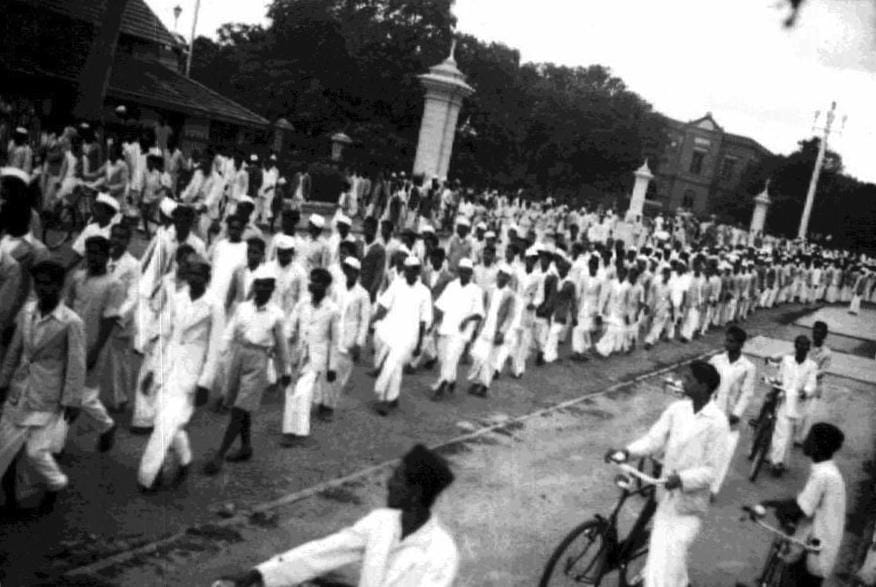
Therefore, if they adhere to institutions which have bad policies, you can change the people only by reforming those institutions, or by causing them to become disaffected from those institutions if the institutions cannot be reformed. Therefore, the only time that you can produce what we might call a nonlinear change in the course of policies of nations are those conditions of crisis in which the little people themselves begin to question those institutions. Under those circumstances, if a people is inspired, great enterprises may be accomplished. I saw the people of India inspired in my small contact with them in 1946, by the great enterprise of independence. Even the coolie making four or eight dollars a day, was inspired to think of nation-building and the industrial development of India.
So, in periods of crisis, it is possible under the best circumstances to evoke in the people—the little people—a passion and the ability to comprehend great issues. As Shelley says (I’m not anti-English, I’m only anti-British), there are periods in which the power for receiving and imparting profound and impassioned ideas concerning man and nature is increased. In such times of crisis this is possible. However, also in such times of crisis there is a peril: Lacking leadership for great enterprises, mankind will often turn itself into beasts. The same little people will destroy themselves. We saw that in Europe in the case of Mussolini’s Italy. We saw what happened to Germany. We saw what happened to other nations during the 1930s period.
A crisis is approaching at which the failed institutions of the previous period must either change their policies or be replaced. According to the alternatives presented, mankind will take the lower branch toward Hell, or mankind will embrace a great enterprise and take the higher road toward progress. And therefore, I propose that the question of North-South relations be situated in the conception of this branch point.
The Folly of Disarmament
The two superpowers have got themselves into a fix, as I told my contacts in the United States from the relevant Soviet government. Therefore, I understand some of their problems; I understand the things they’re saying; I understand their complaints, their concerns. However, I point out to them that as long as they adhere to their present policies, and adhere to those policies in the deepening crisis, we shall have thermonuclear war. I also concede to them that if the United States continues its present policies, and tries to negotiate on the basis of present policies in the crisis we’re in, we shall also have thermonuclear war. The two superpowers, if they attempt to negotiate their present respective positions under crisis-management conditions, will only negotiate war, because they can make no negotiation, no compromise with their existing agenda, which will prevent war.
You cannot disarm. These people who talk about disarmament—it’s nonsense! Ten percent of the existing thermonuclear arsenals would generate sufficient radioactivity, if detonated, to wipe out all higher forms of life on earth within two years after their detonation. If present calculations of the behavior of radioactive caesium are true, the world weather pattern will simply take the radioactive caesium produced by a thermonuclear warhead explosion, run it around the globe, and deposit it in various parts of the world. The caesium will replace iodine in people’s systems. It gets into the system, and people die a particularly horrible death, along with their animals, along with the birds and fish as well.
So, what’s the sense of a 5 percent or a 10 percent or a 50 percent disarmament? What good is it going to do? It does no good whatsoever. What’s the sense of a peace movement? The present peace movement is a fraud. As a matter of fact, the peace movement is a war movement. It’s just against nuclear war; it’s for conventional war. As Paul Warnke, who is the leader of it, has said, and as Senator Kennedy has said quite clearly in his public statements in support of the peace movement, as people in West Germany who are in the leadership of the peace movement have said: The peace movement is a conventional-war movement.
War against whom? War against the developing sector—that’s quite peaceful! And war against the developing sector will lead to war between the superpowers; there’s no way you can avoid this, as Iran illustrates. Britain and the United States decided to destroy Iran. And what is Iran now? Iran is now a vacuum which is sucking the two superpowers into a point of conflict. If you destroy other sections of the world, you will suck the two superpowers into a point of conflict. Britain decided to destroy Argentina. Argentina is a major supplier of Soviet grain. Can we avoid some degree of conflict there? Perhaps not a full-scale war, but a heated-up confrontation is on the agenda. Will the Soviet Union allow its citizens to go hungry because of a British blockade of Argentina?
Look what’s happening in Africa: genocide. Let’s stop calling it by any other name; it’s deliberate genocide against the black population of Africa. I’ve seen the plans to reduce the population of Nigeria by half and eliminate most of Africa. The plan is in the United States, in the offices of Gen. Maxwell Taylor and William Westmoreland, among others; in sections of the State Department. These plans were laid down in the Office of Population Affairs of the State Department and the National Security Council of Henry A. Kissinger. I’ve seen them, and their operation. And they lead to war.
A Competent System of Economics
Which brings us back to the question: What is the positive policy which would substantiate my proposal—the proposal, again, that we establish an East-West/North-South three-way agreement on long-term economic development, and that we predicate political détente between and among the systems on the basis of that agreement to 20 to 50 years of development in the period ahead?
Let’s turn to the second obstacle: economic theory. Contrary to the mythologies that are taught in every university in the United States and Western Europe today, the British system of economics and its derivatives, like those that are taught today, made not one single bit of contribution to the development of industrial states in Western Europe and Japan or North America. If the British system of economics had been used, we should not have gotten out of feudalism. Britain is the only industrialized nation which did not develop under the aegis of what was called a mercantilist policy—the economics of Leibniz, the economics of Hamilton, and so forth, or the economics of Colbert. Britain did it by looting its colonies. History therefore shows that no nation can develop as an industrial power without looting other nations, except by following the mercantilist policies of Colbert and Leibniz, that is, what later became known as the American System.

The American economy was developed under the American System, as laid out by Alexander Hamilton in a series of reports to Congress from 1789 to 1791, concluding with the December 1791 Report to the Congress on the Subject of Manufactures. [It was during this period that the] American System was used for the first time. Up to Lincoln’s period, every period of successful economic development in the United States was done under the aegis and under the policies directly following from the American System. The successful industrialization of France was accomplished in two phases, under the influence of Colbert during the 17th Century up until Colbert was ousted, and then, in one of the greatest explosions of industrial and military power in modern history, during a few years from 1793 to about 1798. During this short period, the École Polytechnique, under the leadership of Lazare Carnot and Gaspard Monge, made a revolution in science and conducted an industrial revolution—they did things in four years that people say you couldn’t do today in the extent of 20. People talk to me about ten-year projects, and I laugh. If you have to, you can do it in three. You can mobilize a nation and get it done.
The successful industrialization of Germany was accomplished on the basis of the American System as represented in Germany by Friedrich List, in the 1830s and 1840s. The successful industrialization of Japan was carried out on the basis of the same American System. Japan is the model of reference for the developing sector today, that is for all sensible nations of the developing sector. I’m not saying you should imitate everything Japan does, but Japan is clearly the proof that for a developing nation, particularly a nation like India, which has greater advantages today than Japan had in 1868—Japan is always the model of reference for comparison. Japan’s industrialization under the Meiji Restoration was based entirely and consciously on the American System. Any literate Japanese will tell you that the only competent economics is that of Hamilton, Mathew and Henry Carey, and List. The Americans say that Japan is very unfair—Japan is unfair not to be stupid like those Americans who have abandoned the American System for the sake of the British system.
Now let me just turn to the basics of this: British economics is monetarist economics. It starts with the assumption that the fund of money as such is the source of wealth. Let me just indicate to you what is the issue and what is the possibility of mobilizing, for example, Americans, and people in Western Europe, for an American System economic policy as the internal feature of this East-West/North-South development effort.
The Significance of Potential Relative Population-Density
In scientific economics, we start with only one metric. That metric is potential relative population-density.
By that we mean the average number of persons we can sustain per average square mile through the productive labor of that population alone. That is, what is the ability of the population to reproduce and to maintain itself? That’s the fundamental measure of economics. To give some indication of what this means: According to the anthropologists—I wasn’t there—some millions of years ago our ancestors were living pretty much as gifted baboons, talking pretty much like hippies in the United States today. They had a mode of hunting and gathering which, as I read it, if sustained as a culture, would have permitted the human race never to exceed at most several million individuals. Yet contrary to that, the human species today is estimated at four-and-a-half billion individuals, and with the existing technology, or technology we ought to have developed during the past 20 years, we could sustain quite comfortably tens of billions of people on this earth, at standards of living in excess of those found in Western Europe and the United States today.
We have the technology. The first thing we have to do is make sure that about 35,000 to 40,000 kilowatt-hours of electricity is generated per capita [per year]. If we start with this energy supply, the developing sector can very quickly bring the standard of living up to that comparable to Western Europe and the United States. We have the technology—we just have to have a little nuclear energy, otherwise we can’t do it.
In the future, we can go into space. And with what we know now, we could build Earth-habitable locations in space sometime during the next century, at social costs not in excess of the social costs of maintaining a person on Earth today.
So, there are no limits to resources; there are no limits to population. The more creative people we have, the more creativity we’re going to have, and the faster we’re going to grow. Resources are not a problem. Our problem is to determine what policies will actively increase both the potential of the population density and the quality and opportunities of the individual in society. That’s what economics ought to be concerned with. And the monetary side of the thing comes in as a secondary consideration. That is what I define as economic science.
The way society achieves an increase in potential relative population-density is chiefly by injection of new technologies, or advanced technologies, which represents man’s mastery of the lawful ordering of the universe in a more perfect way. By injecting these more powerful ideas about the universe into the practice of production in high-technology industry and basic infrastructure, we increase the average person’s power to produce, increase the number of persons we can sustain, and increase the standard of living which we are able to provide by means of that labor.
The problem is to sustain this process of injecting technology. First of all, it means we have to have institutions which make technological progress the efficient instrument of national policy. Technological progress is the first proper instrument of policy of any nation. Secondly, within that, we must promote education and science comparable to what that requires. We must educate to produce individuals in whom all creative potentialities are optimized, as citizen as well as productive persons. We must educate to the level that our technology and technological progress require. We must realize that progress results from investment and reinvestment. We must have policies under which the margin of wealth—which is comparable to profit measured on a national scale—is invested in improving the scale and quality of production.
We must be dirigist; we must plan to cause this surplus to go into the areas which are of greatest benefit to the nation. This means technological progress in agriculture, in industry, and in basic economic infrastructure. The other investments will have to go tagging along at a lower priority.
Why We Are Called Mercantilists
How do we mobilize, then, this profitable part of our production and capacity in order to foster growth? Here is where we come into direct conflict with the British Oxbridge economists.
We are called by the British mercantilists, neo-mercantilists, and protectionists, as the Americans were when they were still Americans—before they became British. We believe in protecting our industries, our agriculture, and our infrastructure—protecting them by tariff policies and protecting them with fair prices. That is, we do not expect agriculture to prosper if we demand that the farmer sell his product at a price below his cost of production. Therefore, we must ensure that our farmers have fair prices, so that they may prosper and reinvest. We will even subsidize our farmers to make sure that they can progress and not fall behind the rest of the world. We demand that our vital national industries be protected by tariffs, be protected by international agreements with friendly nations for cooperation on this question, and be protected by our providing fair prices for the products of those industries. So, those industries which are doing a good job maintaining competitive standards, will not be ruined by foreign dumping.
We also differ with the British on a second point: on the creation and use of credit. We are opposed to usury—that is, the lending of money as a resource. We insist that the power to create credit must be reserved to the government alone, the government of sovereign states. The government of a sovereign state prints money. It does not itself spend the money that it prints. Rather, it loans this money, in currency notes, to a well-regulated banking system, so that the capital is made available for a few categories of projects of public and private investment, so that the capital may be available on a medium- and long-term basis at low interest rates to meet those objectives which are agreed to be in the national interest and require capital.
This arrangement must be put on a gold-reserve basis, otherwise we would have trouble with international relations. We require gold-reserve issues of currency by the state through a regulated banking system to provide ample credit for medium- and long-term investment at reasonable interest rates for those categories of improvement of agriculture, industry, and infrastructure which we have agreed are in the national interest. If somebody wants to borrow for something else, that’s their business, but they shall not use the funds of the state for that purpose. If somebody wants to loan their savings for that purpose, they may. These restrictions are necessary to prevent inflation and to maintain national priorities.
This is not inflationary, contrary to what the British say. If I were the head of the government of the United States, I could print as much money as I chose, and by this system I could never inflate the economy. Because before any money is spent, it must be lent to utilize idle resources, or otherwise idle parts, labor, and capacity. And it is lent only to create economic infrastructure or to create improvements in agriculture and improvements in industry, all of which are beneficial to the economy. These improvements increase national productivity, which increases national wealth per capita. And that is our credit policy.
The creation of a new economic system may be simply accomplished if those industrialized nations which either have or can have a large surplus capacity in high technology capital goods or production issue credit on a gold-reserve basis. Since they don’t have to borrow from anybody, these nations can lend it at any price they choose. The new credit could be lent at 1 percent interest; it could be lent on deferred payment terms; it’s no problem. If the state creates credit, that’s not a problem. Then this created fund, which corresponds to the otherwise idled productive capacity of the industrialized countries, is lent for long-term and medium-term credit for investment by the developing countries. I estimate that the order of magnitude of this credit-generating capacity should be between $200 and $400 billion per year added to the present level of development. That means that the governments of the developing sector will, through their national banking systems, borrow part of this amount, which is essentially borrowing the currencies of the exporting country in order to purchase exports of the type that they require from these countries. This means that these imports will be over and above the purchases that the nation would make on the basis of its current balances.
This mechanism, if it were agreed to, would ensure, I believe, an adequate level of investment. It is quite feasible in terms of the productive capacities of the industrialized countries. Adding $200 to $400 billion a year to the present level of capital goods exported from the industrialized to the developing nations, I think would be adequate to reverse the pattern of the developing sector, if we are patient. In some cases, it will take longer than others.
Furthermore, this would cause an economic boom in the industrialized nations—not because of profits on sales to the developing sector, but because the increased turnover of capital goods in producing industries would accelerate productivity and generate great profitability through increased productivity. This becomes now—at a point when the present international monetary system is breaking apart in a depression—the only alternative for the industrialized countries, particularly the capitalist industrialized countries, to the depression, which if it is unleashed will be worse than that of the 1930s and much longer. It also represents, if followed through, a basis for common interest in economic development and in peace among nations of East and West and North and South.
I propose that people in the developing sector ignore this piece of nonsense known as the Brandt Commission and all these other pieces of diversionary nonsense. The nations of the so-called South, or some of them, must make a unilateral statement on the nature of the crisis and what must be done to stop the world depression and to stop war. They must declare that the solution to the crisis is to be found not by peace negotiations, not by disarmament, but by creating the conditions under which peace negotiations are unnecessary and in which disarmament does not require negotiation; it simply happens. Therefore, I propose that the developing nations, and the spokesmen of them, either official or unofficial, make a unilateral statement to this effect: that there be international cooperation on East-West/North-South development interrelatedly; that conditions of political stability and peace be premised upon the mutual self-interests of the parties in promoting economic development.
Because this is a time of crisis, that which I have been proposing since 1974, which has been suppressed, rejected, which used to make me a figure of attack precisely because of prevailing institutions, may now be proven the useful solution. Now that these institutions have weakened themselves in depression and crisis, perhaps we can intervene to appeal to the conscience of nations which now themselves may despise these institutions. And if you of the developing sector begin to give leadership in this matter, at this time when your intervention is needed, perhaps we can stop World War III. Perhaps your intervention will succeed where previous paths of negotiation have failed.
Thank you.