Editor’s Note: This article was first published in New Solidarity, the newspaper of the LaRouche movement, Vol. 11, No. 92, February 2, 1981, and is provided to EIR courtesy of the LaRouche Legacy Foundation.
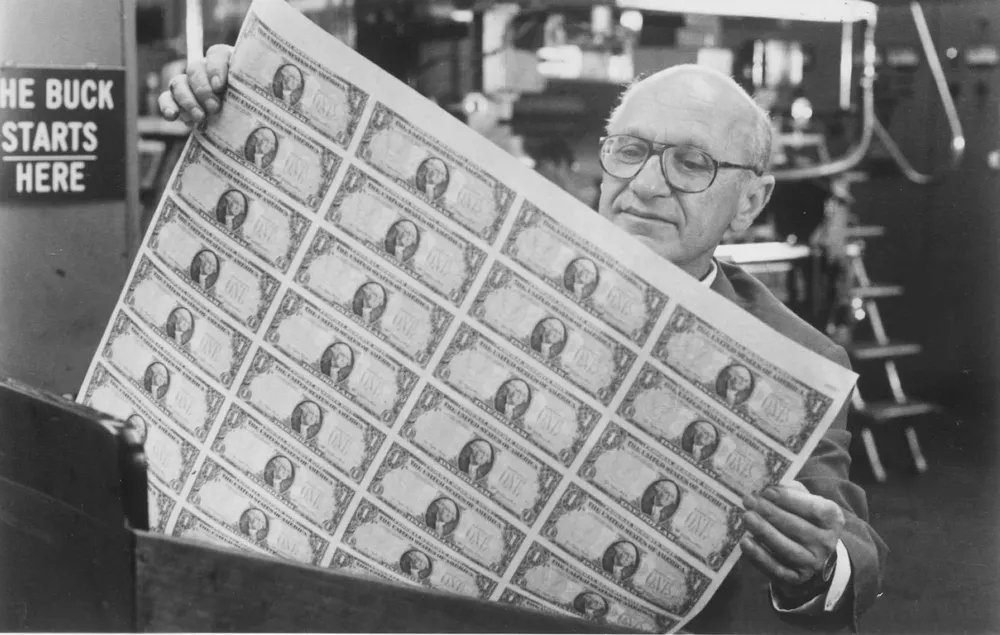
Milton Friedman’s good repute among American conservatives is a monstrous hoax. Now that Federal Reserve Chairman Paul Volcker has thrown the U.S. economy into a 1930s-level depression by applying Friedman’s monetary theories, it is imperative that Friedman’s economics be thrown out along with the Carter Administration.
The New Benjamin Franklin House has announced the release in paperback of The Ugly Truth about Milton Friedman, by Lyndon H. LaRouche, Jr. and David Goldman. The book is the first serious intervention against the hoax that Friedman represents as economic science.
Excerpted below are portions of the book’s opening chapter, which locates Friedmanism as fascist economics pure and simple.
You want to prove that Milton Friedman is a fascist? It’s easy. Quote him.
—Prof. Arthur B. Laffer of the University of Southern California, in conversation with the authors.
Milton Friedman’s public record defense of Nazi Economics Minister Hjalmar Schacht and his eerie justification of Hitler’s economic methods published twenty-five years ago should have set off alarms in the minds of his readers. Statements of this nature are more than a reflection of the man’s character. Fascist economics is the ultimate response, or “final solution,” for an economy that monetarist mismanagement has thrown into apparently hopeless crisis. There is a thin line between monetarism in general and fascist economics as such. Among the leading monetarists, Friedman is the one with the least compunction about crossing that line.
Germany’s economic breakdown crisis in 1933 was not, in fundamentals, far different from what the United States is experiencing now. Nine years before the great 1931 international economic crisis, Hjalmar Schacht had performed the misnamed “miracle” of ending the great hyperinflation of the early 1920s. What Schacht had in fact done was to negotiate credits from his friend Montagu Norman, the governor of the Bank of England, in return for handing over the German economy to London. Germany stopped investing in industry by written agreement with its British creditors, and became a speculative fairground for short-term British capital. The international monetary crisis of 1931 brought the German economy down, and Hitler’s SS became the bill-collectors for Germany’s delinquent account, before it struck them that they could do some collecting on their own.
Nine years ago, the Nixon Administration took Milton Friedman’s advice and removed the link between the dollar and gold. The August 15, 1971 monetary debacle turned the American economy into a speculative fairground for the City of London. The devalued dollar ceased to be a vehicle for productive investment, and hundreds of billions of dollars piled up in the City of London, in the so-called Eurodollar market. Now valued at $1.2 trillion, larger than the U.S. money supply, the Eurodollar market is the primary cause of double-digit inflation in the United States.
Federal Reserve Chairman Paul Volcker, the Undersecretary of Treasury who fought for the end of the dollar-gold link in 1971, took Milton Friedman’s advice once again in October 1979. Instead of concerning himself with interest rates in the future, Volcker announced in what the press called “the Saturday Night Massacre” that the Federal Reserve would hold down the rate of growth of the money supply—period….
America, like Germany in the 1930s, is undergoing a monetary crisis, but the monetary crisis is the form of a crisis in the underlying physical economy. Since approximately 1967, America’s investment in both capital goods and labor has been insufficient merely to replenish our existing capital stock and skilled labor pool. The authors conducted a survey through the Executive Intelligence Review demonstrating that per-annum capital investment was $50 billion short of the annual depreciation requirements of industry in 1979: the condition of the American labor force is a national scandal. Since 1971, the financial flow of capital has been concentrated into nonproductive, often speculative investment, under the policy slogan “post-industrial society.” The rate of growth of demands for income in the form of debt service in the nation’s economy (and internationally) has become an inflationary cancer, outstripping the economy’s ability to produce real profit in the form of a surplus of tangible wealth.
Monetarist economics invariably produces such crises by suppressing capital investment. At the point of crisis, the choices available are only two: Either the economy undergoes general financial reorganization in favor of relaunching the economy’s productive potential—the solution associated with LaRouche and Jacques Rueff—or the economy must be cannibalized to protect the failing financial structure. Since the second option requires political methods that, as William F. Buckley said in 1971, “cannot get a sufficient exercise in democratic situations,” we call that option by its German and Italian name: fascism.
Hjalmar Schacht did more or less exactly what Paul Volcker, under Milton Friedman’s guidance, is doing now: impose a regime of “fiscal austerity” on the German economy, crush consumption, and maintain tight conditions on the credit markets. Neither Schacht nor his admirer Friedman makes an attempt to halt inflation. Their method is this: If, for example, there is an annual 10 percent inflation, then the economy must make up for that inflation by gouging an additional 10 percent each year out of the flesh and bone of the productive economy.
The analogy to this sort of method is given by the case of a loan-sharking victim. In a hypothetical case, illustrating the general principle encountered, a person with $20,000 earned income incurs $5,000 in debt service payment obligations to a loan shark. Unable to pay all of the $5,000, the victim “refinances” $2,000 of the debt service payment at 50 percent effective annual interest. He pays the $1,000 instead of the $2,000 portion of the $5,000: a total of $4,000. The following year, he owes $6,000 in current debt service, instead of $5,000. The next year $7,000, and so forth.
That is Schacht’s, and Friedman’s, “monetarist” approach to “fighting inflation.” That is the fascist economics policy Friedman applied to Chile under the Pinochet dictatorship—a dictatorship now contemplating ways for cutting out the growing ratio of “useless eaters” among its citizens.
What drives fascist economies in practice is the political economy of military power. Physically depleted economies are hollow shells from a military vantage point. A nation’s capacity for warfighting in depth depends on its ability to deploy productive resources for military purposes. A healthy economy can afford even extraordinary levels of military expenditure; during the Second World War American home consumption actually rose, despite the enormous cost of military production and diversion of manpower into the armed services. Military production as such tends to expand the capital-goods industries that are essential for improving the national stock of fixed capital, creating a “productivity spinoff” that benefits the civilian sector. That is also the experience, for example, of the National Aeronautics and Space Administration.
However, an economy depleted by Friedmanite methods cannot sustain military production in depth; it must rely on shallow “in-width” military production and blitzkrieg methods of war-fighting. Fascist economies simultaneously loot their own productive base, while devoting massive amounts of resources to war-autarky expenditures. To ensure that “energy autarky” and military programs receive first access to limited supplies of credit, Schacht created an array of special financing institutions, including the infamous “Mefo-Institut,” with the equivalent of unlimited check-cashing privileges at his Reichsbank. The Carter Administration has done essentially the same thing through the Energy Security Corporation, the Synthetic Fuels Corporation, and other Schachtian “off-budget” institutions.
Friedman’s Defense of Hjalmar Schacht
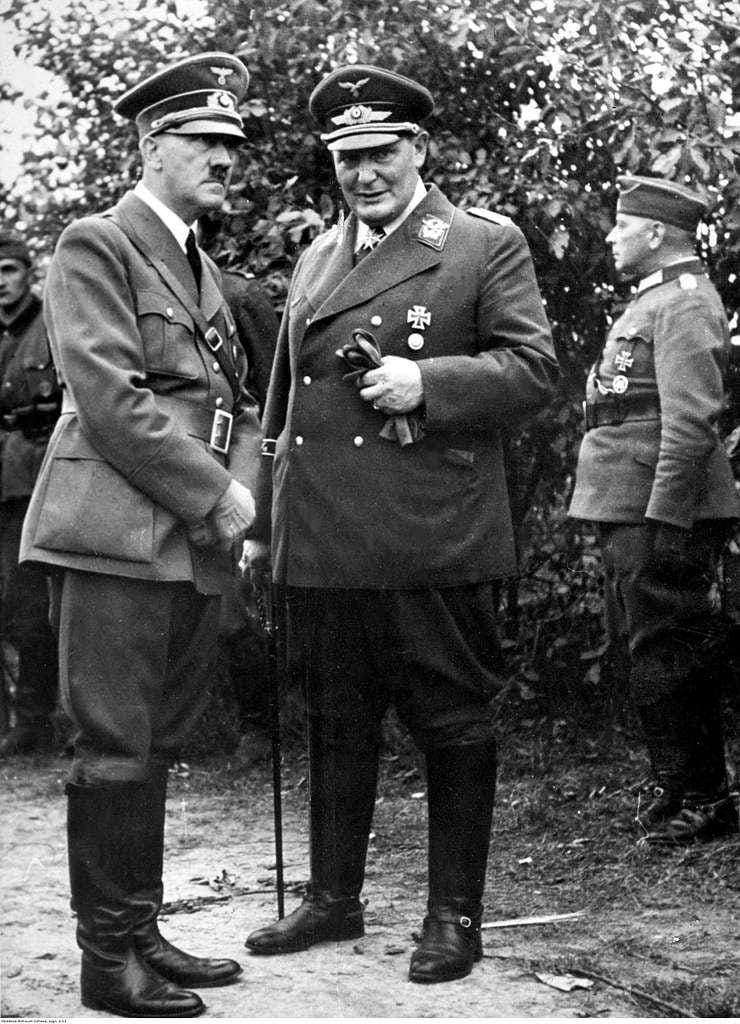
Since the demise of the Nazi regime and the post-war studies of the Allied Strategic Bombing Survey, Friedman and other monetarists have devoted special attention to the Nazi economy, including the internal debates among its leaders. The center point of this discussion is the 1938 economic crisis during which Field Marshal Hermann Göring dumped Schacht from the Reichsbank and Economics Ministry, and took over plenipotentiary economic powers. The issue was whether the Nazi regime could continue to cannibalize its capital and workforce to produce weapons, as Hitler and Göring insisted it must, without leading to an internal economic collapse, as Schacht finally admitted it would. The Nazis obviated the internal effects of the crisis produced by five years of Schacht’s “economic recovery” by conquering their neighbors. Gold from the Austrian central bank supported the decimated Reichsmark after the 1938 Anschluss, and the Nazi war machine temporarily thrived on Czech, Dutch, Belgian, and French plant and equipment, and on the 14 million slave laborers murdered at the work camps….
To a sane, moral person, the differences between Schacht and Göring are the equivalent of a factional debate between the eighth and ninth circles of Dante’s Hell. Göring is arguably more satanic than Schacht, but it is Schacht’s policies that made Göring’s war machine possible.
Two standard works have come from the ranks of Field Marshal Göring’s American admirers. One is Germany’s Economic Preparations for War, by RAND Corporation analyst Burton H. Klein, published in 1958 by the RAND Corporation. The second is Studies in the Quantity Theory of Money, written two years earlier by Milton Friedman and colleagues. The two works are complementary. Klein, drawing on similar conclusions reached earlier by the Strategic Bombing Survey, argued that Germany devoted insufficient resources to her war mobilization because of Schacht’s unfounded concern over inflation. Friedman and his graduate student, John J. Klein, attempt to demonstrate that Schacht’s fears of an internal inflationary explosion were unfounded, because “the German economic controls system was successful not only in restricting individual spending but also in inducing individuals to hold their accumulating assets in the form of cash.”
The John J. Klein paper, entitled “German Money and Prices, 1932-1944,” was written during the early 1950s as a doctoral dissertation under Friedman’s direction at the University of Chicago. The 1956 volume also contains studies of hyperinflation in post-war Europe and in the American Confederacy, along with other studies of war-related economic breakdown.
Burton Klein was rather more overtly hostile to Hjalmar Schacht than were Friedman and his students, concluding:
There is no doubt that without this concern for inflation, and without such an effective exponent of financial conservatism as Schacht, Germany would have had a larger rearmament…. Procuring additional funds by borrowing, it was thought, would destroy confidence in the economy and lead to an inflation. The fear of inflation weighed heavily in the policy decisions of the whole decade. The German leaders simply did not at this time understand the elementary economic lesson that a nation can finance anything which can be produced.
Friedman: ‘Nazism Worked’
The argument is certifiably lunatic, as we shall prove below: If a nation expends its entire investment resources on nonproductive expenditures, deducting the cost of those expenditures from the maintenance fund for the labor force and industrial plant, the consequences will be first hyperinflation, and then breakdown.
But Milton Friedman’s analysis, from the vantage point of the “quantity theory of money,” goes even further off the deep end. Unlike Burton Klein, he ignores the physical problems of wringing war materiel out of a depleted economy, and adopts a single criterion for the success or failure of the Nazi economy: whether it succeeded in maintaining price stability. What is remarkable, the paper concludes, is that the Nazis managed to hold the increase of wholesale prices between 1932 and 1944 to a mere 22 percent, or less than 2 percent per year, despite the fact that the money supply rose over the same period by 437 percent. In Studies on the Quantity Theory of Money, Friedman states point-blank that Nazism worked:
Germany did not choose to pay for its increased expenditures by taxation. Nor did it urge individuals to invest in government securities. It did, however, borrow heavily from the German banking system. To avoid a price boom, and simultaneously to have ready access to the credit market, the German government imposed economic controls. First wage, price, and credit controls and then rationing. Eventually Germany became a directed economy.
The objective of such controls is the restriction of spending on the part of individuals, so that individual spending will increase less rapidly than the quantity of money. Such a policy, if rigorously enforced, should restrain a rise in the price level. As indicated earlier, this policy appears to have been successful in Nazi Germany.
Friedman’s explanation for this “success” is horrifying. In his “quantity theory,” the effect of Nazi territorial annexations is to reduce the problem of excess money creation, by spreading the same amount of money over a larger population!
The Reichsmark was made legal tender in Austria in April 1938; in Sudetenland in October 1938; in Memel territory in March 1939; in the Free City of Danzig in September 1939; in East Upper Silesia in September 1939; in the Annexed Eastern Provinces in November, 1939; in Eupen, Malmedy, and Moresnet in June 1940; in Luxembourg in February 1941; in Alsace and Lorraine in March 1941; in Carinthia, Carniola, and Lower Styria in June 1941; and in Bialystok in January 1942. The above areas were directly incorporated into the Reich. The Reichsmark was also made legal tender in the Protectorate of Bohemia-Moravia concurrently with the Czech koruna.
Carefully noting these events. Friedman concludes:
For the purposes of this study it has been assumed that the amount of money issued for the newly annexed areas was the same percentage of total hand-to-hand currency as the population of their areas was of the new total population; this assumption is then used to estimate the stock of money in the territory of 1937 Germany.
In their perverted way, John Klein and Milton Friedman are making a correct point: The annexations did buttress the value of the Reichsmark, which, in 1938, stood on the verge of inflationary collapse. However, it was not the fact that the Reichsmark went out of “old Germany” into new populations, but the fact that new populations were brought into Germany in cattle cars, that prevented the Nazi economic system from breaking down.
In the “Blitzkrieg” economy, where existing (and antiquated) industrial plants spew out “production in-width” of existing technological models, the only economic recourse is the cannibalization of the workforce. That is the content of the downward revision of the German money supply statistics to take into account annexed populations, which Friedman et al. factor into the Nazis’ “success.”
In an October 15, 1941, remark to his Berchtesgaden cronies, Hitler put Friedman’s arguments in a slightly more honest fashion: “Even to Schacht,” Hitler said, “I had to begin by explaining this elementary truth: that the essential cause of the stability of our currency was to be sought for in our concentration camps.”
Anti-Inflation—Mass Murder
Having proven that Nazi policies worked by virtue of the stability of the wholesale price index, Friedman and his co-authors prefer Göring to Schacht, and prefer Albert Speer, who replaced Göring’s stooges at the Economics Ministry in 1942, to Göring. They quote favorably the evaluation of the Strategic Bombing Survey that the Göring Economics Ministry “expressed the general attitude that sacrifices of the civilian population should be kept at a minimum. It tried to equilibrate the divergent claims of the industrialists, the military, the gauleiters…. High-cost firms were protected, production of superfluous civilian goods continued, and scarce materials allocated to nonessential programs.” Therefore, Friedman writes:
German authorities realized after the Battle of Stalingrad in December 1942, that current economic policies were not resulting in the production of armaments sufficient to insure success in the new phase of the war. For this reason, a New Ministry of War Production was created. Albert Speer as its head had almost unlimited control over the industrial resources of Germany. His assistants for the most part were young managers of efficient business enterprises. At this late date industrial capacity could not be expanded. The only alternatives were either to restrict civilian consumption or to improve the use of existing industrial capacity. He took the latter course and achieved significant increases in armaments production.
Precisely how Speer accomplished this, Friedman does not report: The 250 percent increase in arms production Speer accomplished between 1942 and 1944 was the result of the most systematic collection and mass murder of slave laborers in human history.
Speer rejected the crude mass extermination program Göring had proposed under the code-name “Green File,” in favor of more efficient methods of working slave labor to death. Göring’s secret orders had stated:
Many tens of millions of people in the industrial areas [of Russia] will become redundant and will either die or have to emigrate to Siberia. Any attempts to save the population from starving to death by bringing in surplus food from the black-soil region can be made only at the expense of feeding Europe. They undermine Germany’s ability to hold out in the war…. There must be absolute clarity on this point. From this fact there follows forcibly the extinction of industry as well as of a large percentage of the human beings.
Despite the tendency toward hyperinflation under fascism, it is possible to suppress inflation, at least for some period of time, as Milton Friedman said in his now-classic study of Nazi economics. In a 1976 discussion with LaRouche, the French economist Jacques Rueff proposed an alternative definition of fascist economics as “inflation turned inward against the economy,” leading to the same conclusion as LaRouche’s different approach. Instead of absorbing the consequences of massive nonproductive spending through increasing price levels, the Nazi economy absorbed these consequences by cannibalizing the economy’s own flesh and bone, turning inflation inward. Rueff’s definition is precise and correct, and stands in striking contrast to Milton Friedman, who leaves the consequences for the real economy out of his analysis altogether….
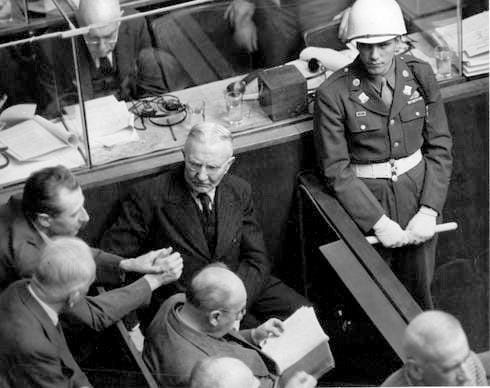
Hjalmar Schacht was a monumental liar—witness his performance in the dock at the 1945 Nuremberg War Crimes Tribunal. But Milton Friedman makes him look like a man of integrity. The two factions among the Nazi economic planners (and their present-day disciples) can be characterized as those who merely want to lie to the public, in the deeper sense of Rueff’s analysis, and those who want to lie also to themselves.