(閱讀中文)
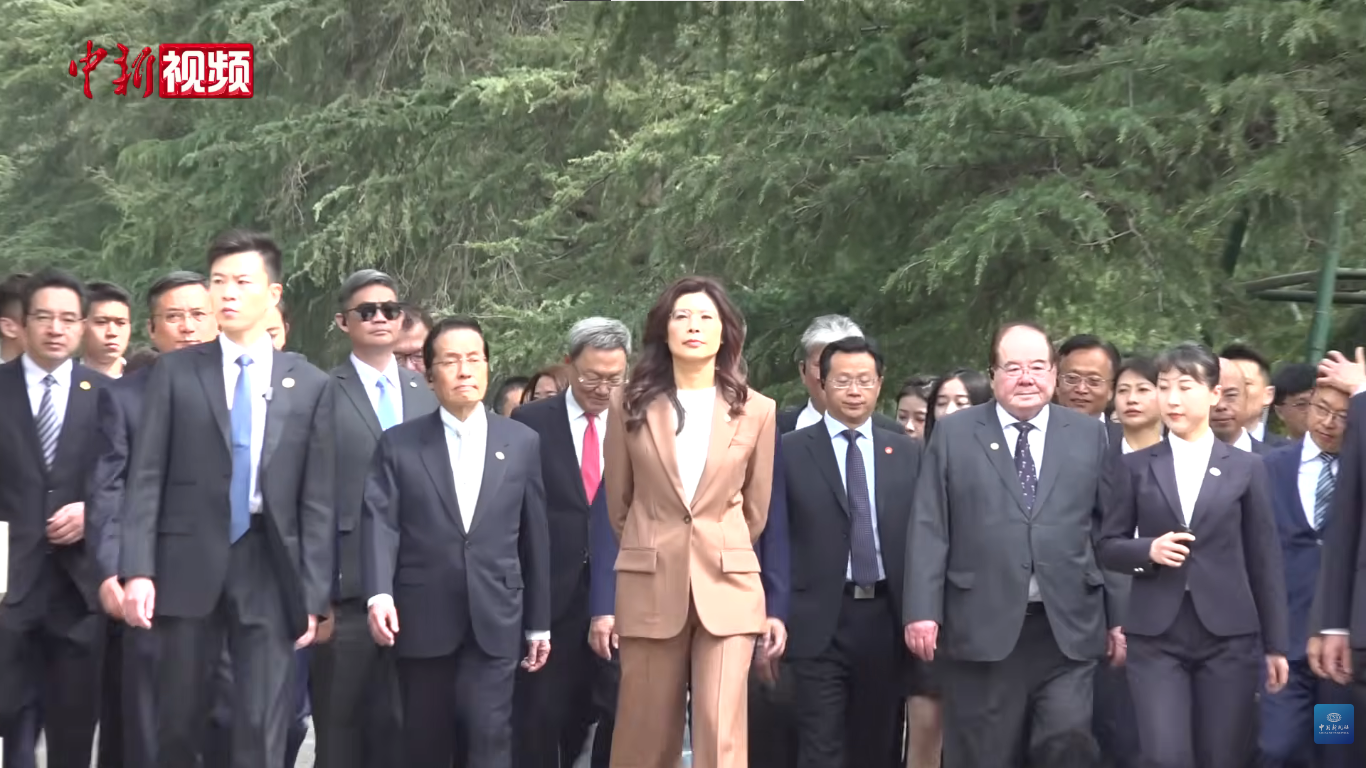
On the morning of April 10, inside the Great Hall of the People, Kuomintang Chairwoman Cheng Li-wun and Chinese leader Xi Jinping shook hands for fourteen seconds before the cameras. It was the first meeting between the heads of the KMT and the Communist Party of China in ten years, and the highest-level cross-strait contact since former Republic of China President Ma Ying-jeou met Xi in Singapore in November 2015. Cheng had come with a dozen party officials for a six-day visit through Shanghai, Nanjing and Beijing—the clearest message in a decade that the Taiwan Strait need not remain a chessboard for external powers.
From Independence to ‘I Am Chinese’
Cheng's path to the Great Hall is itself a parable of Taiwan’s shifting political currents. A former member of the Democratic Progressive Party (DPP) who once supported Taiwanese independence, she was elected KMT chairwoman in October 2025 with over 50 percent of the vote in a six-way race. In her victory speech she spoke of a future in which Taiwanese people could proudly say, “I am Chinese,” and told the island that “Taiwan must not be a sacrificial lamb on the altar of geopolitics.” “We must think of the future prosperity of the 23 million people in Taiwan, dissolve the tensions and contradictions across the Taiwan straits and make sure there isn’t war,” she said. Xi Jinping sent congratulations.
She took the KMT reins at a moment of DPP exhaustion. Through July and August 2025, DPP-aligned organizers tried to flip the legislature by mounting recall drives against 31 of the 54 KMT legislators, hoping to hand President Lai Ching-te a legislative majority without an election. Not a single legislator was recalled; in the final round, votes against the recalls ranged between 64 and 69 percent. In December, Lai's $40 billion special defense budget was blocked yet again by KMT and Taiwan People's Party lawmakers in procedural committee—a pattern they have repeated multiple times since Lai first proposed it. “The KMT's resolute position,” said caucus secretary-general Lo Chih-chiang, “has been to invest in combat readiness, but also to invest in peace.”
A Journey of Peace, Reprised
Cheng and her delegation flew from Taipei to Shanghai on April 7, where they were met by the mainland's Taiwan Affairs Office and boarded a high-speed train to Nanjing—capital of the Republic of China from 1927 to 1937 and again from 1946 to 1949. At her welcome banquet, Cheng laid out four meanings for the trip: that political differences need not end in war; that the “1992 Consensus” remains the basis for exchange; that cross-strait peace is the most beneficial path for the Taiwanese people; and, pointedly, that Taiwan “should not become a pawn—or even a discarded piece—in geopolitical games.”
Cheng had been to Nanjing in that role before. Twenty-one years earlier she accompanied then-KMT Chairman Lien Chan on his April–May 2005 “Journey of Peace,” the first visit by a senior KMT leader to the mainland in sixty years. Lien’s meeting with Hu Jintao at the Great Hall of the People opened the way to the 2008–2016 “golden era” of cross-strait exchange under Ma Ying-jeou, when some ten million people moved across the Strait each year. Ma himself met Xi twice—in Singapore in November 2015 (when both were serving as president), and again in Beijing in April 2024—keeping a thin party-to-party channel alive even after the DPP took office and official cross-strait communications effectively froze.
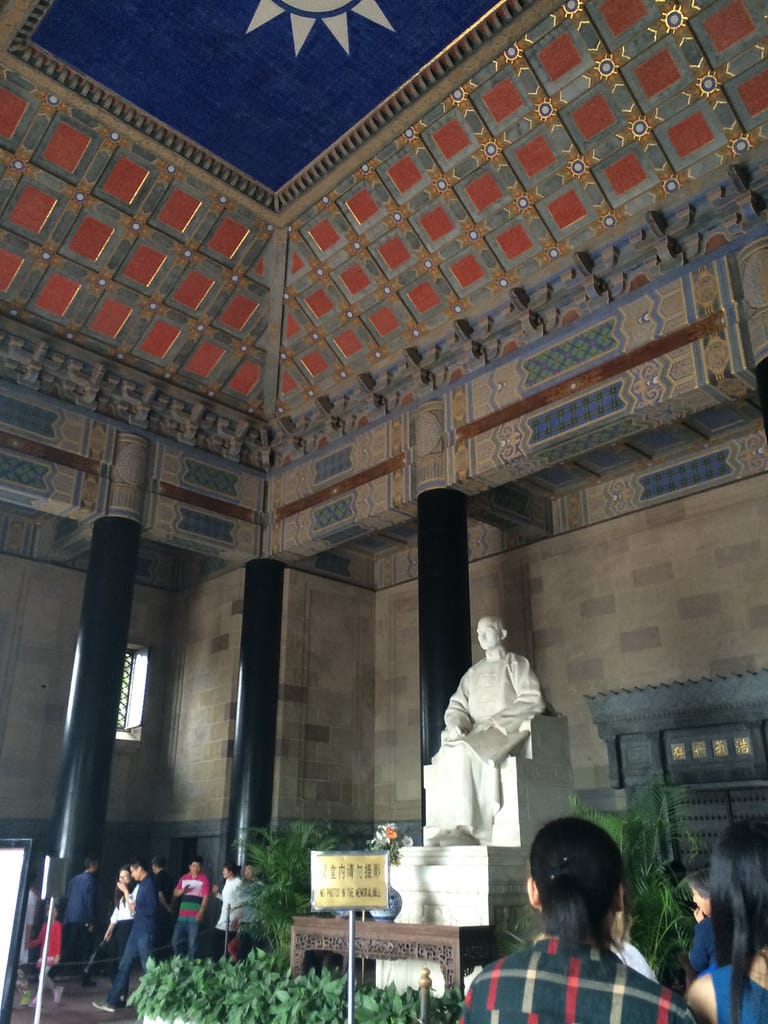
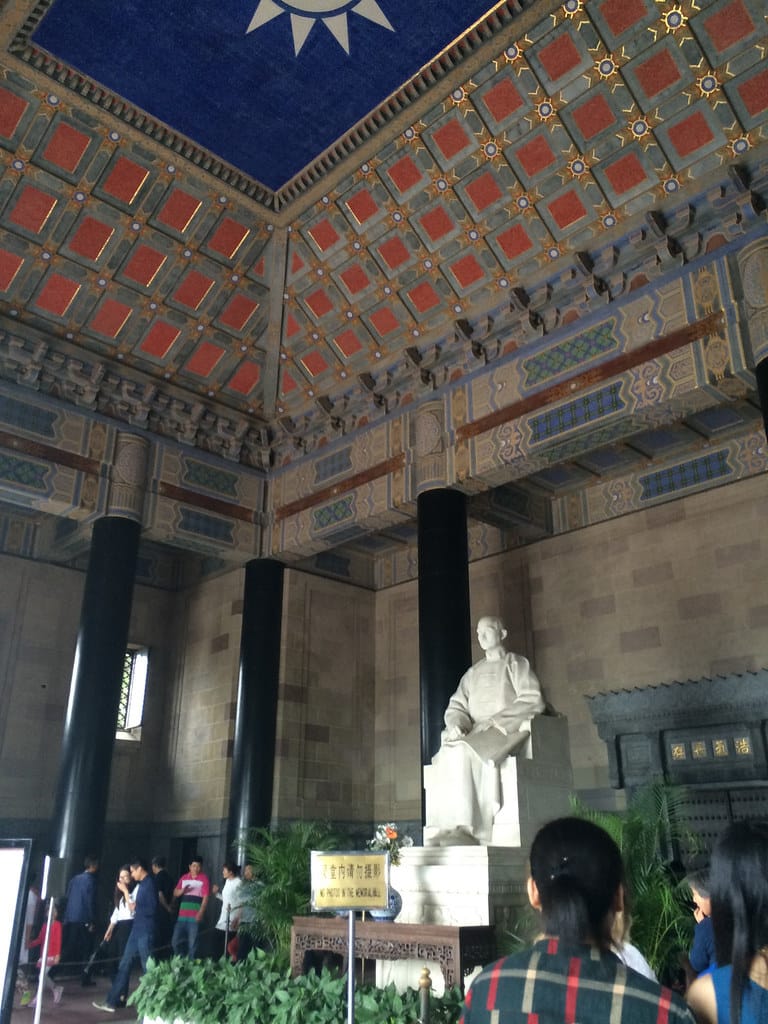
On April 8, the second day of her trip, Cheng climbed the 392 steps of the Sun Yat-sen Mausoleum in Nanjing, as she had done in 2005 with Lien. The KMT’s ceremonial text, read aloud by spokeswoman Jiang Yizhen, opened with the date rendered in the Republic of China calendar—“the eighth day of the fourth month of the 115th year of the Republic of China”—a statement asserting the ROC's existence, read on mainland soil, in front of a CPC escort. Cheng was on the verge of tears during her own speech. Sun Yat-sen, she said, had “founded Asia's first democratic republic, the Republic of China”; the KMT, under his Three Principles of the People, built Taiwan, Penghu, Kinmen and Matsu “into a free and democratic society.” (Taiwan’s Mainland Affairs Council responded that the mausoleum is “the only special protected zone where the CPC allows the KMT to mention the Republic of China,” and that those remarks would not reach the mainland’s 1.4 billion people.)
The Great Hall
Two days later, in Beijing, Cheng called on both parties to “transcend political confrontation” and build institutionalized mechanisms for dialogue grounded in the 1992 Consensus—the modus vivendi under which each side accepts there is “one China” while leaving the exact meaning open. She expressed hope that “the Taiwan Strait will no longer become a focal point of potential conflict, nor a chessboard for external powers,” and closed with a personal invitation no KMT chair had ventured before: “I sincerely hope that one day in the future, I will have the opportunity to be the host and welcome General Secretary Xi and all of you here present in Taiwan.”
The Xinhua account of Xi’s remarks emphasized that “compatriots on both sides of the strait are Chinese people and one family” and that “the overarching trend toward the great rejuvenation of the Chinese nation is irresistible.” Xi also stressed that achieving peace and better lives was “a responsibility that the CPC and the KMT cannot shirk.”
Perhaps more striking was what Cheng reported at a subsequent press conference: that Xi had told her “the Mainland respects Taiwanese compatriots’ social system and their chosen way of life, which are different from those of the mainland,” and said of her proposals—which included Taiwan's re-entry to bodies like the World Health Assembly—that “every single one of them could be actively and comprehensively studied, coordinated, and facilitated.”
Ten Measures, Two Reactions
On April 12, the day Cheng’s delegation flew home, the mainland’s Taiwan Work Office announced a package of ten measures to boost cross-strait exchanges: the full resumption of regular direct passenger flights, individual travel to Taiwan by residents of Shanghai and Fujian, easier mainland-market access for Taiwanese agricultural and fishery products, a regular communication mechanism between the CPC and the KMT, and an institutionalized platform for bilateral youth exchange. State media framed the package as tangible proof of Beijing’s goodwill.
The reception in Taiwan divided along exactly the lines one would expect. Cheng, returning to Taipei, said the measures would benefit aquaculture, tourism and other sectors and would let Taiwanese people “enjoy the dividend of cross-strait peace and development.” KMT Vice Chairman Chang Jung-kung described the package as “a gift” reflecting the mainland’s sincerity. President Lai's Mainland Affairs Council, by contrast, urged caution, noting that similar overtures have been “repeatedly opened and suspended” in the past and warning that “without any institutional safeguards for Taiwan's industries, farmers, fishers or the rights and interests of the public, the measures are highly risky.” The MAC charged that Beijing was trying to sideline Taiwan’s elected government by routing cross-strait business through a KMT-to-CPC, “one China” framework. DPP legislator Fan Yun called Cheng’s Beijing remarks “a letter of surrender,” and Lai wrote on Facebook that his government supports peace “but not unrealistic fantasies.”
Ahead of Trump
The timing was not incidental. Cheng’s trip precedes Donald Trump’s planned May 14–15 summit with Xi in Beijing by five weeks. The $11.1 billion Taiwan arms-sale package Trump announced in December 2025 has stalled at the State Department on White House instruction, and Taiwan is expected to be a central topic of the Trump–Xi meeting. By going first, and by reopening a direct channel between Beijing and what is currently Taiwan’s principal opposition party, Cheng has ensured that when Trump sits across from Xi, Washington and the DPP government will not be the only voices speaking for Taiwan. Lai has meanwhile sought to raise Taiwan’s defense spending to 3 percent of GDP, and eventually to 5 percent, as Trump has demanded, and has watched a further $165 billion of TSMC investment flow to the United States, with Commerce Secretary Howard Lutnick now pressing for $300 billion. Washington is extracting leverage, and Taiwan is paying the bill.
Taiwan-based analyst Angelica Oung summed Cheng's trip up neatly: “We restored the status quo we had under Ma. Of course, KMT is not in power right now. But Cheng convinced the mainland that it's possible.” Even if the KMT loses the 2028 presidential election, she added, the détente could hold if the DPP signals willingness to respect it—and by then, Taiwan's dependence on the United States as security guarantor may look even less tenable.
This is the best way to phrase what happened today. We restored the status quo we had under Ma. Of course, KMT is not in power right now. But Cheng convinced the mainland that it’s possible.
— Angelica 🌐⚛️🇹🇼🇨🇳🇺🇸 (@AngelicaOung) April 10, 2026
Some say “well what happens in 2028 if the KMT loses?”
I think if the DPP signals that… https://t.co/PHtlwjtv8G
Taiwan Off the Chessboard
That last point was sharpened the next day by Fudan University's Zhang Weiwei and former KMT legislator Chien Joanna Lei on an April 11 “Cross-Strait Roundtable.” Zhang argued that U.S. hegemony has collapsed on three fronts simultaneously—militarily, in its alliance system, and morally—and that the Iran war has finished off the “end of history” thesis. Lei identified three “strategic misalignments” in Lai's approach: turning Taiwan from a potential bridge into a frontline conflict point; adopting a “peace through strength” posture that is absurd given the military gap with the mainland; and, most dangerously, outsourcing security to external forces at the cost of Taiwan's own agency. Without a substantive second track of cross-strait communication, she warned, the outside world will assume “the DPP speaks for all of Taiwan.”
That is precisely what Cheng’s trip ensured would not happen. Cross-strait communications had been almost entirely frozen during a decade of DPP rule. The KMT chairwoman went to the mainland, spoke plainly, invited Xi to Taiwan, and came home with ten tangible measures for fishermen, farmers, young people and travelers on both sides of the Strait. The framing that has dominated Western discussion of Taiwan—the island as a chessboard, a tripwire, a forward-deployed U.S. asset—looks thinner after her six days on the mainland. A different future is imaginable: one in which the people on both sides of the Strait, rather than external powers, determine their own destiny. People on both sides of the Strait have built societies they have reason to be proud of—and they have far more to gain from recognizing and building on one another’s accomplishments than from being conscripted into someone else’s confrontation.