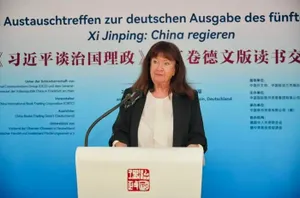

Less than 24 hours after President Donald Trump announced that he would delay a new military campaign against Iran, Helga Zepp-LaRouche appeared on state broadcaster Pakistan TV with an urgent call to action. This pause in military activity is a reflection of how much is at stake, she noted, with many countries, including Pakistan, “extremely active to try to get a negotiated settlement.” A continued blockade of the Strait of Hormuz means a “depression” for the world economy, and renewed hostilities “could lead to a global nuclear war.”
The host then gave her the opportunity to describe the international mobilization for a combined security and economic architecture for the entirety of Southwest Asia, as a vital proposal leading into the May 26 UN Security Council’s special session. Zepp-LaRouche discussed how this emerged from the recent May 15 EIR Roundtable, where former Turkish Prime Minister Ahmet Davutoglu proposed a “regional comprehensive security arrangement” for Southwest Asia—an idea which she had suggested be combined with the Schiller Institute’s emphasis on an extended Oasis Plan of economic development. “You have to have economic security,” Zepp-LaRouche told the Pakistan TV host. “In other words, any kind of security architecture can only work if it’s combined with economic development… only if you inject a perspective of economic prosperity, in which all the countries of the region can participate, is there a chance of peace.”
This lays out the perspective for the next five days before the May 26 special session, as a positive resolution in Southwest Asia would be a crucial step in reorienting a world headed toward the abyss. And none too soon. Despite claims of negotiations with Iran by President Trump, there seems to be little in the way of real progress between the two sides. Trump himself has pledged to renew the strikes in 2-3 days if Iran does not accept his terms, leaving the likelihood of renewed military conflict high. To counteract this, international diplomacy is at an extraordinary level. In addition to the reported calls by Saudi Arabia, Qatar, and the UAE to the White House, Egyptian Foreign Minister Badr Abdelatty has held a series of discussions since last weekend, speaking to his counterparts in Saudi Arabia and Qatar, as well as to Trump’s special advisor, Massad Boulos. Meanwhile, Russia and Pakistan held a Consultative Group on Strategic Stability in Moscow on May 18.
At the same time, the situation around Ukraine is again becoming a major flashpoint for disaster. Russia’s Foreign Intelligence Service on May 18 alleged that the government of Latvia has agreed to let Kiev launch drones from the Baltic country’s territory, to strike deep into Russia. If that happens, it warned, NATO membership will not protect Latvia from a “just retribution,” and went on to list the locations in Latvia where Ukrainian drone forces are now stationed. Similarly, Lithuanian Foreign Minister Kastutis Budris threatened an attack on Russia’s exclave Kaliningrad in a recent interview, saying: “We have to show the Russians that we can get into their little fortress that they built in Kaliningrad.” Lithuania is also reportedly considering joining NATO’s nuclear umbrella, and changing its constitution to allow nuclear weapons to be stationed on its territory.
Russia’s Chairman of the State Duma Committee on International Affairs, Leonid Slutsky, responded by warning that the actions of the “hotheads” in the Baltics “is fraught with the most serious consequences for these countries,” adding that an attack on Kaliningrad means Russia’s nuclear doctrines “will inevitably come into play.” And if the message wasn’t clear enough, Russia began large-scale strategic nuclear exercises on May 19 involving 8 out of 12 of its fleet of strategic nuclear submarines.
These examples illustrate the dangerous state in which the world finds itself today. In the face of the world finally moving away from 500 years of colonialism and unipolarity, some in the West would rather go to global war than accept such a transformation. This dangerous trajectory must be stopped.
It’s of note that three key world leaders—Donald Trump, Vladimir Putin, and Xi Jinping—all will have convened in Beijing over the last week, presumably discussing some of these weighty topics. Hopefully, these strengthened relationships can at least open the door to a more rational approach, and give urgent assistance in orienting President Trump. The vote in the U.S. Senate to advance the War Powers resolution against his Iran war is certainly an important step.
Either way, the May 26 UN Security Council special session is a unique opportunity to introduce a new concept into the strategic situation. Join the mobilization, and be sure to distribute Helga Zepp-LaRouche’s open letter in the lead-up to the event.