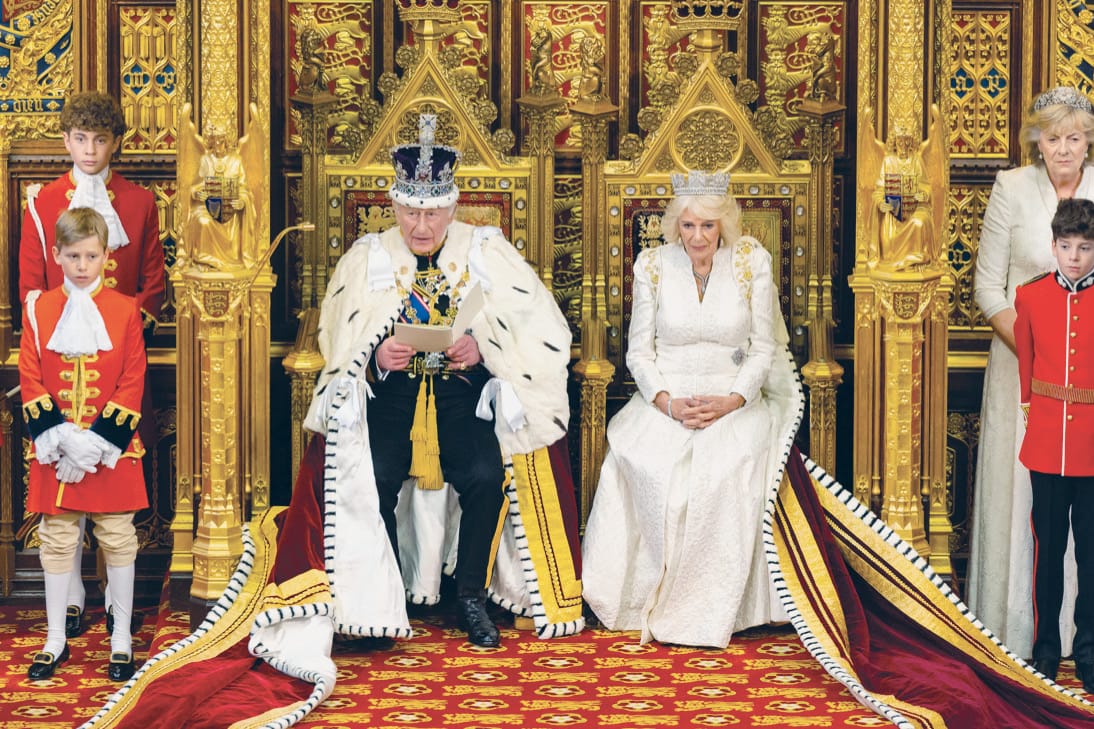
May 14—As unconvincing as the “I’m alright, Jack” pronouncements of the caricature of the common downtrodden Englishman, the long-running theater of the British monarchy hit a new low this week, when the United Kingdom’s King Charles III opened the session of Parliament May 13 for the new parliamentary year. Looking distinctively ridiculous and uncomfortable in his official robes, with the heavy imperial crown perched oddly on his head, Charles labored through the government’s agenda, reading through a list of thirty-seven bills for passage and implementation in the coming session in a dispassionate but allegedly authoritative monotone. There was a passing moment of suspense over whether the traditional speech might be postponed, as the government which drafted it might soon be out of office, but the puppeteers of the government insisted the “show must go on.”
Despite warnings of the deepening of the fiscal crisis facing the kingdom—there is no money, no growth, and the national debt has reached 100% of GDP—there is a refusal to address the cause for this, i.e., the end of the era of 500 years of European colonialism which allowed the colonizers to provide for the minimal needs of their populations by looting their colonies. The City of London stands behind this system, allowing debate to occur on “process,” on “following the rules” as UK Prime Minister Keir Starmer often repeats, rather than addressing the cause. As a result, political choices are limited to profiled “debates” over meaningless distinctions between “left” and “right” solutions.
Thus, while Starmer won a huge mandate in 2024 by insisting he would end the “carousel of chaos” which he attributed to the Tories, this now seems to describe rule by his Labour government. Starmer is the seventh Prime Minister in ten years, another in the line of those described by the senior political commentator of the Telegraph, Annabel Denham, for whom politics is a “job creation scheme” for people who lack “not just a guiding philosophy but the intellectual curiosity to form one.”
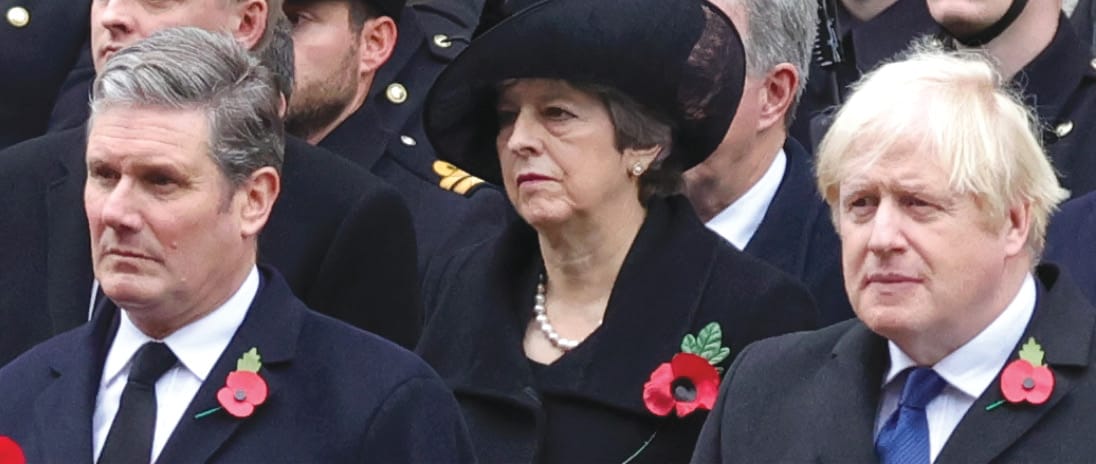
This is an adequate description of Wes Streeting, who just resigned today as Health Secretary, in the leadership contest to replace Starmer. Streeting said that it would be “dishonorable and unprincipled” to remain in Starmer’s government. Streeting calls himself a “fiscal realist,” guided by what Denham called a “pragmatic willingness to involve the private sector in public services.”
In reality, this so-called pragmatism is in keeping with the post–Big Bang economic consensus brought in by Prime Minister Margaret Thatcher in the mid-1980s and continued by Prime Minister Tony Blair. The “Third Way/New Labour” policy of Blair hangs over the politics of the UK as a strait-jacket of consensus. With its corporatist mantra of “less government, reduced regulation, privatization, and public-private partnership,” it diverts attention away from its ultimate purpose of defending a global zero-growth policy amenable to the imperial vulture capitalists of the City of London. It was introduced by Blair as a modified Thatcherism, described in a study of Blair’s “Third Way”[1] as a “vacuous … thinly veiled neoliberalism.” In a victory speech delivered on May 2, 1997, Blair exclaimed “Today we are charged with the deep responsibility of government. Today, enough of talking—it is now time to do.”
Starmer channeled Blairite talking points in the aftermath of his 2024 landslide victory. “This vote,” he claimed is a “huge mandate to look for change.” He and his allies are still looking!
The Living Ghost of Blair
The backdrop is the chaos unleashed by the unprecedented thrashing delivered to the Labour Party in the English Council/local elections on May 7. Labour lost more than 1,100 seats, a complete reversal of the mandate received by Starmer in the national elections two years earlier, when Labour won 411 out of 650 seats in the House of Commons. Following the May 7 vote, 90 Labour Members of Parliament (MPs) have called on Starmer to resign, with four government ministers among them. The Home Secretary called on Starmer to provide a timetable for an orderly transition, with Streeting emerging as the favorite.
Yet Starmer is steadfastly refusing to go. In the tradition of Tony Blair—who created “New Labour” with his Epstein-class buddies—he told The Guardian that Labour “must respond to the message the voters have sent us, that doesn’t mean tacking right or left.” He concluded his talk with Labour MPs on May 12 with an uninspiring slogan, calling for “getting on with governing.”
Blair’s legacy was passed on to Starmer by his chief of staff, Morgan McSweeney, who created the “Labour Together” think tank in 2017 to keep centrist MPs from breaking from the Labour Party. McSweeney resigned over his role in aiding the vetting of Peter Mandelson as Starmer’s ambassador to the United States despite Lord Mandelson’s close association with convicted pedophile Jeffrey Epstein.
As of the moment, it appears that the actual directors of this theater, the lords of the City of London, are willing to allow the Starmer era to play itself out a bit longer. There is no one in the Tory Party nor Liberal Dems with any support, leaving only the volatile Nigel Farage as the leading opposition figure. Farage’s Reform Party was the big winner in the Council elections, gaining 1,400 seats, many in districts formerly in the hands of Labour. Farage’s utility to those who actually control politics in the UK, is that the thought of his elevation to 10 Downing Street is frightening enough to allow them to postpone a new election until a consensus emerges for the brutal austerity demanded by the Malthusian controllers of the City of London.
The most likely choice of the City to replace Starmer appears to be Streeting, who is described as being close to Starmer in his politics, except for a much harder-core allegiance to Zionism. In Starmer’s address to party members, he adopted a tougher than usual defense of Zionism, calling for tougher measures to combat “anti-Semitism.”
In this, both Starmer and Streeting are taking their lead from Tony Blair. On May 8, at a private lunch sponsored by The Jewish News, Blair criticized Starmer for his initial reluctance to allow the use of British bases for bombing raids in the war against Iran launched by the U.S. President Donald Trump and Israeli Prime Minister Benjamin Netanyahu. The UK, he said, should have been on America’s side “from the very beginning.” We must be “very clear about this as a country. We’re depending on the American alliance for our country. They are not just an ally. They are an indispensable ally, right?” In this, Blair’s language echoed the speech delivered by King Charles III on April 28 to the U.S. Congress.
Unable to address the systemic crisis facing their declining empire, and unwilling to tip their hand as to which unacceptable alternatives they support, it appears that the Lords of the City are willing to bide their time with Starmer before unveiling the next act.
Notes
- Quoted in “New Labour, the Third Way and Social Democracy: An Ideological Assessment,” a chapter in the 2009 compilation, The Blair Legacy: Politics, Policy, Governance, and Foreign Affairs (Palgrave Macmillan UK).