

July 10—In the aftermath of the unexpected and stinging defeat of the combined military forces of the United States and Israel by Iran, a fight has emerged in the U.S. House of Representatives over implementing the proposed de facto merger of the U.S. and Israeli militaries. Section 219 (formerly 224) of the National Defense Authorization Act (NDAA) of 2027 would integrate the two nations’ defense sectors, especially in tech and other areas related to the “battlefields of the future.” In the Senate version of the corresponding bill, the offensive provisions are contained in section 1217.
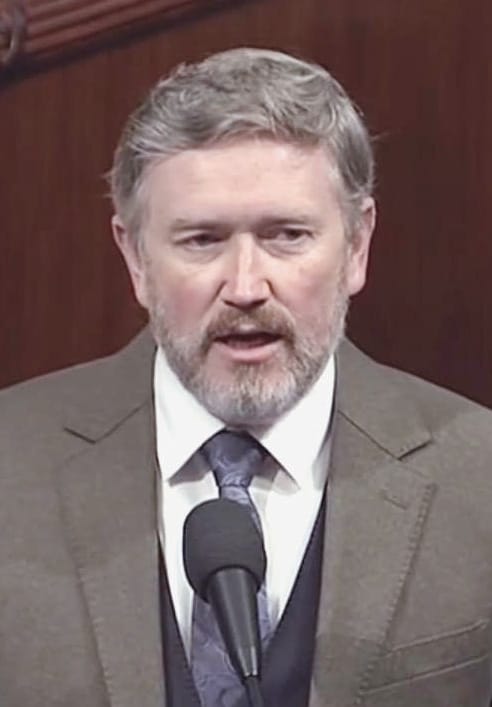

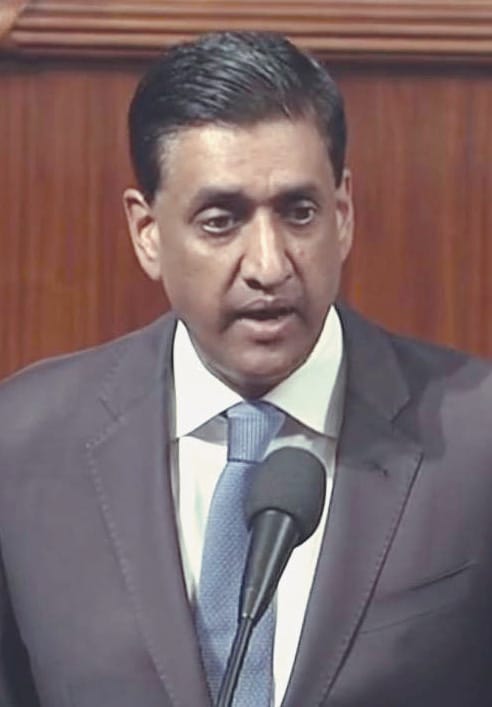
U.S. Rep. Thomas Massie (R-KY, C.D. 4), Credit: C-SPAN; Former U.S. Rep. Dennis Kucinich (D-OH, C.D. 10, 1996-2013), Credit: Sare for Senate; U.S. Rep. Ro Khanna (D-CA, C.D. 17), Credit: C-SPAN.
The “U.S.-Israel Defense Technology Cooperation Initiative” is designed to impose tighter integration in multiple areas, including military planning, tech development, procurement systems, and research capabilities, by coordinating artificial intelligence (AI) and autonomous systems, directed energy and advanced sensing, cyber defense, and electronic warfare. Under the measure, a single U.S. official would have oversight of coordinating the integration between U.S. and Israeli military and intelligence functions. This would include military logistics, guidance, surveillance, and lethal systems, along with hybrid warfare, plus full data sharing. It is being pushed as a way to “win without fighting.”
Independent U.S. presidential candidate Diane Sare issued a strongly worded denunciation of the proposal, characterizing it as “treason” and stating:
Committing to such cooperation with any foreign country would be a threat to the national security of the United States and the safety of the American people. The American and British military were not linked like this even during World War II when we were fighting Hitler together. But it is not just any country; it is Israel: a state that is currently run by war criminals who are committing genocide and ethnic cleansing against Palestine and Lebanon.
According to opponents of Section 219 from the Quincy Institute for Responsible Statecraft, the measure would “lock-in” support for Israel, making it “less a matter of political choice and more a structural feature of U.S. national security policy.” The brief produced by the Quincy Institute warns that it will limit oversight of defense matters and minimize political accountability, making the U.S. defense relationship with Israel “deeper and less transparent.” The Institute has called for stopping the “U.S.-Israel military-industrial merger in its tracks.”
Representatives Ro Khanna (D-CA, C.D. 17) and Thomas Massie (R-KY, C.D. 4) introduced an amendment to remove it from the NDAA bill, but their motion was rejected by the House Armed Services Committee last week. The bill will come up for passage again, possibly as soon as July 13, when Congress reconvenes.
Other opponents include former Rep. Marjorie Taylor Greene (R-GA, C.D. 14) and journalist Tucker Carlson. They are asking why special status should be granted to Israel, especially at a moment when Israel’s policy of genocidal “ethnic cleansing” of Palestinians has made the country a pariah. Greene said of 219 that this is what “a complete capture [by] a foreign government looks like.” Former Congressman Dennis Kucinich, another vehement critic of the provision, says this legislation is an attack on U.S. sovereignty, embedding “another nation’s military establishment within the long-term planning and strategic architecture of the U.S. government.” He further emphasized that the measure would also shield Congress from the political risk of voting to fund Israel every two years, by instead giving Israel direct access to the full $1.5 trillion defense budget.
Constituent Pressure Forces a Change from a Leading Defender of Section 219
Rep. Adam Smith (D-WA, C.D. 9) has dropped his opposition to an amendment that would strip a provision to merge key sectors of U.S.-Israeli defense and intelligence planning, research and procurement from the NDAA. Smith, the Ranking Member of the House Armed Services Committee, initially demanded that the amendment introduced by Reps. Khanna and Massie, which would have stripped Section 219 from the bill, be rejected, and the committee affirmed his recommendation.
In a message to his constituents, Smith wrote that he still believes that the provision offers benefits to the U.S., particularly in the area of anti-drone and anti-missile technologies. However, “after several conversations with constituents, I agree with the position that this provision is about more than just the U.S. working to improve our defense technology.” Smith describes himself as a strong supporter of Israel’s right to exist, but adds that he is “very critical of the Netanyahu government.” He told the Wall Street Journal that his constituents discussed with him their anger at the brutal murder of a Turkish-American journalist by West Bank settlers. In explaining why he now favors the Khanna-Massie amendment, he said, “You have to put pressure on Israel somewhere.” His reversal will allow the two Representatives to reintroduce their amendment, but Smith stopped short of what opponents of Section 219 have been emphasizing.
Supporters of 219 told the Wall Street Journal that this measure has been under consideration for seven years and that rejecting it would be a setback for coordination with allies. Such “coordination” has been a theme of AI and tech sector CEOs with ties to Jeffrey Epstein, who worked on deals which partnered British and Israeli tech and surveillance firms with their U.S. counterparts. This was a major feature of the banquet the United Kingdom’s King Charles III held at Windsor Castle honoring President Donald Trump on September 17, 2025. Trump was accompanied by CEOs of more than a dozen Silicon Valley AI, and tech firms, who signed deals with their new British “partners” totaling $42 billion, with pledges for another $300 to $500 billion over the next period.
The Khanna-Massie amendment is expected to be taken up when the congressional recess ends on July 13. Helga Zepp-LaRouche, founder of the Schiller Institute, welcomed Smith’s reversal and called for a mobilization to back the Khanna-Massie amendment.