Editor’s Note: This article was first published in New Solidarity, the newspaper of the LaRouche movement, Vol. 7, No. 9, April 9, 1976, and is provided to EIR courtesy of the LaRouche Legacy Foundation.
WIESBADEN, April 6 (IPS)—Despite our profound disagreements with the Atlanticist faction allied to Averell Harriman, it has been Labor Committee policy—especially since the Spring of 1975—to forewarn leading members of that faction of certain kinds of developments. Although Harriman et al. are supporting fascist forms of austerity for the advanced-capitalist sector, those forces have shown a semblance of rationality lacking in the Rockefeller-Kissinger forces on such matters as thermonuclear war and other insane adventures.
For example, we collaborated with such Democratic Party and also certain Republican forces on exposing the danger of the Schlesinger “Limited Nuclear War” doctrine and the NATO MC 14-4 policy resolution. In response to our specific information on certain Rockefeller moves, key representatives of the Harriman forces then said of the Rockefeller forces, “They’re insane,” and after independently verifying our information, those Democratic and certain Republican forces moved to reduce the danger involved.
Although the Harriman forces initially blocked on the Angola issue, after our organizing throughout the U.S.A. had created sufficient mass base for the Congressional Black Caucus to act against Kissinger’s Angola plans, the Harriman forces gave certain flanking support to the effort of the Black Caucus. This is not to suggest that we caused the Harriman forces to develop policy differences with Kissinger et al. On the contrary, we know the Harriman faction’s outlook, and therefore know where it will respond favorably on certain issues under appropriate conditions.
The third notable example was our campaign against the danger of a February outbreak of thermonuclear confrontation. By the first week of December 1975, our comparison of the published scenario for a NATO thermonuclear escalation scenario, Hilex 75, with actual developments warned us that the scheduled maneuver was operational, rather than being a mere simulation. We verified this by a computer gridding of the Hilex scenario against actual deployments then occurring or already completed.[1] The scenario indicated conclusively that, supplemented by the Angola situation, a projected Syrian-Israeli military confrontation in Lebanon during February would almost certainly escalate to an actual thermonuclear confrontation with the Soviet Union.
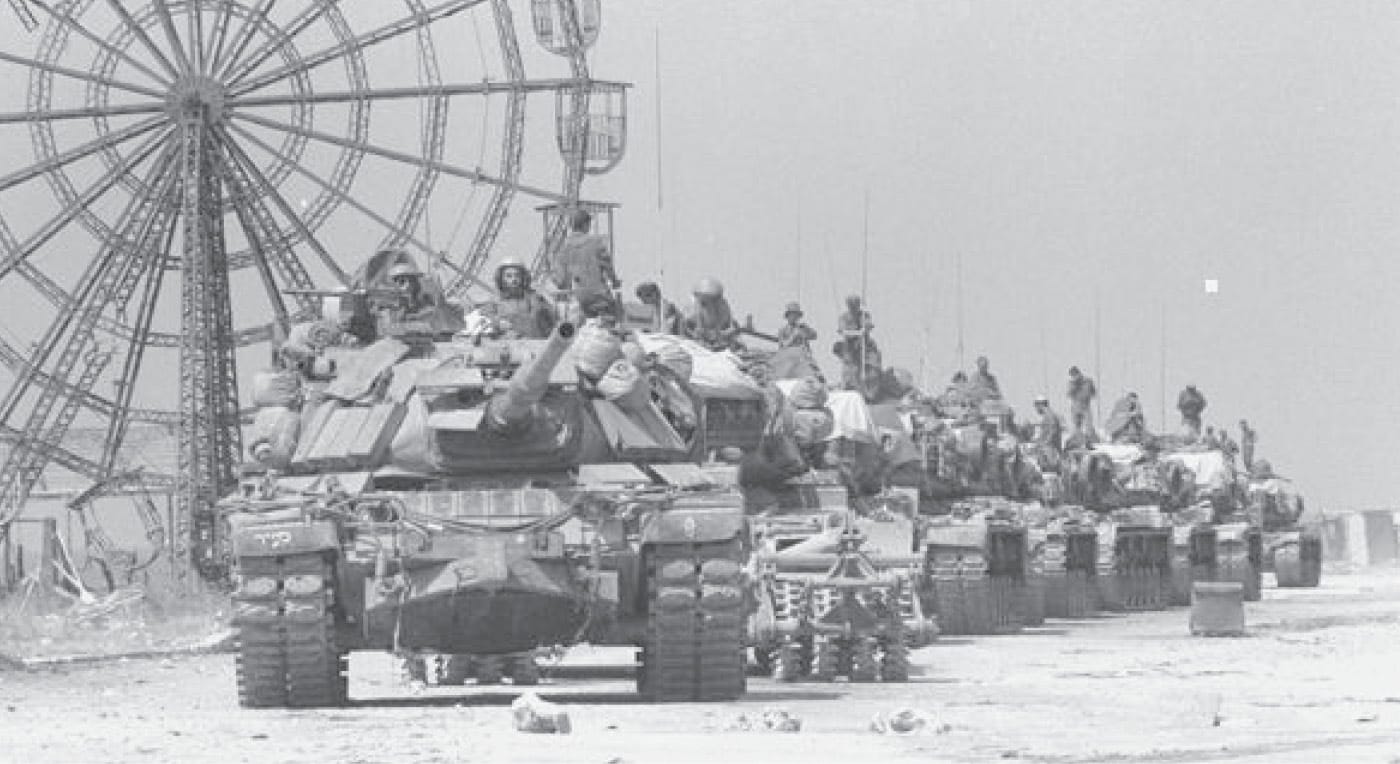
Naturally, we warned every relevant faction of our findings, as well as deploying an international mobilization against the war danger. As we later learned, our warnings intersected other warnings concerning the dangers arising from the Lebanon crisis. Several things happened in response to the combined effect on our own and others’ warnings. Among the reactions, Averell Harriman and Senator Ted Kennedy went on TV to denounce the dangers of confrontation, and to propose their joint alternative negotiations with the Soviet leadership. British, French, and other forces acted along lines signalled by the White House, in forestalling an Israeli military reaction to PLO intervention in the Lebanon situation. Key forces in Israel also acted to stop the war danger.
Although, for fairly obvious political reasons, there is now a general cover-up of the Hilex caper, actions were taken in response to our own and others’ warnings, and the immediate war danger was aborted. At about the same time, Kissinger’s power was further reduced, but without going the full distance to dump Rockefeller’s favorite Frankenstein monster out of the position of U.S. Secretary of State.
Most recently, acting through appropriate indirect channels, we have strongly warned the Harriman and related forces that a right-wing coup in Peru—now going into place—must lead almost certainly to the outbreak of the RAND Corporation–designed and Kissinger-pushed “Second War of the Pacific.” Those circles’ response has been that Rockefeller is no longer wholly in control of South American operations.
Such an expression of manic over-confidence from among Harriman-linked forces illustrates the point that sometimes, well-meaning fools are more dangerous than deliberately wicked madmen. Harriman forces and certain British forces over-confidently imagine that they are rapidly getting the world under a reasonable degree of political control, a folly which points up the fact that they have failed to learn the most essential lessons of the experience of 1928-1945, a lesson which may be usefully entitled “The Frankenstein Monster Principle in the Politics of Crisis.”
Adolf Hitler as a Frankenstein Monster
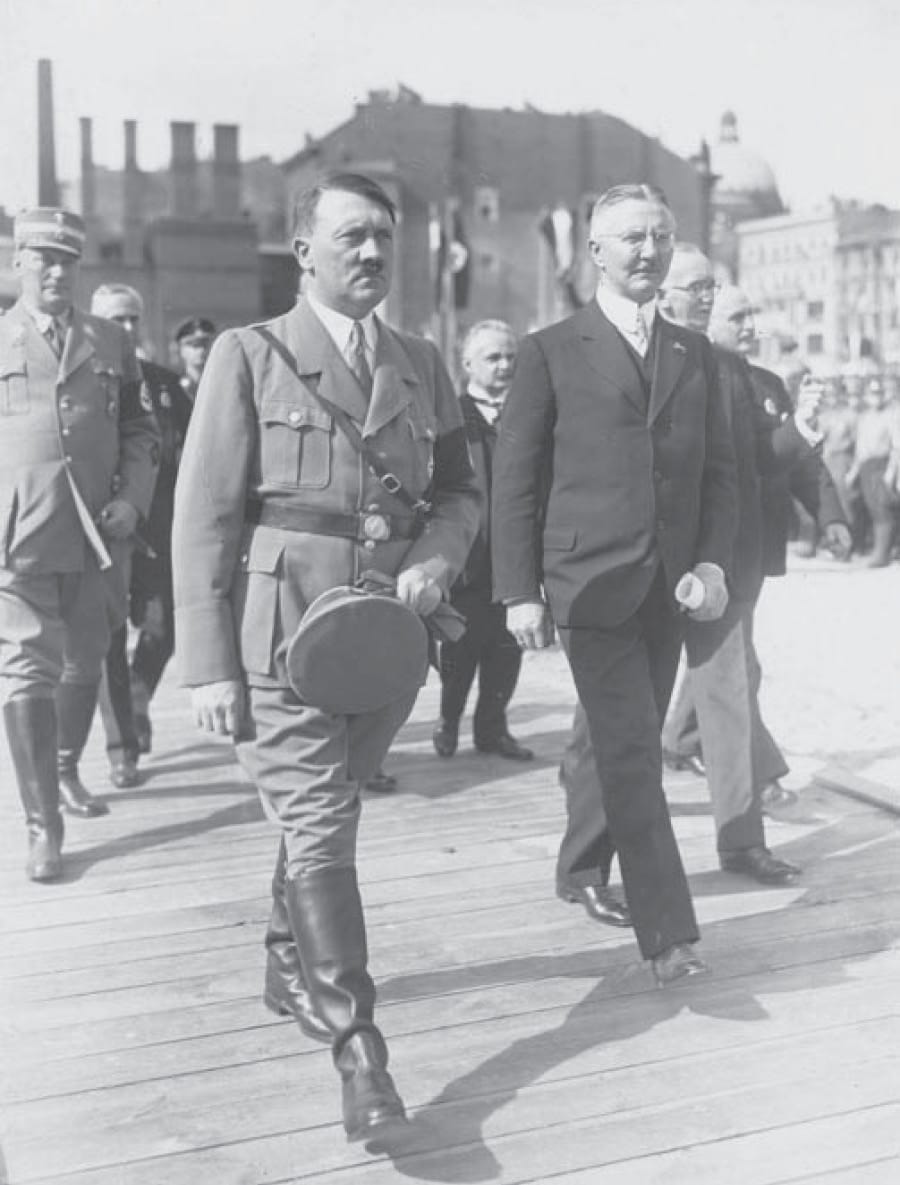
Let no one make a public jackass of himself by ridiculing the report of certain basic historical facts I now restate. Adolf Hitler’s regime in Germany was predominantly a Frankenstein monster created by the fathers of the same British and U.S. financier-linked factions now, again, proposing to impose the austerity measures of Nazi finance minister Hjalmar Schacht not only upon Germany, but the entire advanced-capitalist sector. Any person who imagines that I am even slightly mistaken or exaggerating in giving that report is either honestly ignorant of history or, if from among leading circles, a plain damned fool.
The Hitler regime was the outcome of a process launched from the end of 1918 by the Anglo-American faction of the Armistice Commission imposed upon defeated Germany, what German contemporaries of that period referred to as the “occupying powers.” The leading U.S. component of that operation was the National Civic Federation and the Civic Federations’ intelligence arm of that time, the Russell Sage Foundation (the same Russell Sage Foundation involved in the fascist Law Enforcement Assistance Administration and related projects today). The key U.S. operative for the Civic Federation and Russell Sage Foundation of that period was Hamilton Fish Armstrong, the founder of the New York Council on Foreign Relations.
It is a very bad half-truth to state that the Ebert government of Germany during late 1918 and early 1919 was a social-democratic government. It is true that Friedrich Ebert,[2] Scheidemann,[3] and Noske[4] were formally leaders of the German social-democracy; however, they were also wartime operatives of the German intelligence establishment, and were all directly involved in German Eastern European operations during and after the war. The latter included political intelligence “special operations” overlapping and sometimes cooperating, even during the war, with the British Scandinavian-based network around Swedish British agent Branting.[5] The most cursory glance at the gross facts of Winter and Spring 1919 shows conclusively that Ebert et al. were not based on the social-democratic organization, but were puppets of the Armistice Commission and German General [Wilhelm] Groener, whose immediate power base was the Freikorps units. Anglo-American agent [Wilhelm] Canaris was up to his ears in this operation, as were also elements of the Dutch government, the same Dutch government intensely involved in some other operations of Hamilton Fish Armstrong et al.
The development of the fascist movement in post-war Germany, including the entry of Adolf Hitler into politics, was not an endemic German development, but German developments variously directly and indirectly determined by the Armistice Commission and related agencies.
Hitler came to power in the following way.
The key to Hitler’s rise to power was Hjalmar Schacht. From 1928 onwards, with backing from the fathers of today’s leading Atlanticists, Schacht pushed for the original version of the exact same kind of economic austerity which both the Rockefeller and Harriman factions, in particular, have been energetically pushing upon the entire advanced-capitalist sector. The fascist features of the Humphrey-Hawkins slave-labor bill are a direct imitation of fascist programs pushed for Germany by Schacht and the Nazis.
As is being attempted today, the initial phases of Schacht’s fascist austerity were pushed through with the complicity of certain social-democratic factions. The next phase was a push toward de facto coalition governments of “national unity”—a kind of all-party combination, minus the Communists, rallied around the national necessity of austerity measures to produce the alleged upswing. These measures were in fact being pushed upon Germany by the forces of the still effectively occupying powers, with the German war debt key to the operation.
However, social-democratic complicity and even the Brüning[6] government proved insufficient to maintain political control of the austerity program. After the axis had setbacks in the elections, Schacht went to his British and U.S. financier friends with the warning that their man, Adolf Hitler, was in danger, and that Hitler had to be pushed into power quickly, lest Schacht et al. lose control of the Germany situation.
This maneuver required some special assurances be given to the New York–centered Jewish financial interests—a selling job which members of the New York Times Sulzberger family may recall with some few pangs of regret: the famous words of assurance were that Hitler will not actually represent a threat to the Jewish community in Germany.
With that backing from within England and New York, Schacht moved, with the aid of the Rockefeller-linked Schröder bank, to arrange Hitler’s German financial backing and the installation of Hitler into the Chancellorship.
The original intent of the New York and British groups backing Schacht’s Hitler was in part identical with the motives behind the Humphrey-Hawkins bill today. It was also a move to develop Germany as a “marcher-lord” force for operations against Eastern Europe and the Balkans. Up through 1938, Hitler was still the Atlanticists’ private Frankenstein Monster, a creature they had developed and a creature they mistakenly imagined they could—like the fictional Dr. Frankenstein before them—control.
The British and American financiers maintained that consoling delusion up through the Wehrmacht conquest of the Low Countries and France. The “phony war” on the European Western Front of 1939 and early 1940 was conceived as a mere gesture of containment in the West which would keep Hitler moving southward and eastward toward his assigned military duties.
During mid-1940, the New York and London financier interests discovered that their Frankenstein monster, Hitler, had taken on an independent life and will of its own. Naturally, the falsified official histories attempt to make it appear as if the Second World War was a simple continuity from August 1939 to the end; the official accounts cover up the crucial change in allied strategic policy during mid-1940.
This, incidentally, has a hideous psychological-political significance for the Federal Republic and Germany today. [From] 1938 through 1945 is the only period since 1918 during which, to most recollections in the Federal Republic, Germany was united as a nation around a nationally-determined policy. That is the hideous heritage the Atlanticists have imposed upon a significant stratum of the German population. It is that hideous heritage which today’s Atlanticists are, wittingly or not, exploiting in their efforts to consolidate the Federal Republic politically around support for the current Schachtian proposals of Europe.
Let there be no doubt on that point. Until the atrocity of the November 1975 Rambouillet conference, a strong plurality of German Federal Republic forces—Stoltenberg,[7] Wehner,[8] and Mischnick,[9] for example—were moving toward consideration of an IDB-type new world economic order. Such a pro-IDB policy represents an organic expression of the urgent national self-interests of the Federal Republic as an industrial nation. During and since Rambouillet, the New York Atlanticists and their allies and stooges have used every trick of arm twisting, threats, and psychological warfare to attempt to again impose a Schachtian policy upon Germany.
As Der Spiegel, the Frankfurter Allgemeine Zeitung, and other Federal Republic journals have recently noted, there is a recent emergence of pro-fascist ferment among lumpenized West German youth, a phenomenon which the German section of the European Labor Committees is able to directly corroborate. Do Harriman, [George] Ball and Kennedy, as well as Rockefeller and Kissinger, intend then to put that section of Germany again through horrors like those of the Nazi period, to be fatally followed by a 1977 influx of fifty divisions of Warsaw Pact armor-spearheaded forces through the Federal Republic? If Harriman, Ball, and Kennedy continue on their present Schachtian policies, that is exactly what will result.
The problems of today’s Federal Republic of Germany do not originate in Bonn, Düsseldorf, or Frankfurt, but in lower Manhattan.
The Frankenstein Principles
What the Harriman-linked forces obviously refuse to understand is that the mid-1940–1945 horrors of World War II are an exact paradigm for the much more monstrous consequences their wicked muddling of the present will quickly produce. They—or their immediate predecessors—created Adolf Hitler, a Frankenstein monster that ran out of their control. That consequence was entirely lawful, and should have been clearly foreseen by an informed leading circle which had not been hysterically blinded by its manic-paranoid obsession with debt collections. They are making the same blunder all over again, this time on a global scale.
It is in that respect that we observe that fools, such as Harriman, Ball, and Kennedy, can sometimes be even more dangerous than calculating monsters. They are “merely” hysterically determined to secure a certain type of result. Those insane, blind fools refuse to understand that the result to which they are aiming will itself set into motion forces beyond their power to control. Of course, this is clear to those of us who employ the “higher-order manifolds” conceptions for understanding the politics of crisis; however, even for those who operate in a much cruder way, such as the Harriman forces, the danger ought to be clear enough.
The same principle directly applies to the immediate danger of a “Second War of the Pacific” in South America. The Harrimans et al. may foolishly imagine that they can control the situation there. They refuse to recognize that Kissinger, Einaudi, et al., have already put into place a set of institutionalized conditions which, at the next crucial development, will take on an independent life to the point that no one can control the results.
Peru
The diabolical scheme to transform all South America into a war zone, the “Second War of the Pacific,” is a hideous scenario devised in part by the RAND Corporation. As the RAND designers explain this policy, the point is to decimate the continent in a war which has no overall military objective but destruction itself, with the imagined ultimate political result that the depopulated, bloodied continent can then be put together, like so much helpless putty, through North American interventions.
Chile and Bolivia are to go to war with Peru, presumably over disputed territory between Peru and Chile and Bolivia’s demand for an access to the Pacific Ocean. Brazil joins on the side of Chile and goes to war against Argentina; Ecuador allies with Chile, and so forth. In consequence, the entire continent plunges into an emulation of the 1618-1648 Thirty Years’ War in Germany, after which—presumably—the New York financiers pick over the remains according to their pleasure.
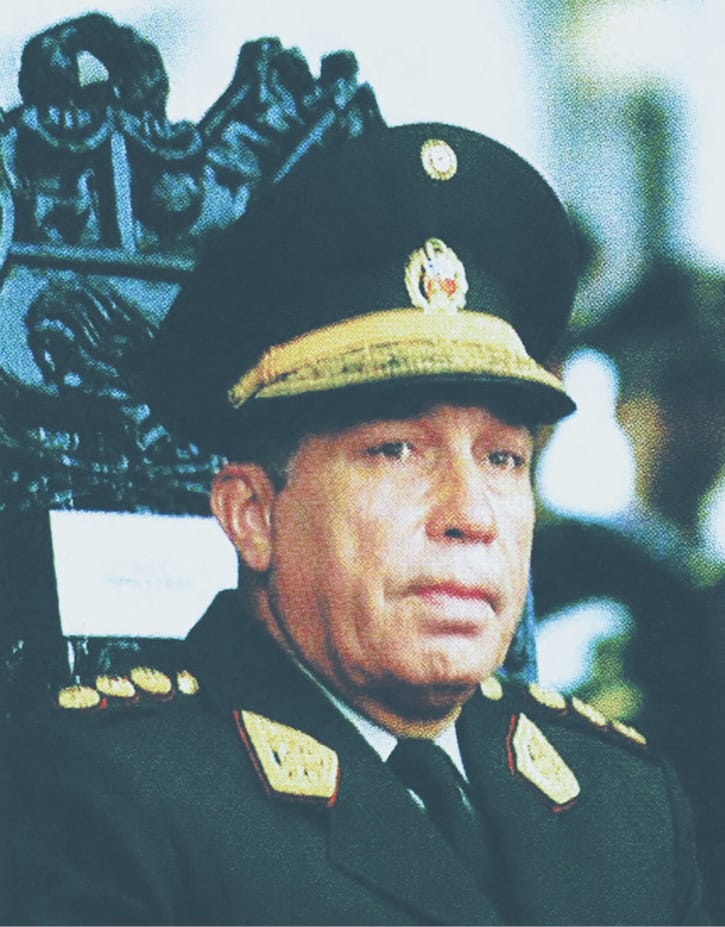
The chief obstacle to launching such a horror upon Latin America has been, up to now, the left-bonapartist government of Peru. Although Morales Bermúdez, the dominant military figure of the junta, is a traditional conservative, he is also a patriot, who does not wish his nation destroyed according to Einaudi’s and Kissinger’s script. Up to the end of December, the “Second War of the Pacific” was more or less effectively blocked through conservative patriot Morales Bermúdez block with the left-wing forces of his government.
This was destabilized partially through stupid Soviet sabotage of the debt moratorium efforts of the developing sector, and through the ostensibly clever but actually stupid realpolitiking maneuvers of frightened developing-sector forces within the Group of 77 and UNCTAD. As a result, over the year-end, the International Monetary Fund and New York banks were able to proceed with a successive wave of punitive, destabilizing crackdowns on a Peru betrayed both by the Soviet leadership and by the cowardice and stupidity among its Group of 77 allies.
To understand this process, it is useful to consider the recent history of Portugal. The Soviet leadership may complain as much as they choose against Willy Brandt et al. in this affair; it was the Soviet majority which contributed the decisive margin for the right-wing turn in Portugal.
The crucial issue in Portugal during late August and early September was not Soares’s[10] forces, not this or that general or colonel, nor even the dirty work of State Department thug Carlucci.[11] The issue was Portugal’s external debt. If the land reforms and development program of the left was to be realized under existing global depression conditions, Portugal required a debt moratorium.
Then, turn directly to Soviet behavior during the UN Special Session of early September 1975, sitting with folded arms while Moynihan,[12] Enders,[13] et al. proceeded with open thuggery against the developing sector’s forces. After Soviet non-support for the debt moratorium faction within the Group of 77 and UNCTAD, Portugal’s fate was sealed.
This is not unrelated to even worse conduct by the Soviet spokesmen at the March Geneva UNCTAD meeting, where the Soviets acted as a wrecking-crew on the mere discussion of the debt problem, thus effectively aligning against the developing sector behind UNCTAD Secretary General Gamani Corea and the Brookings Institution for the reactionary and stupid “indexing” chimera. (In general, this reflects not Soviet malice against Cunhal,[14] Peru, or the developing sector generally, but both the political stupidity of the current Soviet majority coalition and the influence of U.S.A. and NATO agents through such channels as those directed by Zagladin,[15] Arbatov,[16] et al.)
Beginning with the IMF crackdown on Peru during early January, the government began shifting toward the right, at first slowly, then more rapidly as the New York bankers, Einaudi,[17] and Kissinger applied more direct pressure. Ostensibly, the latest right-wing shifts directed by Morales Bermúdez represent a naive effort on his part to contain the pro-war right-wing influence of Kissinger’s tame generals and colonels by dumping the “liability” of his government’s left wing. In fact, this is a blunder even from Morales Bermúdez’s own political standpoint; by cutting off his left-wing flank, he sets himself up to be chopped off by the Kissinger-Einaudi forces.
Once such a coup occurs, and if it is followed by an outbreak of hostilities on either the Bolivian border (already shaping up around an alleged guerrilla issue) or on the Chilean border, as is most probable, the war is on, and once it gets underway, the consequences can not be stopped. The RAND-Kissinger-Einaudi “Second War of the Pacific” is, like Hitler, a Frankenstein monster which, once unleashed, can no longer be controlled by its creators.
In fact, the only thing which can securely prevent such a war is immediate financial debt moratoria for not only Peru, but also Argentina and Brazil. Given the present regime and internal conditions in Argentina, the current situation in Brazil, and the situation rapidly developing because of the New York bankers’ pressures on Peru, the Frankenstein Monster is already in place and beginning to actually stir. In short order, without debt moratoria to abruptly change the internal political-economic geometry in the cited keystone countries (at least), the war will begin, and once it gets underway, a process will be unleashed which can not be stopped.
Harriman and Company may foolishly imagine that by moving in on the Rockefeller machine they can stop the war; at this stage, the financial policies of the Harriman faction itself will inevitably set Rockefeller’s South American Frankenstein into motion. As long as Simon[18] and Company continue with the idiotic policies of Rambouillet, Jamaica, and the fascist “safety-net” outlook, all South America is hopelessly doomed.
Not satisfied with all of South America, Rockefeller and other forces, together with the right-wing U.S. Southwestern-tier base of Ronald Reagan and Company, wish to cause a bloodbath in Mexico—a country which Rockefeller forces have slated for the early death of thirty millions of its nearly sixty million inhabitants. Harriman, Ball, and Kennedy may imagine they are sane relative to Rockefeller, a point which is not altogether without validity, but the criminal stupidities of Harriman, Ball, and Kennedy are playing right into the same end-result as the malignant forces of RAND et al. have planned.
The Case of George Ball
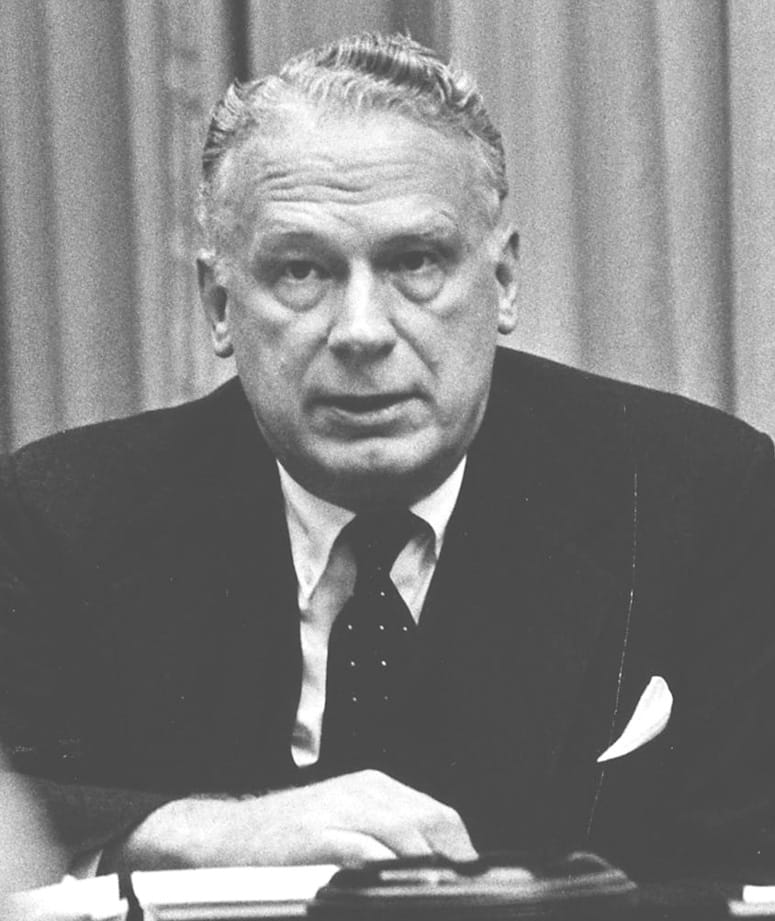
To put the matter in the fewest words, George Ball is an utter fool. On one occasion last year, Ball observed to an IPS journalist that he was no longer concerned with economic questions, but with the U.S. political situation in the developing sector and elsewhere. That observation is noteworthy because it conforms to Ball’s performance then, and from then to the present time.
Such reactions as Ball’s, while reckless follies at this time, are not without ample precedent and are not egregiously atypical of informed financial approaches during the present period.
The leading financiers may say, for publication, that “debts must be honored” even before the very existence of the human race. They do not really mean that in the way that the ordinary person would understand. They mean something else.
The stooges for the leading financiers, the Hubert Humphreys and so forth, may denounce debt moratoria with such demagogic pronouncements as that they are determined “To protect peoples’ savings,” but Democratic Party officials, Governor Hugh Carey, and Mayor Abe Beame did not flinch at looting the pension funds of New York State and New York City trade-unionists when the New York bankers demanded it. In fact, the same financiers, who dictate the policies of the pathetic Humphreys, Careys, and Beames, have already looted the nation’s savings institutions for the purpose of protecting the assets of the bankers’ friends of both the Rockefeller and Harriman factions.
In fact, for those of you who imagine that you have savings to protect in this connection, we forewarn you that what is scheduled to come down is a “Mefo bill” scheme, modelled on Schacht’s, under which your savings will be appropriated “in the national interest,” under an arrangement in which you are given a special kind of actually worthless bond, which can not be redeemed this side of the Pearly Gates. Only an hysterical child would actually believe that the New York bankers have the slightest concern to “defend little people’s hard-won savings”!
The difficulty most people have in understanding the key point to be made here is a result of their ignorance of the basic principles of economics. In fact, persons who have had the misfortune to pass a college curriculum in so-called economics are much more ignorant on such matters than persons who have only a high school education. I refer most emphatically to the delusion that paper holdings somehow represent a form of real wealth in and of themselves. The commonplace blunder involved is sometimes properly called “fetishism.”
Paper—paper money, mortgages, bonds, savings books, and so forth—does not represent wealth. It represents a political claim, backed by the courts and police agencies, to appropriate actual wealth from some person who has such wealth—or is presumed to have it. Such paper wealth can be—and often is—created out of thin air, so to speak.
One of the earliest forms of such wealth was developed in ancient Babylon. The ruler sold the right to collect taxes to certain merchants—an arrangement called tax-farming, the role performed by the famous hated publican of the New Testament account. It was, incidentally, the use of this system by the Achaemenid emperors which directly caused the internal decay and collapse of the Persian Empire. Throughout the history of mercantilism and modern capitalism, the essential form of capital has been genetically based on the same principle as the tax-collecting rights of the ancient tax-farmer. It is a political patent, backed by judicial and police force, to collect wealth from designated individuals or kinds of juridical persons.
Although, from a fetishistic point, it may appear that savings books, stocks, bonds, mortgages, and so forth are merely substitutes for real wealth previously created, this is not the case in principle. A paper title to wealth is wealth only to the extent that political institutions give such claims to collection or recovery political authority.
Consider, for example, the debt of the City of New York, or the wealth nominally represented by the bonds of the Port Authority of New York and New Jersey. Here, the power of the city and states to collect future taxes, and state-delegated power of the Port Authority to collect future revenues, was converted into a tax-exempt free-lunch counter for principally large investors. Instead of doing the obvious, taxing sufficient current income to meet current capital spending needs, large real-estate interests and other major investors were privileged to have their taxes kept at a lower rate than under a “pay as you go” tax program. What those interests saved on such unpaid taxes they, directly or through their bankers and brokers, loaned to the city and Port Authority at delicious rates of tax-exempt interest income. Historically, the current debt structure of New York City can be traced back to speculations of the Astors and others during the 1840s, to say nothing of the transit debt itself, which goes back to pork-barrel benefits to major financiers, such as Belmont,[19] from the turn of the present century.
The only way in which “little people” become entangled in such debts is through the political decision of major financiers to dump portions of this worthless debt holding upon layers of duped small savers.
Under conditions of depression, the reality of paper wealth as a mere political fiction asserts itself in a definite way. Firstly, it becomes apparent that society does not have sufficient wealth to meet the debts and related paper claims outstanding. At the same time, to the most powerful and best-informed financiers, this reality leads to a definite strategy by their forces.
Since wealth is a political fiction, the way to gain wealth is, in the last resort, to grab political power—the power to create instruments nominally representing claims to wealth. From a financier’s standpoint, a depression recommends the following policy-maxims. First, forget what stocks, bonds, and so forth are worth at current market prices. Prices don’t mean anything any longer, what counts is what percentage of control one holds over corporations and so forth which might survive the depression. Second, since what will survive the depression will be chiefly settled in the realm of governmental policy, grab the biggest possible hunk of control over government. In short, the leading financiers are not fundamentally concerned with amounts of money, and so forth; their immediate policy is to hold onto and increase their political power over as much of the world as possible.
Some thick-headed flunkey, a bank president or something like that, may actually imagine that his masters are determined to collect the actual sums on debts outstanding. Such a person is a fool all around, even though his employers may consider him a useful muddlehead to use for some of the debt-collecting dirty work or yodelling at weekly Kiwanis or Lion’s Club meetings. Most of the holdings of the bankrupt International Monetary Fund, the principal New York banks, or the Eurodollar market are already hopelessly worthless as ordinary assets—and every responsible financier knows that to be the case. However, maintaining the political authority of those already bankrupt institutions is another matter.
That is the gist of George Ball’s outlook, an outlook which worked quite well during the last depression. George Ball is to be compared with that variety of French general who, from 1870 onwards, was always prepared with a winning strategy for the previous war. George is attempting to deal with the realities of the 1970s in terms of the experiences of the 1930s and 1940s.
It is the Frankenstein Monster problem all over again, as we shall immediately demonstrate.
What Poor George Is Doing
George’s thinking on the current depression runs something like this: Forget economics for the moment. None of us, George privately admits, have the slightest idea of how to get the world out of the depression—no matter what lies about upswings the Brookings Institution and silly Simon have managed to peddle to terrified West Germans, Japanese, or to credulous developing-sector spokesmen gathered at Manila.
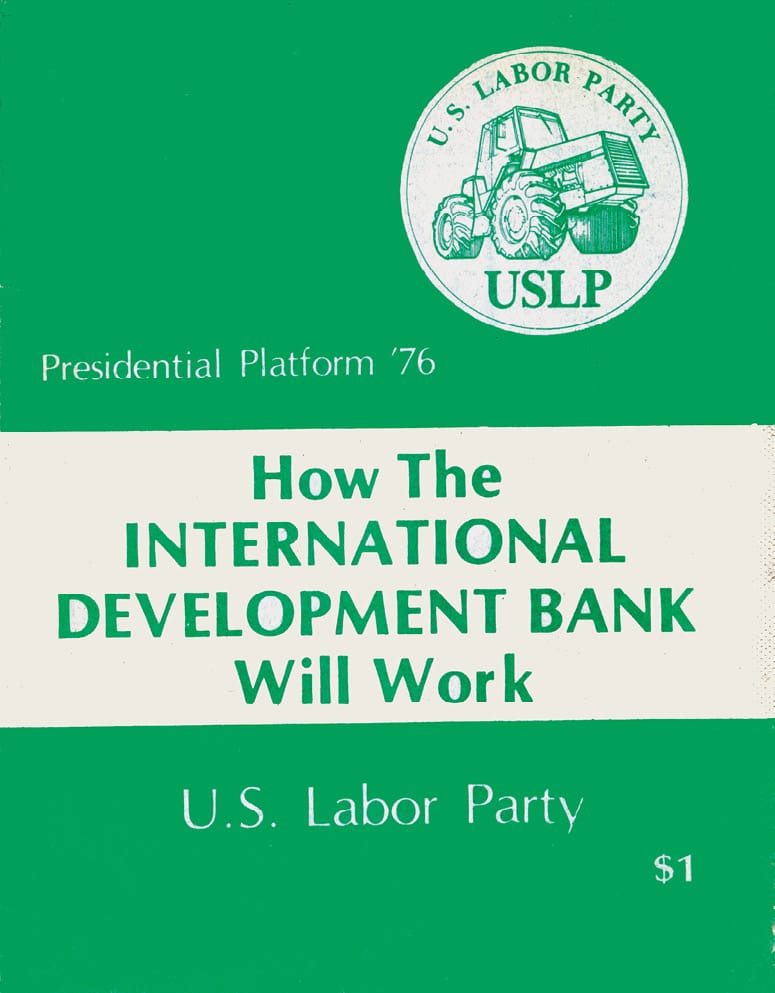
If George consults his best-informed advisors in financial circles, they would assure George that the Labor Committees’ International Development Bank program would immediately end the depression. Those same spokesmen would add, however, “But the Labor Committees’ program means that we of lower Manhattan give up a major part of our present political power!” George, obviously, is having none of that. As far as George and his kind are concerned, his faction has absolutely not a whiff of a competent idea for getting out of the depression.
On economics, George assumes that “Maybe some of us will come up with a scheme for recovery sometime in the future. Now, we have to buy time, and keep political control over most of the world—in the hope that we can come up with something workable in the future.”
Have no doubt that that is exactly what George and his friends know. For example, Ted Kennedy, although no genius, has learned from his advisors that the Brazilian model cooked up by the fascist economists Milton Friedman, Abba Lerner, and so forth, does not work. After a good dose of the so-called “Brazilian miracle,” Brazil today is on the edge of ecological holocaust and total economic collapse. Since the “Brazilian Model” is a pure prototype of Schachtian fascist economics, the only program lower Manhattan has developed for this depression, George and his friends know that their people haven’t the proverbial foggiest notion of how to stop the present worldwide economic collapse—except the Labor Committees’ proposal, which they reject.
George’s view is this. Use the Schachtian fascist model of austerity and police-state regimes to hold things together for a while, long enough for us to—maybe—come up with something which might work. George’s only program is to do anything which might seem to maintain lower Manhattan in the position of world power outlined in the Brookings Institution’s late-1930s “American Century” doctrine.
George’s policy makes the Rockefeller’s backing and Sulzberger’s initial toleration for Adolf Hitler appear to be a really enlightened expression of respectively U.S. and Jewish interests. George ignores the Frankenstein principle. It might be speculated that George wishes to relive the 1930s and 1940s, because he failed to learn the principal lessons the last time he went through that course. We decline to subject ourselves to his process of attempting to learn from such experience.
George and his cronies stupidly imagine that the launching of a Schachtian fascist economic and political order in Europe and the U.S.A. is only a short-term arrangement which could be turned off at least as readily as it is turned on. Ball should ask the ghosts of Gregor Strasser,[20] von Schleicher,[21] and Röhm[22] about such matters: fascist world orders can be singularly ungrateful to their sponsors.
First of all, before the Summer of 1978, the “temporary” fascist order George and his friends are currently pushing would have almost totally destroyed the ability of the world to physically recover from the contractions imposed by successive waves of austerity—even without the probable general thermonuclear war during 1977, which Schachtian order would make virtually inevitable. Meanwhile, a fascist economic order—of the sort Hubert Humphrey is pushing now—would require and produce a fascist social and political order, harder to eliminate than Hitler’s order in Germany. Once George and his friends merely introduce the kind of austerity they are demanding from Italy right now in Western Europe and the United States, they have unleashed a Frankenstein monster that nothing but a successful pre-emptive Soviet thermonuclear war could stop.
Therefore, George has been behaving as an utter fool, and a criminal fool to boot. He should stop it, right now.
The Teamsters’ Settlement Syndrome
Someone close to the top layers of the current Executive is not altogether stupid. The settlement of the Teamsters’ strike, even with the miserable concessions offered, was relatively a stroke of political genius on someone’s part. They made a tactical retreat for the purpose of attempting to prevent the ignition of a global political mass-strike wave. The continuation of that pattern in the International Association of Machinists settlement, and in backing off from the New York Times’ insane rage against the New York transit workers, shows that someone near to the White House is doing a bit of serious thinking.
Whoever did that, bought a slight bit of time to be used for imperative careful thinking things through. Will they think it through properly? Could poor George Ball understand this after reading carefully what we have told him just above? Has George passed the lecture we have just given him? Has he finally learned something?
The Teamsters’ settlement implies that there will be a municipal debt moratorium throughout the U.S.A. The outcome of the San Francisco strike may settle this question one way or the other—at least, it could settle the question, not only within the U.S.A. as a whole, but for the entire world. The implications of the abrupt slight shift in policy reflected in the Teamsters’ settlement means that the ruling circles have given themselves no option but either to resume a crushing attack against labor—now, more difficult than before—or to move quickly toward the International Development Bank and the Emergency Employment Act.
There is no other rational alternative but to quickly pass the EEA through the Congress. If any capitalist circles have managed to comprehend even to a limited extent what we have previously written concerning the “higher theory of manifolds,” they will move quickly to do this—very quickly—as we recommend. Once certain manifolds are entered, one must live by their specific laws.
Notes
- Over the course of Winter 1975-1976, the LaRouche movement discovered a plan by Atlanticist war factions within NATO to advance preemptive nuclear strike capabilities against the Soviet Union under the cover of its “Hilex” (High Level Exercise) military maneuvers. The LaRouche movement deployed internationally to stop this, putting out the warning that such hostile operations threatened a rapid escalation that could lead to full-blown thermonuclear war.
- Friedrich Ebert (1871-1925), President of Germany 1919–1925.
- Philipp Scheidemann (1865-1939), Minister President of Germany from February 13 to June 20, 1919.
- Gustav Noske (1868-1946), Minister of Defense from February 13, 1919 to March 22, 1920.
- Hjalmar Branting (1860-1925), Minister of Finance 1917–1918, Prime Minister 1924–1925.
- Heinrich Brüning (1885-1970), Chancellor of Germany, March 1930 to June 1932.
- Gerhard Stoltenberg (1928-2001), Minister of Finance, 1982-1989, Minister of Defense, 1989-1992.
- Herbert Wehner (1906-1990), leader of the German Social Democratic Party (SPD), 1969-1983.
- Wolfgang Mischnick (1921-2002), Chairman of the Free Democratic Party (FDP) Parliamentary Group, 1968-1991.
- Mário Soares (1924-2017), Secretary-General of Portugal’s Socialist Party, 1973-1986.
- Frank Carlucci (1930-2018), U.S. Ambassador to Portugal, 1975-1978; Deputy Director of Central Intelligence, 1978-1981.
- Daniel Patrick Moynihan (1927-2003), U.S. Ambassador to the United Nations, 1975-1976; U.S. Senator from New York, 1977-2001.
- Thomas O. Enders (1931-1996), U.S. Ambassador to Canada, 1976-1979.
- Álvaro Cunhal (1913-2005), General Secretary of the Portuguese Communist Party, 1961-1992.
- Vadim Zagladin (1927-2006), advisor to Leonid Brezhnev and later to Mikhail Gorbachev.
- Gyorgy Arbatov (1923-2010), director of the Soviet think tank, the Institute of U.S.A. and Canada.
- Luigi R. Einaudi (1936-), during the 1970s head of the U.S. Department of State policy-planning for Latin America; U.S. Ambassador to the Organization of American States, 1989-1993; OAS Secretary General, 2004-2005.
- William E. Simon (1927-2000), U.S. Secretary of the Treasury, 1974-1977.
- August Belmont Sr. (1813-1890), née Aaron Belmont, the Rothschilds’ permanent agent in the United States.
- Gregor Strasser (1892-1934), leader of the left-wing faction of the Nazi Party, arrested and executed as part of the Hitler’s June 30, 1934 “Night of the Long Knives.”
- Kurt von Schleicher (1882-1934), Chancellor of Germany, December 1932 to January 1933; murdered on June 30, 1934 during Hitler’s “Night of the Long Knives.”
- Ernst Röhm (1887-1934), leader of the Sturmabteiling paramilitary organization (the Brownshirts), arrested during the “Night of the Long Knives” and later executed.