
The following is an edited transcript of remarks by Estêvão Damacena to Panel 2 of the Sept. 4, 2026 EIR-IPC Roundtable, “An Alternative to War and Looting in the Americas.” Damacena is a member of the Schiller Institute in Brazil. The video is available here.
Hello, everyone. My name is Estêvão Damacena. I am a member of the Schiller Institute in Brazil.
For me, it’s a genuine pleasure and honor to be joining you all on this very important EIR roundtable discussion. And I do hope that my presentation can contribute to the overall goals of this meeting. My presentation title today is “Brazil’s Physical Economy Vulnerabilities and How We Can Overcome Them.”
The physical economy is destined to produce goods and products that are tangible, grounded in reality—they are indispensable to the well-being of humans. To keep the physical economy alive, resources such as energy, steel, aluminum, iron, chemicals, fertilizers, etc., are indispensable. In this sense, the physical economy is intimately connected with manufacturing.
In 1980, the manufacturing industry represented 35% of Brazil’s GDP. In my opinion, this number can’t be overlooked.
It showed that we were on the path of becoming a powerful industrialized country. It was a result of a relentless state orientation toward development, a process that began with President Getúlio Vargas in the 1930s. So, for a moment in its history, Brazil was able to create and maintain a wide industrial complex. However, since the 1990s, due to the introduction of new liberal reforms in South America, Brazil’s manufacturing industry has been suffering an alarming collapse.
As I mentioned before, in 1980, the participation of the manufacturing industry in Brazil’s GDP corresponded to 35%. However, today, in 2026, 40-some years later, manufacturing has dropped to only 15% of Brazil's GDP. So, we are witnessing a process of complete erosion of Brazil’s industrial capabilities.
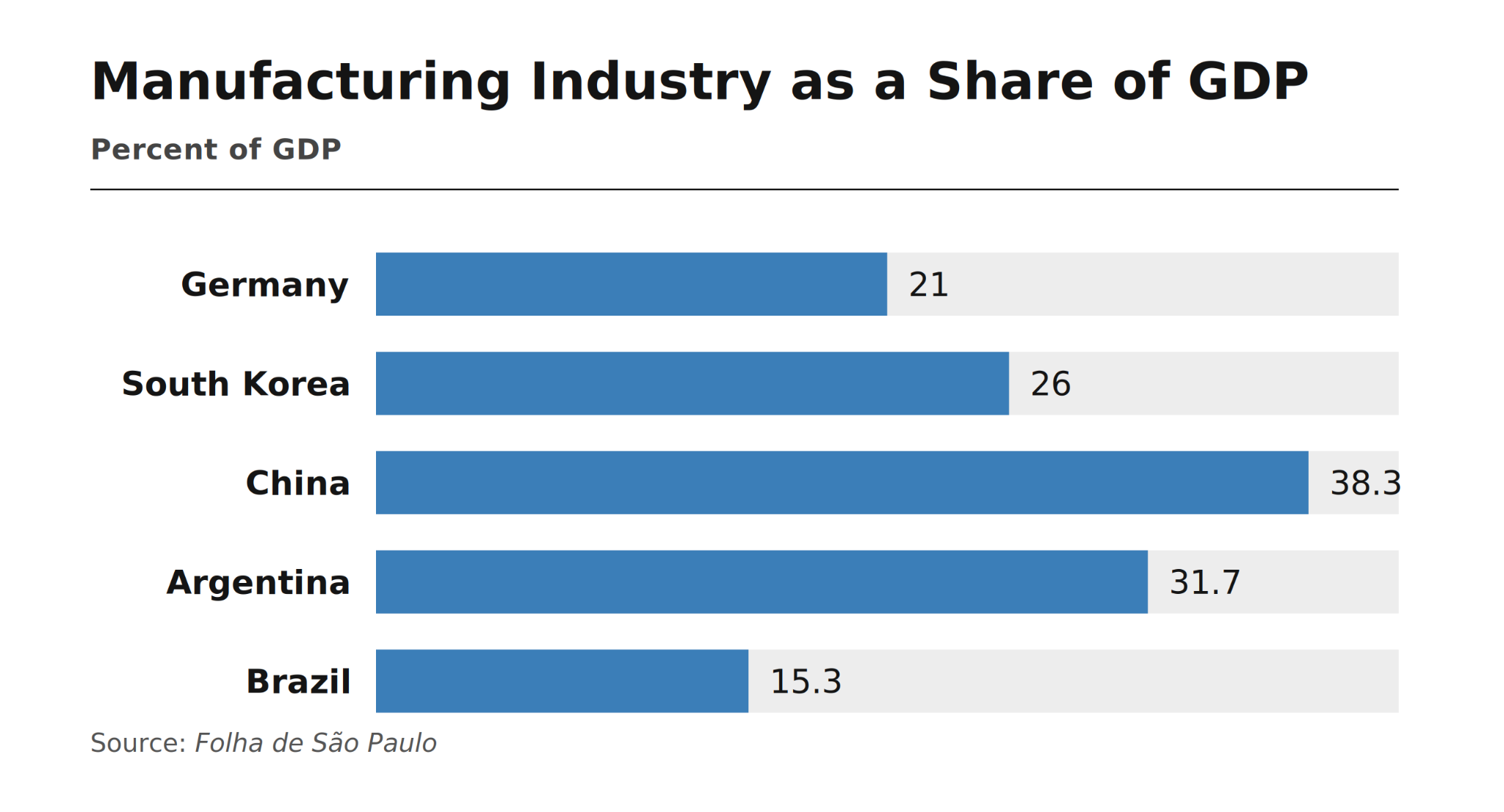
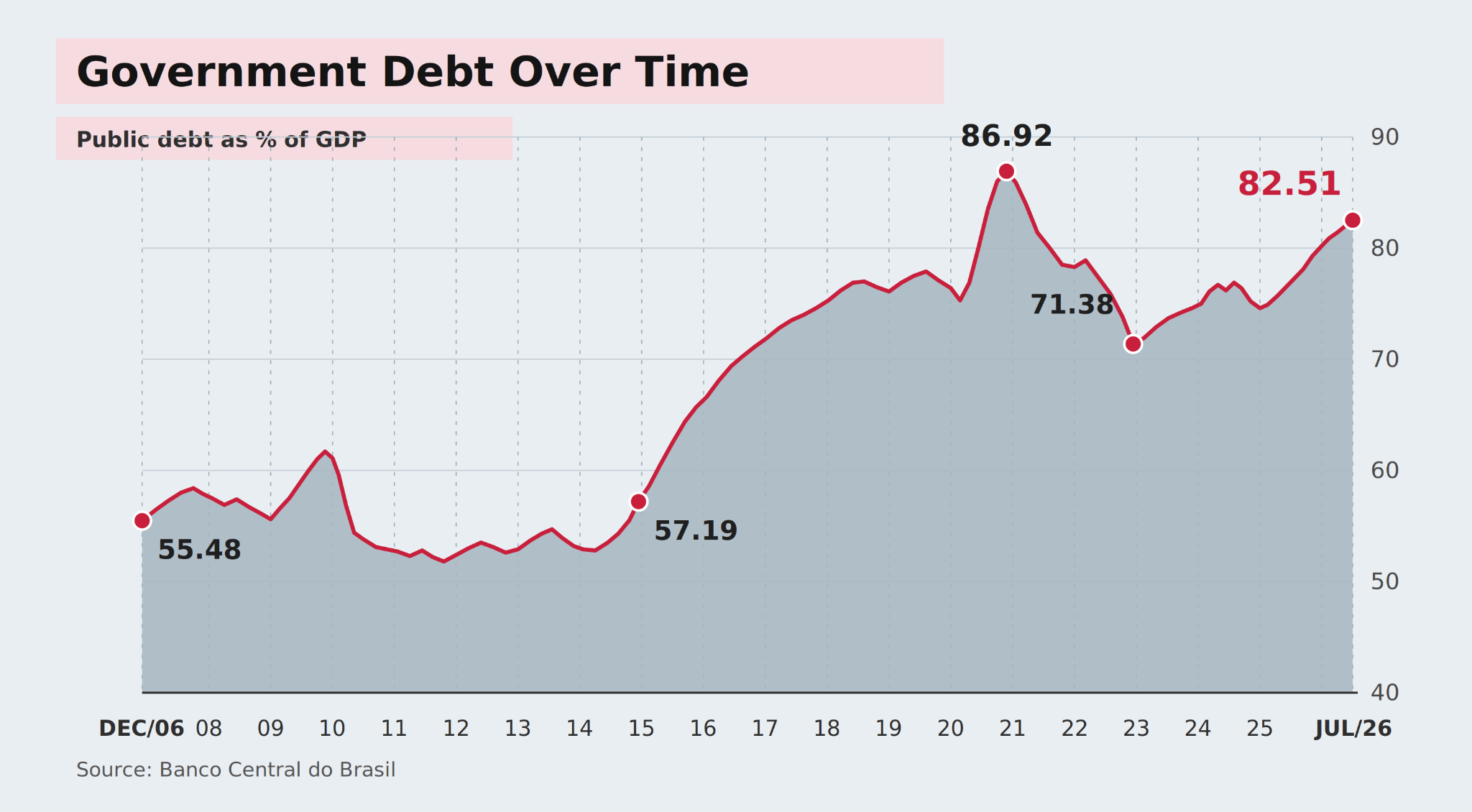
In Figure 1, you can see Brazil’s manufacturing as a percentage of its GDP compared with that of other countries. Among many reasons, I would say the major cause of Brazil’s industrial decline is heavily associated with our current financial system. Unfortunately, Brazil has one of the highest interest rates in the world, around 14% annually. As a consequence, the financial institutions, instead of allocating credit to people to actually produce and expand our industrial capabilities, are actually playing with usury and speculation. As you can see in Figure 2, the Brazilian government is suffering from a dangerous increase in its indebtedness. In July of this year, we reached an 82.5% debt-to-GDP ratio, the highest since 2021. Considering that our interest rates are so high, a huge part of the government’s budget is being used to pay interest to the financial institutions. Around 36% of the government’s budget is being directed to pay banks and investment groups. It is a large quantity of money that otherwise could have been used in other important areas—development, infrastructure, and overall expansion of the industrial capabilities.
So, this configuration of no credit for industry, plus massive government debt, is one of the main factors which is dragging the Brazilian physical economy down. So, in my opinion, it is urgent for Brazil, as a sovereign nation, to plan an effective line of action to overcome these issues. Following this goal, I would like to endorse here, on this presentation, one of the Schiller Institute global initiatives as a way to address our own problems.
Our movement has been emphasizing the importance of governments fighting against the oppressive conditions that irresponsible financial systems can create in societies. In my opinion, the most urgent action that needs to be implemented is giving the state more agency to intervene in the banking system, separating commercial banks from investment banks, for example. This policy is modeled on the Glass-Steagall Law passed under President Franklin Delano Roosevelt’s administration in June 1933 in the United States. Under the Glass-Steagall policy, the state obligated the financial institutions to direct their credits and deposits towards production rather than speculation. If Brazil applies these same Glass-Steagall Law principles within its financial system, I believe that it will stop the bleeding of its budget. Also, it will contribute to making sure that the banks will fulfill their public duty, which is to apply credit in production, therefore opening the possibility to reactivate our industrial and physical economy once more.
Thank you all for listening.