The Lead
'Always Under Human Control': From Petrov to the Summit
by Jason Ross (EIRNS) — Sep. 25, 2026
On Sept. 26, 1983, the screens at a Soviet early-warning center reported five American intercontinental ballistic missiles in flight. The duty officer, Lt. Col. Stanislav Petrov, had minutes to pass the alarm up a chain of command that would likely have ordered a counterstrike, and with it a thermonuclear exchange that would leave most human beings dead in its aftermath. He reasoned that a United States starting a nuclear war would not start it with five missiles, and reported a malfunction. He was right: the satellites had mistaken sunlight on high clouds for rocket exhaust. Petrov was not a system or a protocol. He was a human being exercising the judgment that cannot be reduced to a statistical outcome, and the UN General Assembly chose the date of his decision as the International Day for the Total Elimination of Nuclear Weapons, which it now marks.
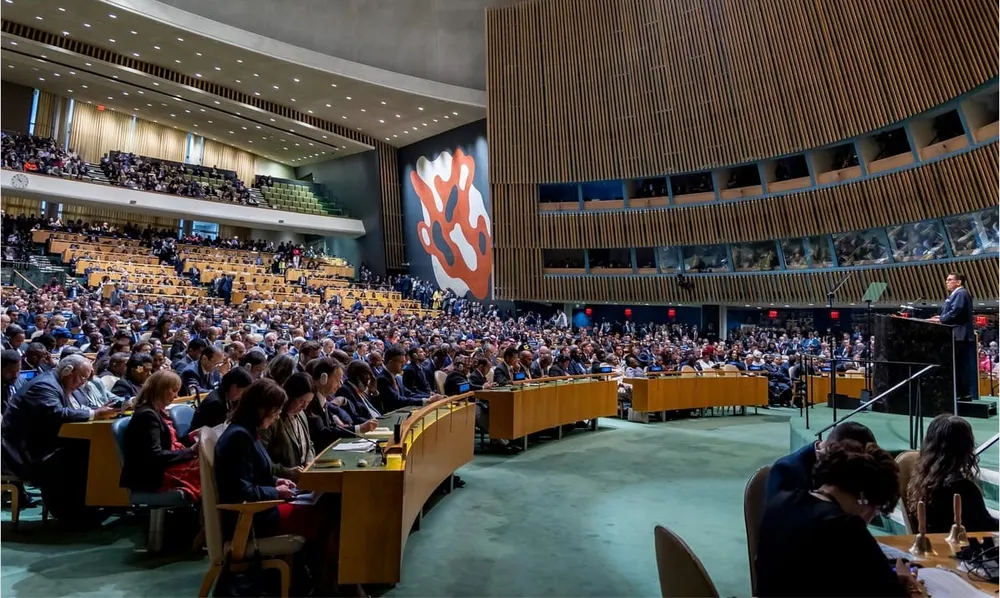
Look at the present from that standpoint. On Tuesday the President of the United States told the Assembly he was weighing whether to make a deal with Iran or “annihilate the Islamic Republic and do it quickly.” On Wednesday the Security Council heard from the people building artificial intelligence. Yoshua Bengio, co-chair of the UN’s scientific panel on AI, said the companies admit their products pose catastrophic risks, offer no convincing technical solutions, and “say they are locked in a race to make those AIs even more powerful.” Panama’s foreign minister stated Petrov’s principle: “There are decisions which, by their nature, cannot be reduced to a statistical outcome.” The U.S. reply was that international dialogue “cannot be allowed to drift towards global governance.”
Then consider the Trump-Xi summit. President Trump met Xi Jinping’s plane at Joint Base Andrews—the first president to meet a visiting political leader there since Kennedy in 1962—and at the White House the next morning Xi laid out his view of U.S.-China relations: “The Thucydides Trap can be overcome.” The “trap” is a statistical claim about history—that a rising power and a ruling one usually end in war. Xi’s answer to it is Petrov’s: it is a decision. He said the two countries have “the capability and responsibility” to “ensure that the development of AI is always under human control,” and “shoulder a historic responsibility of advancing human development and progress.” Trump said the two “have never gotten along better.” What the governments agreed, by the reporting so far—an AI dialogue, an AI “hotline,” military channels, a trade truce extended to Jan. 10—is what Xi called “mechanisms for crisis communication and prevention.” The comity is real and worth having. But the relationship must move beyond improved forms of crisis management, to the establishment of a new paradigm.
Lyndon LaRouche described the obstacle to such relations, and the alternative, in March 1983, half a year before Petrov’s night and eighteen days before Reagan’s address on strategic defense, in a televised speech to the citizens of San Diego:
This doctrine is called Mutually Assured Destruction, or appropriately, MAD. The doctrine essentially is that thermonuclear ballistic missiles are the ultimate weapon—a weapon so terrible that neither the United States nor the Soviet Union would actually ever launch a nuclear war. The argument is that we can eliminate war by maintaining static garrisons, static forces of this type, and by setting up arrangements which are in general called “crisis management.” This means red telephones, special conferences, and so forth, to make sure nothing goes out of control, and that the two governments do not find themselves wandering by miscalculation into a situation in which they might actually set off a thermonuclear war.
His alternative was not a better telephone but a joint program: the two powers, “independently but in parallel,” to end the missile’s standing as “the ultimate weapon,” and “then proceed on the basis of that agreement to a program of eliminating thermonuclear weapons”—"to free the world from more than 20 years of thermonuclear terror”—turning the science “to assist the development of developing countries, to increase the general welfare of mankind on this planet.”
The hotline is just a start. Helga Zepp-LaRouche told the International Peace Coalition on Friday that whether the United States goes to war to keep its dominance “is the question which will decide if mankind exists or not"—and of Xi’s claim that the trap can be overcome: “I eminently think it’s possible.”
Many are putting their names to that possibility. More than 2,000 organizations and individuals have endorsed the appeal that goes to the General Assembly on Sept. 29—no first use, abolition by 2045, the budgets redirected. At least sixty of them have also signed the Appeal to Pope Leo XIV to convene the heads of the three principal nuclear powers, as John XXIII gave Kennedy and Khrushchev a way out in 1962, among them Peter Kuznick, who co-wrote it. In Paris on Friday, ten Schiller Institute organizers put eight thousand copies of it into the hands of the crowds waiting for the Pope.
Will the two presidents stop at the hotline, or proceed to a program? What is needed is the summit at which the management of differences gives way to the coincidence of interests.
Contents
New World Paradigm
- Xi’s State Visit Ends with Tea, the National Archives, and Two More Meetings on the Calendar (↓)
- More Than 2,000 Endorse Appeal for Nuclear Abolition Day, Sept. 26 (↓)
- Africa Repeats a Demand It Has Made for Three Decades (↓)
- Very Successful Beginning for the Pope’s Trip to France (↓)
Collapsing Imperial System
Strategic War Danger
- Latvian President Says Does Not Expect Russian Military Operation Against Europe (↓)
- Small States Tell the UN They Are Paying for Wars They Have No Part in (↓)
- El Mundo Scare ‘CIA Report’ Debunked (↓)
Give the gift of EIR 🎁
Click here to buy a gift subscription to someone who needs to see through the noise.