“The unipolar system is actually collapsing,” observed Russian Presidential Press Secretary Dmitry Peskov during a press conference with Indian media on Tuesday. “And then at the same time, [it] is trying to regain power…. So this is a very dangerous process.”
The dynamic underlying so-called current events, so succinctly identified by Peskov, is playing out ever more overtly on the world stage as humanity continues to grapple with stopping two major regional wars—either of which could erupt into a global, civilization-ending war—and with the biggest power-keg of all: the unsustainable speculative bubble that is the bankrupt trans-Atlantic financial system.
The imperial scramble to maintain power was on full display in the frantic deployment of European warmongers, led by Tony Blairite “fixer” Jonathan Powell, to Kiev on Sunday to intercept the American negotiating team of Witkoff and Kushner on their return from Moscow, aiming to ensure that the U.S. stays in-line with the war agenda. This was followed up by a call between UK Prime Minister Burnham and President Trump on Monday, and a meeting of the Ukraine Defense Contact group on Tuesday, where even more missiles were promised—to arm Ukraine down to the last Ukrainian.
On the other hand, the majority of the human species is moving forward toward the formation of a new system, one which recognizes the equality of nations in what Xi Jinping has called “a community with a shared future for mankind.”
As part of those efforts, we look forward to this weekend’s summit of the BRICS, taking place from Sept. 11–13 in New Delhi, at which Presidents Putin and Modi will have a bilateral meeting, with many others expected. In his discussion with Indian media as part of the lead-in to the summit, Peskov pointed to the BRICS’s growing shift toward payments in national currencies, rather than the dollar, a “de-dollarization” process which he said was not begun by the BRICS: “I would say that it’s rather America that is against the dollar as a reserve currency…. America is ruining trust in the US dollar, and the more trust is ruined, the more trust goes in favor of national currencies.”
The failure of the unipolar system is seen just as strongly in Southwest Asia: the lawful consequence of the U.S.–Israeli folly in Iran is that there is a new security architecture taking shape in the region, one which does not rely on outside military presence. The Mecca agreement is a step in that direction. “Self-sufficiency when it comes to security is the only way forward,” Qatari Foreign Ministry spokesman al-Ansari [noted] on Tuesday. “Yes, we need our partners. Yes, we need our allies. But we cannot depend on them alone for our security.”
But, given these two opposing dynamics, which way will the United States go?
Putin and Trump spoke on the phone for one hour on Tuesday in what Kremlin aide Yuri Ushakov reported was a “constructive and quite frank” conversation centering on the Ukraine settlement. Putin made clear to Trump that Russia’s view is that the “circulated myths about the Russian threat” are “a pretext for Europeans to ramp up their support for Ukraine” and increase their own militarization. He also reportedly outlined “actual tangible actions that the Americans could take to expedite the cessation of the hostilities.”
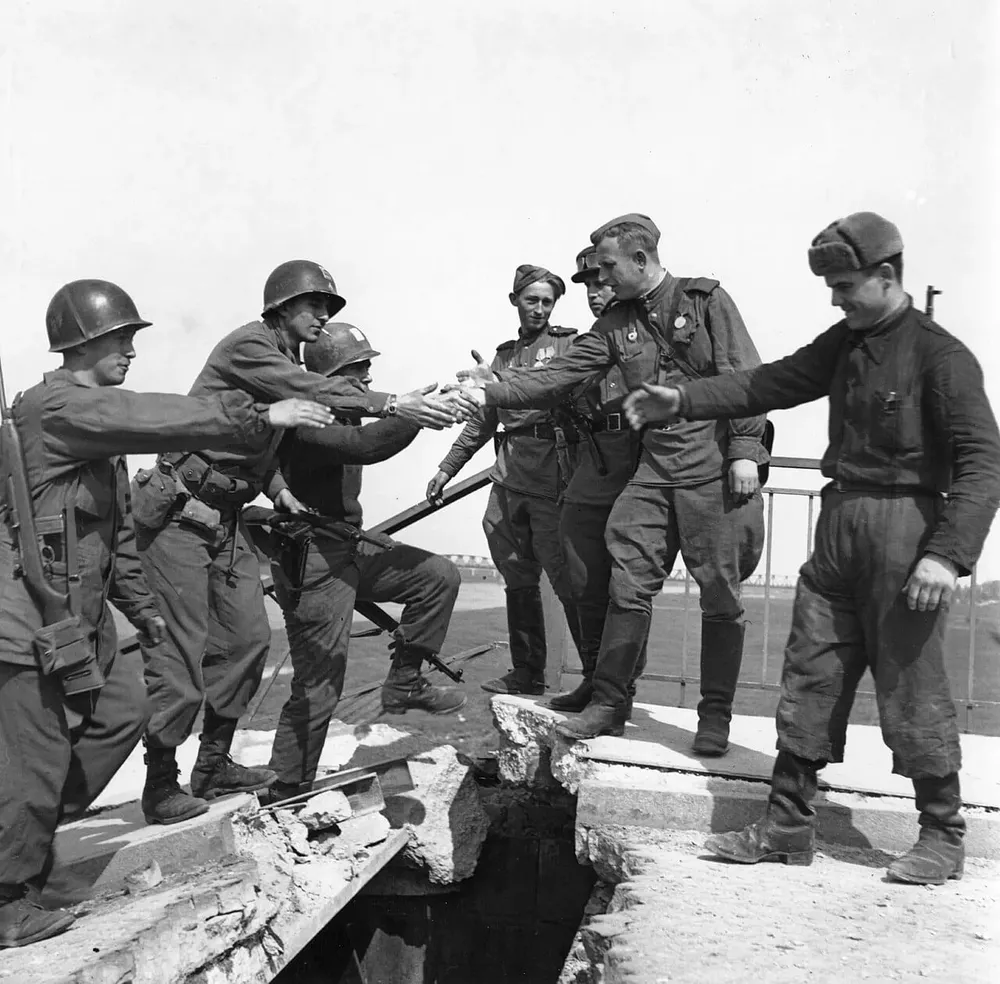
Russia has made it quite clear that despite the many destructive actions on the part of the U.S., the two countries share a history in fighting the colonialism that stemmed from Europe. In an interview on the Bolshaya Igra show on Sept. 8, Russian Foreign Minister Sergey Lavrov outlined some of that history: “When European colonists set out for the Americas… Catherine II played a decisive role in supporting the colonists against the British colonial rulers. We should be mindful of the historical roots of our relations…. One only needs to look at the newsreel footage of Elbe Day to understand that it was a very sincere bond among those who fought Nazism with weapons in their hands. It was the Spirit of the Elbe, if you like.”
It is this “better America” that is being looked to now, in hopes of shifting the world dynamic out of the hands of America’s historic enemy: the British imperial system of geopolitics and war.
As we approach the 25th anniversary of the 9/11 attacks, an event that ushered in a new phase of fascism and war, LaRouche independent Presidential candidate Diane Sare was [interviewed] on the Jack Stockwell show, nearly a quarter century after Lyndon LaRouche’s amazing interview on that show the morning of Sept. 11, 2001. There, Sare laid out a picture of that better America—rooted in the insight, leadership, and courage of Lyndon LaRouche, whose 104th birthday would have been today.
History is not a passive process. This fight can be won—don’t let the unipolar world order take us all down with it.