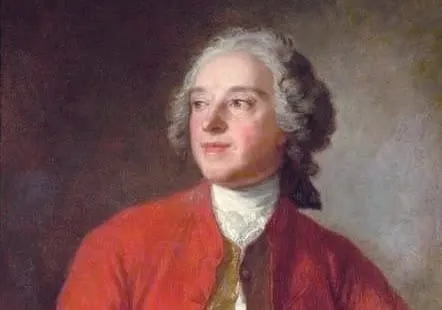
April 27—The story of Pierre Augustin Caron de Beaumarchais’s role in spurring French and Spanish decisions to surreptitiously fill the huge supply wants of the American revolutionists, and himself setting up the intricate network of deliveries of arms, munitions, and uniforms, is as daring and inventive as any of the ploys of his most famous stage creation, the “Figaro” of The Barber of Seville, which debuted in February of 1775 and took Paris and London by storm. This is not some modern appraisal; Benjamin Franklin himself referred to Beaumarchais as Figaro. The tale is told in fascinating detail in a chapter of Ferreiro’s Brothers at Arms, “The Merchants,” pp. 32-74, and readers are encouraged to immerse themselves in this extraordinary account. For now, a thumbnail sketch.
Pierre Augustin Caron (1732-1799), who later added the name “Beaumarchais,” which was derived from a property of his first wife, to suggest an aristocratic background, was in fact the son of a watchmaker living a few dozen miles outside Paris. At age 21 he invented an improvement in the catchment mechanism for pocket watches that won him notice in the French court, and from there his career took off, in a succession of roles as financier, publisher, playwright, merchant, and “fixer” for the French king. In the Summer of 1775, he crossed paths with American envoys in London still trying to secure some kind of settlement with Britain, and became a passionate advocate of the American cause.
Recognizing the desperate need of the American forces for arms, munitions, and supplies, he set up a front company he dubbed Roderigue Hortalez & Cie., named for Spanish-sounding associations he had from a year stay in Madrid a decade before, to funnel this materiél. In January 1776, he approached Vergennes and the King directly, proposing that the French government place one million livres “at the disposal of your agent, who will style himself Roderigue Hortalez et Compagnie, this being the signature and title of the firm under which I have agreed to conduct the entire business.” In late February, he followed up with a memorandum to Vergennes, “Peace or War,” which began prophetically, “The famous quarrel between America and England, soon to divide the world and alter the European system, forces each power to carefully examine how this separation will influence it, whether in its service or to its detriment.” Beaumarchais continued: “We must aid the Americans”; if not, Britain could attack France’s sugar islands in the Caribbean, and France would be forced to “belatedly start a fruitless war.”
Beaumarchais’s memorandum coincided with intelligence that Vergennes received, that, indeed, the insurrectionists were fully committed to their cause, not maneuvering for better terms in a rapprochement with Britain. On March 1, 1776, Vergennes sent his counterpart in Spain, Grimaldi, a proposal that each nation put one million livres into Beaumarchais’s front company—somewhere close to $1.3 billion in today’s equivalent! Spain accepted, and Roderique Hortalez was up and running. Independent channels of Spanish supplies were simultaneously proving the lifeline that maintained American troops fighting the British west of the Alleghenies and in the Mississippi Valley.
Beaumarchais was in a position to address the Committee of Secret Correspondence of the Second Continental Congress with a letter dated August 18, 1776, with the following words:
Your deputies, gentlemen, will find in me a sure friend, an asylum in my house, money in my coffers, and every means of facilitating their operations, whether of a public or a secret nature. I will, if possible, remove all obstacles that may oppose your wishes from the politics of Europe. At this very time, and without waiting for any answer from you, I have procured for you about 200 pieces of brass cannon, four pounders, which will be sent to you by the nearest way; 20,000 lbs. of cannon powder, 20,000 of excellent fusils, some brass mortars, bombs, cannon balls, bayonets, platines, clothes, linens, &c. for the clothing of your troops; and lead for musket balls.
By the end of that year, French, Spanish, and Dutch merchants—with Hortalez in the lead—had provided at least 10,000 muskets and roughly one million pounds of gunpowder, in Ferreiro’s estimate, to American forces. This was vital to Washington’s victories at Trenton and Princeton. In the Spring of 1777, “While [British political and military leaders] Germaine, Howe, and Burgoyne were planning their [Summer] campaigns,” five Hortalez-chartered ships were at sea to America, “their combined cargoes sufficient to arm, clothe, and outfit an army of 30,000 men…. Many more Beaumarchais vessels, eventually totaling 40 cargo ships of various types, were being readied in ports around France” (Ferreiro, pp. 69-71). One of these cargoes provided the muskets which enabled the American victory at Bennington, and American forces at Saratoga, October 1777, were largely clothed and armed by supplies coming through Beaumarchais conduits.
Ultimately, Beaumarchais was ruined by his American operations. He contracted debt well beyond the funds provided under-the-table by France and Spain, counting on repayment through American shipments of goods, especially tobacco, as had been promised initially by American envoys. But misrepresentations of Beaumarchais’s role, alleging that all his activity was secretly underwritten by France and Spain and that these countries did not expect repayment, reached the Continental Congress. Only one paltry shipment of U.S. agricultural goods ever reached Beaumarchais. But his outsized contribution to the American cause was secure. And he had already written the next of his Figaro trilogy, The Marriage of Figaro, a profoundly republican play with a much more scathing indictment of the aristocracy than The Barber of Seville, to be set to the glorious music of Mozart in 1786.[1]
Notes
- The reader is encouraged to read David Shavin’s “Mozart’s Entschlossenheit, or ‘Don Giovanni’ vs. Venetian Ca-Ca,” a December 2010 article in the Schiller Institute archive. It includes an absorbing treatment of the way Beaumarchais’s Marriage of Figaro was vital to republican organizing around the French court from its premier in 1784, and of its conversion into an opera with a libretto by Lorenzo da Ponte and music by Mozart, two years later in the Austrian court in Vienna, with similar effect.