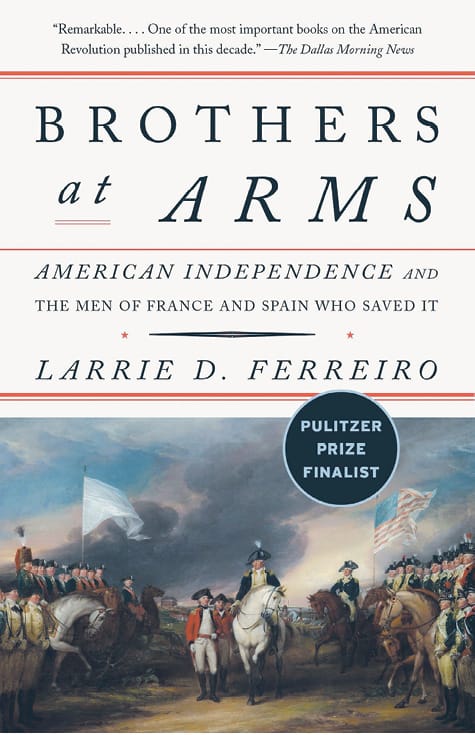
Brothers at Arms: American Independence and the Men of France and Spain Who Saved It
by Larrie D. Ferreiro
2016, Alfred A. Knopf
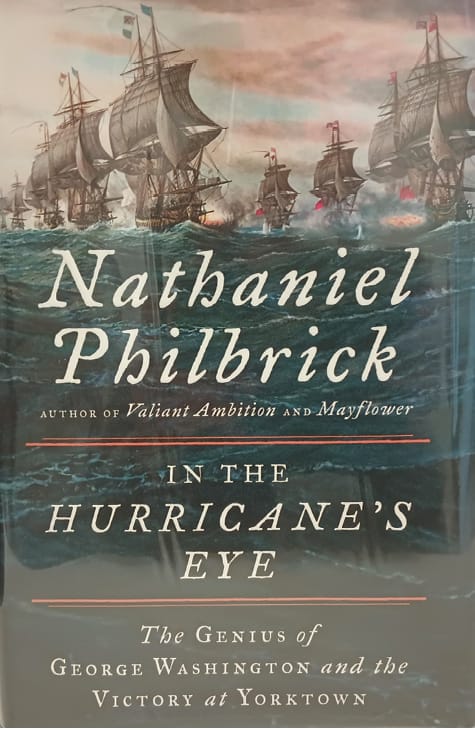
In the Hurricane’s Eye: The Genius of George Washington and the Victory at Yorktown
by Nathaniel Philbrick
2018, Viking Press
EIR’s 250th Anniversary Series
The year 2026 marks the 250th anniversary of the Declaration of Independence by what would soon become the United States of America. That instrumental document laid down the principles of an anti-oligarchic republican form of government, and would go on to be the inspiration for countless other peoples around the world, forever changing the shape of history. Today, this history is either misunderstood or intentionally misconstrued, and the U.S. has nearly abandoned the outlook of its Founding Fathers. Over the course of this year, EIR will be publishing key articles on the true anti-oligarchic history of the United States in the hopes of contributing to the widest possible discussion of these principles, the rediscovery of which has enormous implications for whether the world can get out of its current state of turmoil today.
April 27—It is Sept. 5, 1781. France’s general Comte de Rochambeau and his entourage have left Philadelphia by boat, heading south, in the next stage of the journey of his 5,000 troops alongside Washington’s 2,500, in a race to Yorktown to lay siege to British Lord Cornwallis’s army, soon to be trapped there. Philbrick recounts what happened:
After stops at Fort Mifflin, Red Bank, and Billingsport, where they enjoyed some bread and butter and tea with the fort’s elderly commandant, they continued on to Chester. While still a good distance from the town’s landing, they noticed a man standing on the waterfront, gesticulating wildly with his hat in one hand and a white handkerchief in the other. He was dressed in the blue and buff regimentals and was leaping about like a man possessed. Could this be the commander in chief? Of course not. His Excellency was, in the words of Guillaume de Deux-Ponts, “of a natural coldness and of a serious and noble approach.” He would never allow himself to act this way.
But sure enough, it was Washington. (Philbrick, pp. 170-171).
Washington had just received word that France’s Admiral de Grasse had arrived in the Chesapeake Bay. For three years Washington had had to suffer the anxieties and frustrations of seeing one after another opportunity for French naval forces to neutralize Britain’s naval superiority off America’s coasts, thus permitting a decisive land victory, come undone. As late as early Summer, 1781, Washington saw France’s naval forces’ lack of intelligence in the Caribbean as a “chasm.” “There seems to be the strangest fatality and the most unaccountable silence attending the operations to the southward that can be conceived,” he wrote. Now the “main chance” had materialized and been confirmed in stunning fashion.
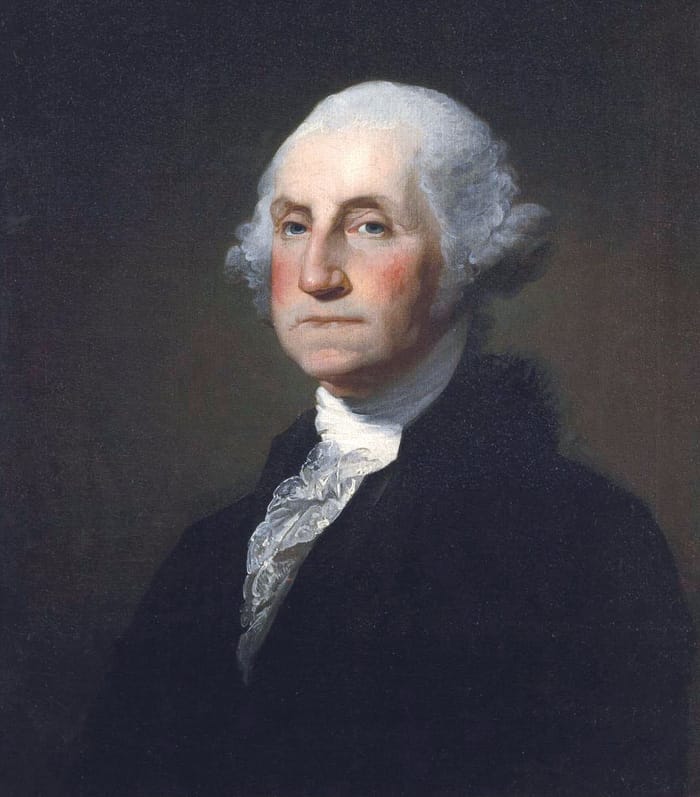
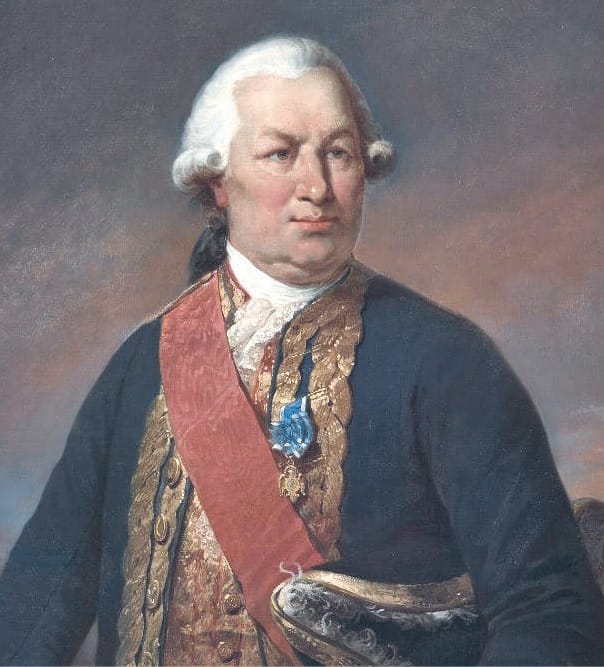
The way this came about, in the second half of the 1775-1781 War of Independence, seems to be a tale of overwhelming chance and contingency, involving theaters of conflict raging from the Caribbean to the Mediterranean to the Baltic; huge delays in news of sailings and destinations; and the timing of some of the worst hurricanes on record! But Washington’s steadfast passion to create the potential for decisive victory among this welter of variables, stands as the essential element captured in Philbrick’s subtitle, The Genius of George Washington and the Victory at Yorktown.
The chance for a strategic knockout blow had been tangible since news had arrived in the American and French camps north and east of New York in mid-August that de Grasse, who was known to be heading to American waters since early Summer, was leading his fleet to the Chesapeake Bay, not New York. This decided a longstanding question of which location would be the objective of joint American-French operations. The challenge was formidable. As Ferreiro put it starkly, “Washington and Rochambeau now had to coordinate three separate armies and two fleets across hundreds of miles in the face of unknown enemy resistance to arrive simultaneously at one location [Yorktown], and do it in just six weeks.” It was only on Sept. 5, with news that de Grasse’s fleet had actually been sighted at the Chesapeake, and further news a few days later that de Grasse had repelled a pursuing British fleet, that Washington and Rochambeau knew for certain that the culminating moment of the Revolution was within grasp.
The Crucial Aid of Europe
These two books, meticulously researched and dense with extraordinary insights, are a revelation. They provide an in-depth picture of a reality largely downplayed in standard U.S. historiography of the American Revolution: just how essential the aid of Europe, and particularly that of France and Spain, was to the success of the American cause—not just from the moment of sealing the French-American alliance in early 1778, or the coordination of French and U.S. forces to secure the victory at Yorktown. It was a dense fabric of assistance from the very beginning, exemplified by the singular role of Lafayette as the war progressed, and including an outsized role of Pierre-Augustin Caron de Beaumarchais, the renowned author of The Barber of Seville, who arranged front companies to eventually funnel into the American forces weapons and munitions amounting to over $3 billion in today’s dollars (see accompanying article).
These books concentrate not on the ideas of the Revolution—profound republican ideas from Europe over preceding centuries which inspired the American cause[1]—nor the role of various individual European patriots who came to America to assist Washington’s beleaguered forces. Names such as Lafayette, von Steuben, Kosciuszko, Pulaski, de Kalb and Barry are justly celebrated. Rather, they concentrate on the assistance provided by nations—France and Spain—which was capable of shifting the odds in favor of the American cause. These accounts relate the extraordinary events which made victory for these ideas possible.
They also provide an essential dimension of grand strategy that needs to be re-learned today, if the ideas of the American Revolution, universal in their character, are to be re-installed in the country of their first realization. Only coordinated action of assembled patriots of many countries, emphatically including the Global Majority, led by the BRICS nations, can spark and sustain the revival in the United States of the outlook which defeated the British Empire then—and must do so again, in that Empire’s modern, London-centered globalist-financier reincarnation.
The Role of France’s Navy
It would be idle to try to reproduce the specifics of books so rich in conception and detail. Most useful for this review is to identify certain crucial dynamics and qualitative factors, to entice readers to dive into these books themselves.
One such aspect is the way the French took the lead in remedying three grievous deficiencies Washington faced in maintaining an army in the field for seven long years, let alone achieving victory. The greatest of these deficiencies was the lack of a navy capable of challenging the overwhelming superiority of the world’s greatest maritime power of the time—that of Great Britain. France did have such a navy, built up methodically in the decade preceding the American Revolution, as France reacted to its devastating naval defeats in the Seven Years’ War (1756-1763). A “guerre d’escadre,” that is, “a war of battleships” entering into direct clashes, was entirely out of America’s reach. As Ferreiro puts it, “creating and provisioning a navy … required a powerful, centralized government that could raise and spend large sums of money.” This was out of the question, when Washington had to scramble relentlessly to pry from the largely dysfunctional Continental Congress enough to barely keep his army together. The best the American forces could attempt was a “guerre de course,” commercial raiding—done so spectacularly by John Paul Jones in the Bonhomme Richard (named for the Poor Richard of Franklin’s Almanac) off England’s east coast, for instance, but not of strategic weight.
Washington was almost driven to despair when each arrival of a series of French fleets came a cropper. It started with Admiral D’Estaing’s fleet in the Summer of 1778. Washington hoped the French ships would bottle up the British forces occupying the revolutionary capital, Philadelphia. Instead, they proceeded to New York, which was the headquarters of British commander Henry Clinton. But the draft of the French ships was 3-4 feet deeper than the New York harbor allowed passage, protecting Clinton’s ships from attack. D’Estaing’s fleet then sailed to the British naval hub of Newport, Rhode Island, only to be scattered by a savage Atlantic storm.
The misfirings continued through to early 1781, when French Admiral Destouches sailed for the entrance to the Chesapeake Bay, to cut off the forces of (now-British) general Benedict Arnold, who were marauding from Virginia’s Tidewater to Richmond. (It should be noted that Clinton’s naming Arnold to this command was one of his greatest blunders. In early 1781, Continental regular and irregular forces in Virginia, hugely under-equipped as Cornwallis was approaching from the south, suffered shaky morale. Naming Arnold, when his treason at West Point seven months earlier was raw in everyone’s minds, fired up the determination of patriots as nothing else at the time could have done.) Destouches had the jump on British forces sent on the same course from New York, under the command of Admiral Arbuthnot. But the British ships had the advantage of copper-sheathing on all their hulls, a major technological advance, which achieved significant increase in average speed. The French had sheathing on only part of their fleet, and could only sail as fast as their slowest ships. Arbuthnot reached the Chesapeake Capes ahead of Destouches, preventing the French from bottling Arnold up. In the ensuing Battle of Cape Henry, March 16, 1781, Destouches won in terms of tactics and maneuvering, but, unable to gain entrance to the Chesapeake itself, broke off the engagement.
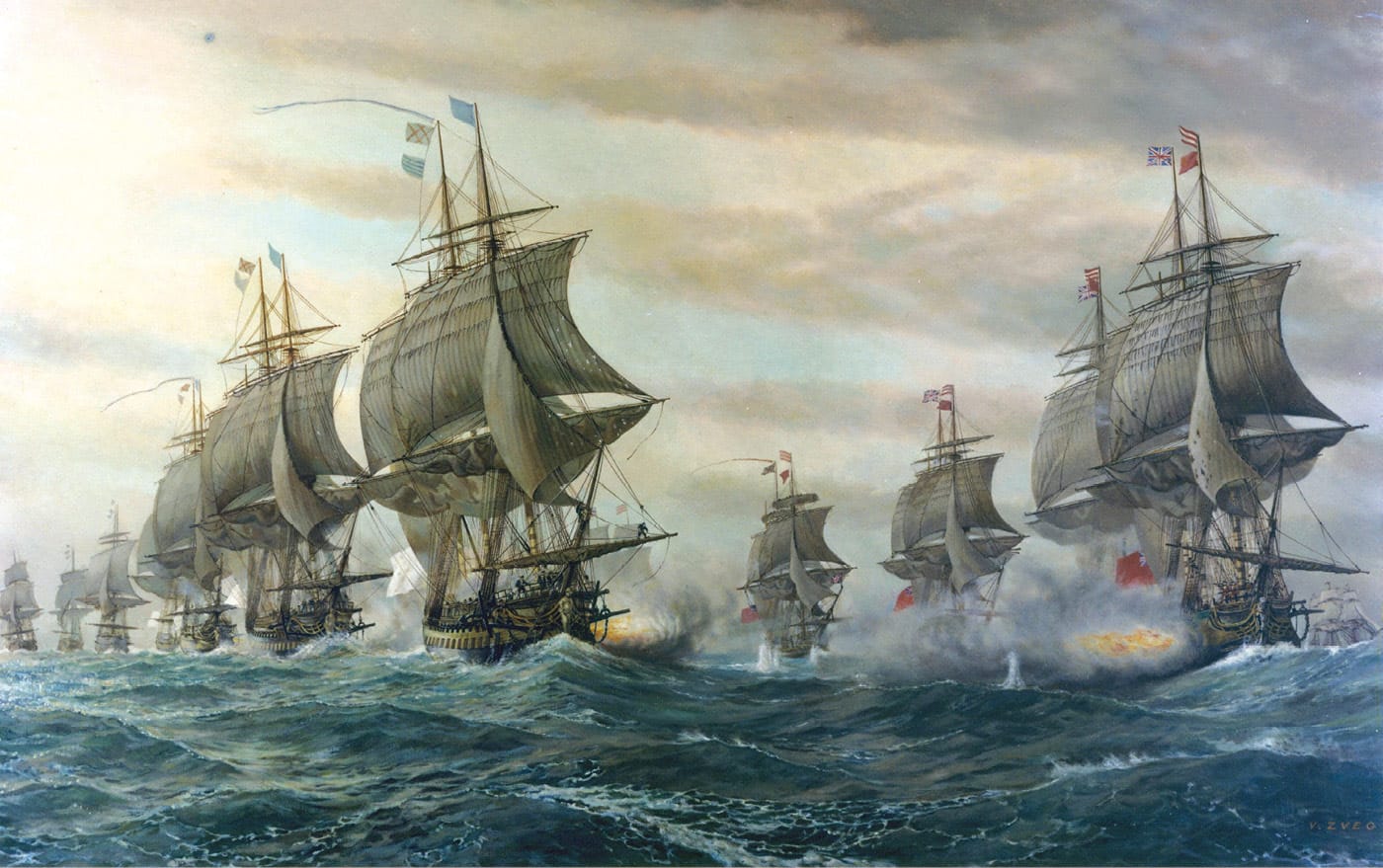
It would be a mistake, however, to see these three years of lost opportunities as an unrelieved setback. The threat of the French fleets created singular beneficial strategic results, a minuet of moves involving England, France, the American colonies, and the Caribbean. The Caribbean, from both French and British points of view, carried more economic and strategic value than the American colonies. In fact, as war spread across the Caribbean after France’s treaty with the Americans in early 1788, an estimated 33% of British naval power was concentrated there, versus 9% along the coast of the American colonies.
One of the purposes of the deployment of d’Estaing’s fleet to the waters off New York and New England in the Summer of 1778 was to draw British naval forces away from the Caribbean. This allowed the Spanish to successfully thread their yearly treasure fleet through the Caribbean. Once the treasure was secure in Spain, the Spanish crown had breathing room to finally join France in officially backing the Americans’ War of Independence, concluded in the Treaty of Aranjuez on April 12, 1779.
More directly, when the British cabinet learned of France’s alliance with the Americans in the early months of 1778, it ordered Henry Clinton to shift 8,000 troops to defend Florida and the West Indies, key spoils of the British, gained in the 1763 Treaty of Paris ending the Seven Years’ War. Clinton was forced to consolidate his remaining forces in New York, and abandon Philadelphia, his prize accomplishment of 1777.
Similarly, in October of 1779, Clinton ordered the evacuation of Newport in fear that French naval power could bottle up the 5,000 British troops there, and enable a combined French-American victory that “would be a second Saratoga.” Strenuous American and French direct attacks on Newport over the previous year had failed to dislodge the British.
However, the history of combat failures, weather challenges, and failure to coordinate the French naval capabilities and American-French ground forces, had reached such a point in the Spring of 1781, after the British repelled the French forces off of the Chesapeake Capes in March, that Washington wrote his former aide-de-camp John Laurens, then in France, that “we are at the end of our tether.” Even news in July that de Grasse was leading a French fleet from the Caribbean to Chesapeake waters left great uncertainty as to the timing of his arrival and possible counter-moves by the British. Washington was haunted by fears of a repeat of the debacle of March.
Hence his cavorting excitement on the shores of the Delaware River at Chester on Sept. 5, 1781, upon hearing that de Grasse had indeed arrived at the mouth of the Chesapeake—joy multiplied several-fold a few days later when he and Rochambeau received news that De Grasse had defeated a British fleet sent to dislodge him and rescue Cornwallis, who was digging in at Yorktown. The results of the March battle had been reversed. Cornwallis’s doom was sealed, and with it, Britain’s capacity to deny the Americans their independence.
Arms and Munitions
The second crippling deficiency the fledgling American military forces faced was munitions and arms. Gunpowder, in particular, was in excruciatingly short supply. It is well recorded that the determined American defense of Breed’s Hill (conflated with nearby Bunker Hill in popular lore) overlooking Charlestown and the Boston Harbor, which inflicted enormous and disproportionate casualties on the British, would not have eventually been forced to fall back, had it not been for the lack of gunpowder. But muskets, uniforms, shoes, artillery, and other essentials were also woefully inadequate.
The French, Spanish, and Dutch all stepped forward to supply these wants in a dense network of private and surreptitious arrangements. The Beaumarchais channel of supplies alone is credited with supplying a crucial margin of muskets for American victories at Trenton, Princeton, and Saratoga. The Dutch island of Sint Eustatius in the Caribbean quickly became a beehive of illicit supply to the American colonies. Barbara Tuchman, in her masterful 1988 book, The First Salute, delves deeply into Anglo-French-Dutch rivalries in the Caribbean and how they affected the American Revolution. Of note is that Britain took no effective action against Sint Eustatius until Catherine the Great of Russia’s League of Armed Neutrality brought Holland into its membership in late 1780, precipitating the Fourth Anglo-Dutch War. The most capable British naval commander of the period, George Rodney, quickly seized the Dutch entrepôt. But in one of the ironic items on the “chance” side of the strategic chalk board, he found such riches on the island to excite his cupidity—by one estimate, $30 billion worth of goods in today’s terms—that he delayed some four months to pocket a large portion and send the rest to England. By the time he was called upon to respond to de Grasse’s moves around the Caribbean and then toward the Chesapeake, he was headed to England for medical rest, in agonies of gout.
French Engineers
The third glaring deficiency in the nascent American fighting forces was the lack of an engineering corps. Here, the French performed a huge service to the American cause, not as great as the naval support, perhaps, but much more important than generally acknowledged. Ferreiro makes the point emphatically, citing the aphorism, “Amateurs study tactics, professionals study logistics.” Washington faced multiple daunting tasks in building a professional army, but “most of all, Washington needed engineers and artillerists.” How many people know the names of brilliant, indefatigable French engineers Louis Duportail and Antoine Felix Wuibert, who designed crucial fortifications and transport logistics throughout the war? Or that Beaumarchais was supervising the embarking of entire boatloads of French military engineers from the French port of Brest? Or that Poland’s Kosciuszko—the engineer who designed the fortifications on the Delaware that delayed the British assault on Philadelphia by several months, and who famously designed the first defenses at West Point as well as the defenses at Bemus Heights in the Battle of Saratoga—was trained in France?
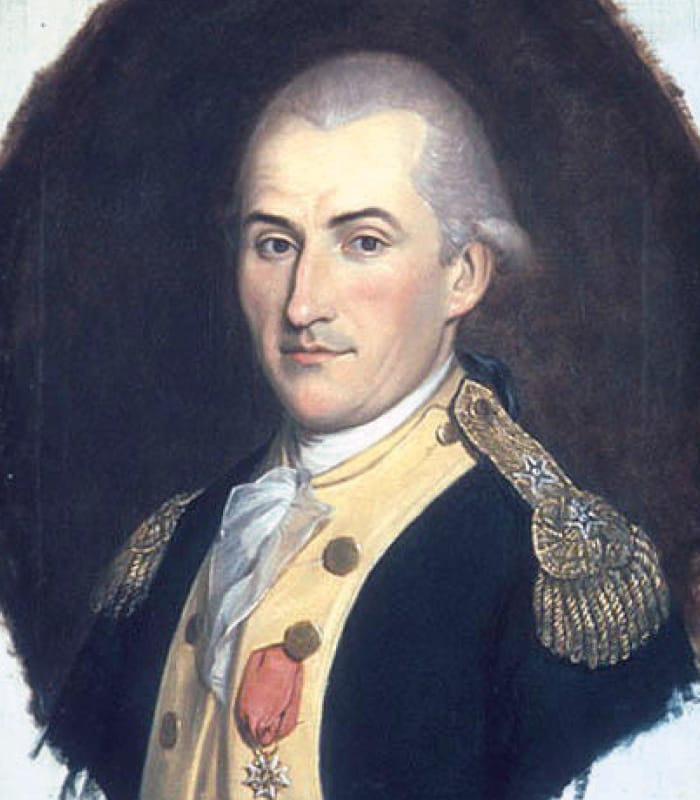
Ferreiro, in particular, does an outstanding job bringing this feature of French aid into high relief, with a special focus on Duportail and Wuibert. Duportail, for instance, designed one of the key forts defending Philadelphia south of the city, Fort Mifflin; laid out the camp at Valley Forge; and organized the logistics for the move of Rochambeau’s French army from Newport to Yorktown. And it was Duportail who first urged the building of a special military engineering academy at West Point, as early as the late 1780s—to be established in embryo form 20 years later by Jefferson, and brought into vigorous functioning in the 1820s, in close collaboration with the tradition of France’s École Polytechnique and Germany’s Göttingen University. As an aside, it is worth remembering that the question of engineering and physical infrastructure was the issue which provided both the spark for the founding of the famed École Polytechnique in France in 1794, as the École Centrale des Travaux Publiques (Central School of Public Works), and also the pathway to the Constitutional Convention in the United States. The 1786 Annapolis Convention, which issued the call for the Constitutional Convention the next year, was convened to resolve border disputes hindering the building of canals and other vital infrastructure.
The Latecomer: Spain
The Spanish role in providing vital aid to the American cause has been largely ignored in general histories, but both Philbrick and Ferreiro provide fascinating accounts. Though Spain did not officially enter the fray until 1779, it provided considerable under-the-table munitions and arms from the beginning. In addition, France, to placate British pressure in the early years not to provide aid to the American rebels, routed much of its help via Spain, and Lafayette’s first voyage to join Washington’s army left from Spain. But though joined to France as a fraternal branch of the Bourbon dynasty, the Spanish crown had its own agenda, focused on a face-off with the Portuguese over control of what would later become Uruguay, in South America. Portugal was planning to bring Britain in on its side, while Spain counted on France to back them. Charles Gravier, Comte de Vergennes, the great architect of French foreign policy throughout the American Revolution, realized that this would prematurely bring on full-scale French-British war across all of Europe. This could upend his careful steps toward backing the American cause as a way to drain off England’s energies in the Caribbean, rebalance much of the rest of the European continent in France’s favor, and eventually sever British control of the American colonies.
Vergennes’s efforts to restrain Portugal were helped by the American colonists’ demonstrations of pluck and endurance in the first two years of the war. Britain had to commit more and more resources to the conflict, making it less likely it would back Portugal in a showdown with the Spanish and French Bourbons. That pluck and endurance was key to a sequence of decisions Vergennes made to sharply intensify France’s involvement in the conflict. If it had looked as though the rebellion would fizzle out, that the colonies would resume British suzerainty, he would be caught with major French resources squandered and the country weakened vis-à-vis Britain just 12 years after the humiliating terms of the Treaty of Paris in 1763.
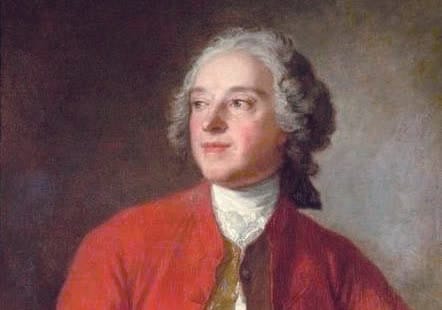
In May of 1776, the French court made the “momentous decision,” in Ferreiro’s phrase, to join Spain in sending two million livres’ worth of arms and munitions to the American insurgents via Beaumarchais’s Spanish-sounding front firm, Roderigue Hortalez & Cie. Two months later, when the Continental Congress adopted the Declaration of Independence, Vergennes’s judgment that the American insurgency had the commitment and staying power for a protracted struggle was justified. When news of the American victory at Saratoga in October 1777 reached him late in December of that year, Vergennes had the pretext for proceeding with the next step he’d already mapped out: a commercial treaty and direct French military aid to the American forces. A final huge step was to dispatch a major new fleet under de Grasse in the Winter of 1780-1781, at a time the French treasury was exhausted. But Vergennes doubled down on the French commitment.
The Spanish official entrance into the war in Spring 1779, set in train a fascinating sequence of moves which were ultimately decisive in winning the Battle of Yorktown. Key to this was a single enterprising and astute Spanish official, Francisco de Saavedra. The sequence, in stripped down form, was this. The most devastating series of hurricanes ever to hit the Caribbean struck in October 1780. This had two immediate consequences. It confirmed for the French that they had to move their fleet out of the Caribbean during hurricane season—something de Grasse fully absorbed as he moved his fleet toward the Chesapeake the next August. And it disabled British efforts to reinforce their forces in Pensacola, the keystone of control of West Florida. This enabled Spain, which had surrendered the Floridas to Britain in 1763 in a swap to regain the British-captured Havana, to retake Pensacola by mid-Summer 1781. This in turn freed up enough Spanish ships of the line for Saavedra to propose to de Grasse, that instead of de Grasse leaving six major ships in the Caribbean to protect France’s crucial harbor of Cap François on the northern coast of Haiti and taking 24 ships to the Chesapeake, Spain would supply the protection of the French interests, and de Grasse could take all 30 of his available ships north. The difference was decisive in his victory of the Capes over the British five weeks later.
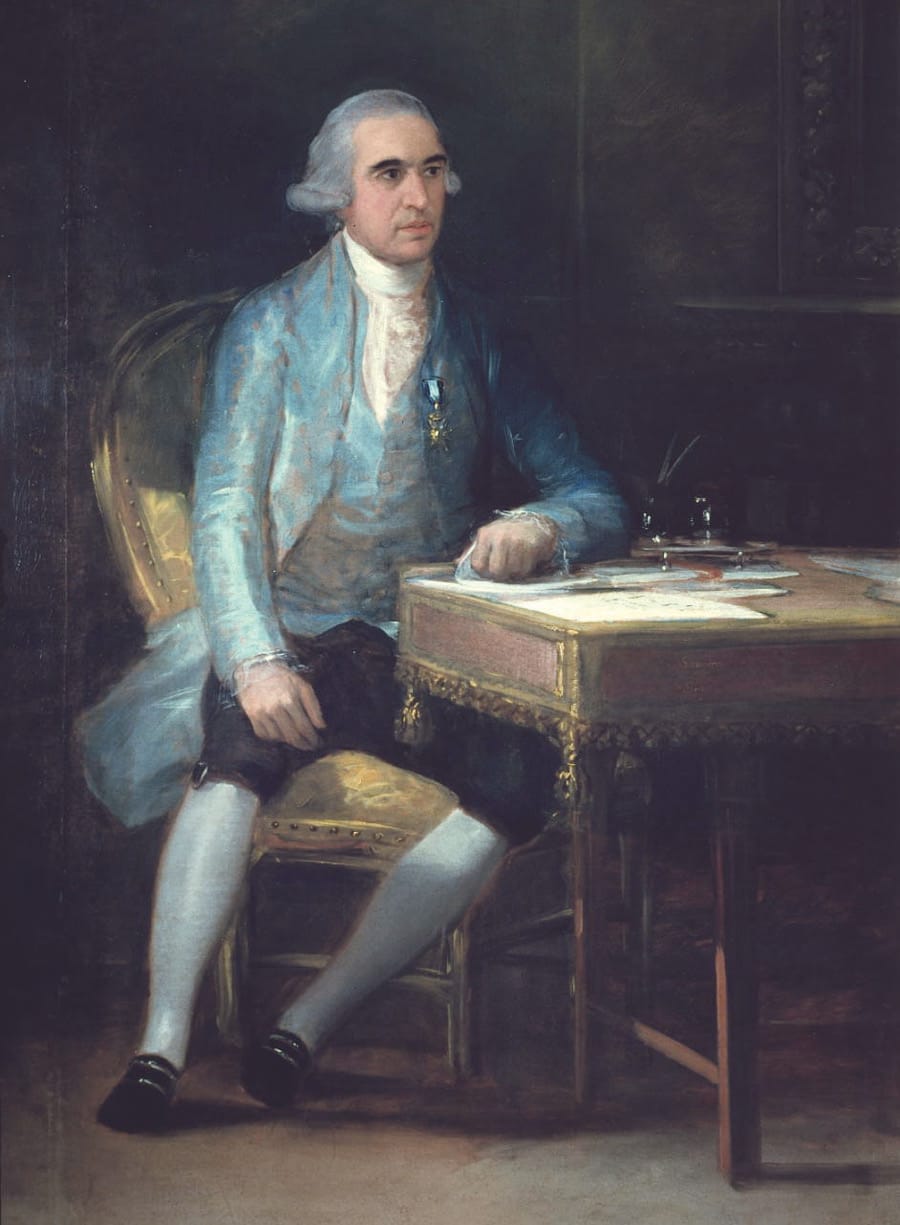
But there was still a problem of the hard specie that de Grasse needed to take with him to pay for Rochambeau’s army and his own fleet’s expenses once de Grasse reached American shores. The French planters of Haiti refused de Grasse’s appeals to lend the funds. In stepped Saavedra again. He persuaded the planters of Havana to come up with the needed 500,000 Spanish pesos in coin, with promises of repayment from the next Spanish treasure convoy, and rushed the funds to de Grasse. These were not only vital on their own account, but in a knock-on effect, hugely helped Washington in holding his army together. When Rochambeau and Washington learned in early September 1781 that de Grasse had arrived with the Spanish war chest in coin, Rochambeau gave Washington the remaining metal coins that he commanded—allowing Washington to make the first payment in hard currency that his troops had ever seen, at a time the paper money from Congress, “Continentals,” had lost almost all value. Along with heroic maneuvers by Washington’s finance chief, Robert Morris, this held Washington’s army together.
What Was in It for France and Spain?
The obvious question that arises in assessing the huge role played by the French and Spanish in aiding American independence, is whether it was essentially a means to get back at Britain for the losses in the Seven Years’ War. Would two monarchies truly back the republican ideals of the Revolution?
The answer is not a simple one. In geometry one could call it a “complex domain.” But it’s important to realize from the outset that only a very special kind of strategic conjuncture involving many levels of motives, could have created the space for the American Revolution to survive and prevail.
Ferreiro, in particular, does a masterful job of defining the intricate and evolving French and Spanish state motives. In 1774, as 19-year-old Louis XVI took the throne, “the expanding struggle between Britain and its North American colonists was far down on the list of priorities in both France and Spain, for there were other, more imminent threats in Europe and abroad.” In the case of France, counter-intuitively, “Britain was not of the most urgent of [France’s] concerns.” “Although the global balance of power had shifted dramatically in Britain’s favor, the island kingdom had been left without any strong allies in Europe, so France was still the dominant force on the Continent.” The issue was how “to protect its client states, notably Sweden, Poland, and the Ottoman Empire, from territorial claims by a resurgent Russia.” The Polish Partition in 1772, Russia’s seizing of Crimea from the Ottomans, and equivocal interests of the Austrian Queen Maria Theresa, all threatened France’s position, and potentially could present Britain opportunities to overturn the balance of power.
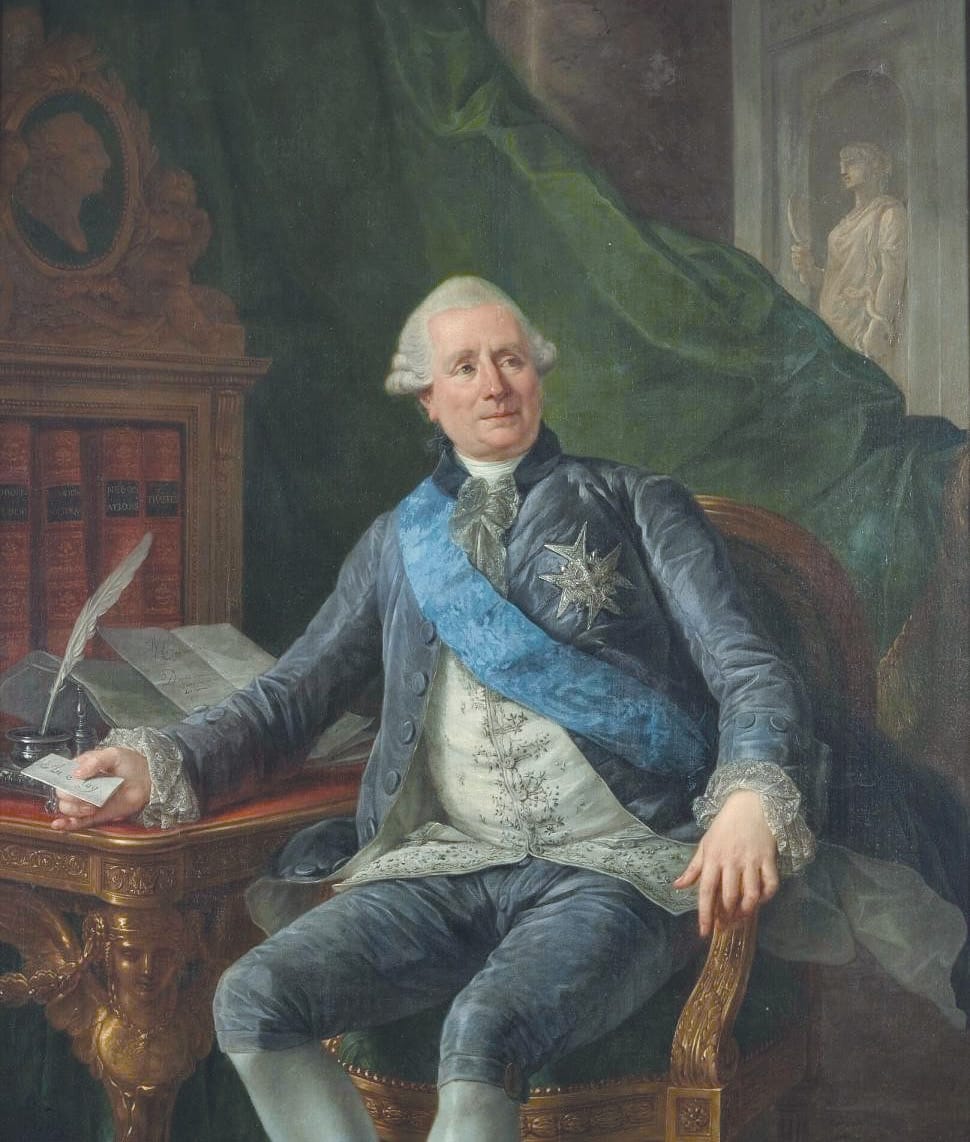
It was this shifting and complex calculus, with the Caribbean factor growing larger and larger, which brought France’s master strategist, Vergennes, step-by-step into aid to the American cause. As Ferreiro puts it, “The arms and munitions that flowed to the Americans through Beaumarchais’s fleet were aimed first and foremost at preventing a distant war between Portugal and Spain from erupting on the European continent. The Treaty of Alliance [with the Americans, February 1778] was intended to prevent America from unilaterally suing for reconciliation with Britain and thereby threatening the French and Spanish possessions in the West Indies. D’Estaing’s fleet [dispatched the Summer of 1778] was meant to disrupt and divide British forces in order to prevent them from destroying Washington’s army and reestablishing control over America. The stability of Europe under French supremacy, not the creation of an independent nation across the Atlantic, was Vergennes’s primary goal throughout the War of American Independence.” (emphasis added)
But on an entirely different plane, the French calculus was the door through which the powerful republican ideas that had long been maturing in the colonies, with input stretching from Italian Renaissance Cardinal Nicholas of Cusa, through circles of Erasmus, Leibniz, Swift, and other propagators of the concept of the “common good” or, in the Constitution’s phrase, the “General Welfare,” could emerge on the world stage, and in turn catalyze momentous republican efforts in South America, Europe, and eventually Asia and Africa.
One of the great arenas of that successor stage was France itself. It is little appreciated that the French Revolution of 1789 was, in fact, two revolutions. The first, led by such figures as Lafayette and Bailly, bid fair to bring the ennobling quality of the American Revolution, and its successful institutionalization with the 1787 Constitution, to dominance in France. The second, the Jacobin, nurtured by Britain to thwart the first, literally cut off the heads of the leaders of the first or hounded figures such as Lafayette out of France and into the prisons of British-allied Austria.
But both the flow of Platonic, humanist, republican ideas into the American colonies, and the way the success of the Revolution spurred efforts of companion thinkers in other parts of the world in the wake of its triumph, is a story much broader than any treatment can attempt here. For now, savor the way “the stars aligned” in a sequence of improbable events and daring gambles in terrain of almost impenetrable uncertainty, to yield the miracle so enthrallingly told in these two books.
Notes
- See “Essential Reading“ in the article “On the Eve of the 250th Anniversary of the American Revolution: Time To Ex-Hume the True Roots of Our Republic, and Un-Locke Its Founding Principles,” EIR, March 21, 2025.