The Lead
‘Peace Need Not Be Impracticable, and War Need Not Be Inevitable’: Sixty-Three Years on
by Jason Ross (EIRNS) — Jun. 10, 2026
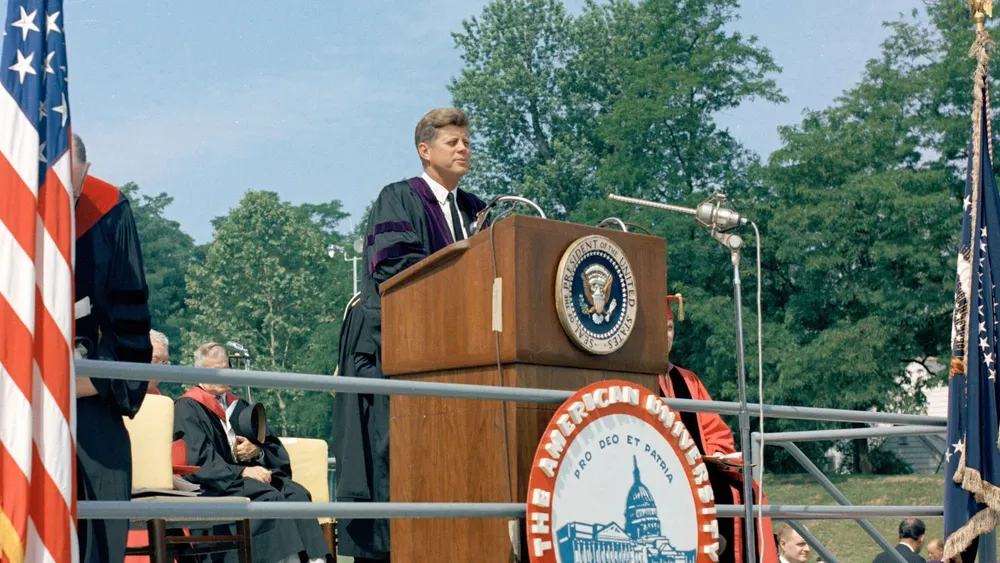
Sixty-three years ago, on June 10, 1963, President John F. Kennedy delivered the commencement address at American University—the speech that opened the path to the Limited Test Ban Treaty signed eight weeks later, to the U.S.-Soviet Hot Line agreement that followed, and to a redirection of his administration’s strategic posture away from the geometry that had allowed the Cuban missile crisis the previous October to develop. The address asked one question:
What kind of peace do I mean and what kind of peace do we seek? Not a Pax Americana enforced on the world by American weapons of war. Not the peace of the grave or the security of the slave. I am talking about genuine peace, the kind of peace that makes life on earth worth living, the kind that enables men and nations to grow and to hope and to build a better life for their children—not merely peace for Americans but peace for all men and women, not merely peace in our time but peace for all time.
The world’s problems, Kennedy insisted, are not problems of cosmic destiny but of human design.
Our problems are man-made—therefore, they can be solved by man... No problem of human destiny is beyond human beings. Man’s reason and spirit have often solved the seemingly unsolvable, and we believe they can do it again... peace need not be impracticable, and war need not be inevitable.
We are asked today to test, through our actions, whether that proposition still holds.
The picture against which it is tested is bleak. Yesterday evening, U.S. Central Command announced three rounds of “self-defense” strikes against Iranian air defense, ground control, and radar installations near the Strait of Hormuz, in response to the downing of a U.S. Army Apache helicopter the Pentagon itself cannot confirm was a deliberate Iranian act and which may have been an accidental collision with an Iranian Shahed drone. The “self-defense” claim, as we report, is itself a fiction: the U.S. naval blockade of Iranian ports is by definition an act of war, and Iranian counter-actions against its enforcement are by definition acts of self-defense. Iran responded with strikes on the U.S. 5th Fleet headquarters in Bahrain and on Muwaffaq Salti Air Base in Jordan. Across the Lebanese border, Israeli drones broadcast recordings of crying children to lure civilians out of their homes, using a tactic the IDF has practiced in Gaza. Israeli National Security Minister Itamar Ben-Gvir proposes rounding up the wives and children of suspected Hezbollah members and throwing them into Israeli prisons notorious for systematic torture and sexual abuse. Ukraine and Russia exchange strikes. The “Coalition of the Willing"—Starmer, Macron, Merz, Zelensky—convened in London on Sunday to reaffirm that all of this is going to continue.
None of this is what Kennedy called for in 1963.
The 250th anniversary of the signing of the Declaration of Independence is only weeks away. Yesterday we published the LaRouche Organization’s call “America at 250: Will We Now, As We Once Did, Come to the Aid of Our Country?"—which names the immediate provocation: a UFC brawl scheduled for the White House lawn on Flag Day, Sunday June 14, being framed as an official celebration of the republic’s founding. The LaRouche Organization contrasts the wrestling match with the Continental Congress of June and July 1776, “the most intensive deliberation on the principles of self-government to have occurred in history since at least the time of Athens, two thousand years earlier,” and proposes a “Trans-Continental Congress on the Inalienable Rights of Man.” The piece reaches back further still, to John Quincy Adams’s July 4, 1821 warning that, by going abroad in search of monsters to destroy, America “might become the dictatress of the world. She would be no longer the ruler of her own spirit.” The June 10, 1963 speech and the July 4, 1821 speech are addressed to the same nation about the same question. It is a question facing us today.
Against the architecture of war, an architecture of peace is being built—incomplete, contested, but visible. Pope Leo XIV—first American pope, the Chicago native who has spent the past week addressing audiences of hundreds of thousands in Madrid on what it means “to be truly human”—will receive the National Constitution Center’s Liberty Medal on July 3 on Independence Mall in Philadelphia, by live telecast from the Vatican. Diane Sare’s independent presidential campaign event follows in Philadelphia on July 5. Helga Zepp-LaRouche’s call for a new security and development architecture continues to gather support, and the Berlin Schiller Institute conference she convened on May 30—"The End of 500 Years of Colonialism: For a Dialogue of Civilizations"—supplied the framework for a path forward.
Other signs of the same architecture belong on the record. At the Asia Society on Monday evening, Kuomintang Chairwoman Cheng Li-wun—whose April 2026 trip to the mainland was the highest-level contact across the Taiwan Strait in ten years—gave veteran China-skeptics a roadmap for cross-strait peace. Her message to Washington was direct: “You can only Make America Great Again by figuring out a way to live with China, not by going to war.” At St. Petersburg on June 4, Putin reconfirmed Russia’s offer to remove Iran’s enriched uranium for dilution under IAEA control—the mechanism that made the 2015 JCPOA possible. In Madrid this weekend, Pope Leo XIV told 600,000 youths in vigil to be “the sparks of a new humanity.” Today in Barcelona, on the exact centenary of Antoni Gaudí's death, Pope Leo XIV blessed the recently completed Tower of Jesus Christ at the Sagrada Familia—the basilica in its 144th year of construction. The Pope’s choice to inaugurate this tower on this date points to time horizons longer than the political weather. And Inter-Bering’s Fyodor Soloviev told EIR that Chinese involvement and Chinese freight could carry the Bering Strait tunnel to a higher economic platform: “The most interesting effect lies not in the benefit to any one country, but in the creation of new infrastructure on a global scale.”
The arc Kennedy described at American University did not bend toward peace by itself. He pushed it. Less than two months after the speech the test-ban treaty was signed. Less than four months after that, he was murdered. How will we now bend the arc of history?
Kennedy closed his American University address with this:
[W]e shall do our part to build a world of peace where the weak are safe and the strong are just. We are not helpless before that task or hopeless of its success. Confident and unafraid, we labor on—not toward a strategy of annihilation but toward a strategy of peace.
The Continental Congress, in June and July of 1776, faced the same question you face today: whether the people would do the work peace requires. Pope Leo XIV, addressing the 250th-anniversary nation from the Vatican on July 3, will pose it again in his own voice. Diane Sare, in Philadelphia on July 5, will pose it again in hers.
The interval between now and July 3 and 5, belongs to us.
Contents
Strategic War Danger
- US-Iran Strike-Counterstrike Escalates Near Hormuz (↓)
- Taiwan Fires U.S. HIMARS Into Taiwan Strait During Cheng Li-wun's Washington Visit (↓)
New World Paradigm
- Bering Strait Expert: Bering Strait Tunnel Will ‘Create New Infrastructure on a Global Scale’ (↓)
- Cheng Li-wun Presents Asia Society a Roadmap for Cross-Strait Peace, a Message to Washington, and Precedents for a ‘Miracle’ (↓)
- China Inaugurates Construction on Three Gorges Dam New Waterway Project, Key to the Nation's Efficiency (↓)
History and Culture
Harley Schlanger Update
Watch The Daily Update with Harley Schlanger, a short video update available every weekday morning from The LaRouche Organization.