The Lead
The World at a Conjunction Point
by Marcia Merry Baker (EIRNS) — Jun. 17, 2026
FLASH: Tonight at the Palace of Versailles, the new 14-point Memorandum of Understanding between the United States and Iran was digitally signed by President Donald Trump and by Iranian President Masoud Pezeshkian.
The world stands at a conjunction point. We hope that announced plans proceed associated with the new memo of understanding between U.S. and Iran representatives—for which a ceremony is said to be set for Switzerland Friday, mandating a ceasefire, and other terms, and the beginning of 60 days of further negotiations. At the same time, the only way ahead for humanity, is for the Oasis Plan approach in the immediate and extended region. It is needed internationally as well, given the economic shock waves coming atop the pre-existing breakdown process in the economies under the Western system.
There is positive diplomacy around this moment. Turkiye Foreign Minister Hakan Fidan met today with Russian President Vladimir Putin, in Kazan, where top leaders from 11 nations are gathered for the Russia-ASEAN annual forum. There are proposals for collective security in the Southwest Asia region from former government officials in Turkiye and Egypt, which in some respects dovetail with that of Putin’s own proposals in recent years, and are coherent with the Oasis Plan approach. An interview was posted yesterday with Hussein Askary, Southwest Asia coordinator for the Schiller Institute, on The Cradle, titled, “How an Iranian Victory Is Redesigning the Geography of West Asia.”
Pope Leo XIV expressed the view of billions of people when, in an interview, he said, “Thank God, there is at least this Memorandum that they will officially sign on Friday….There will still be several points to be established, but it is always better to do so through dialogue, through negotiation, rather than returning to war.”
But the danger continues, for many combined factors. President Trump, at his press briefing following the end of the Group of Seven in France today, claimed victory. While he thanked the leaders of many nations, from Qatar, the UAE, Egypt and others, and thanked both “Putin and Xi, [for the way] they remained neutral,” concerning the U.S.-Israel war on Iran, he otherwise gave a blustering might-makes-right speech. He held forth on how he had stopped Iran after 47 years, from threatening the region. “A 100 percent they would have used a nuclear weapon.” He said that groundwork for this week’s memorandum of understanding was laid by him when he killed Iranian Gen. Qassem Soleimani (Jan. 3, 2020) in a drone strike, which he elaborated on. If the new deal doesn’t work, “then back to bombing.”
Meantime, the economic shocks roll along. Trump may have hallucinated today, “We have the strongest economy that we have ever had,” but he made several references to how, he did not want to be “a Herbert Hoover president,” attached to a depression. This shows unusual accuracy for Trump, although there is no indication he realized what he was saying. The reality is that the economic shortages, shutdowns and chaos will have ongoing effects, soluble only by sound intervention.
The most basic means of life are at stake for multi-millions of people. The UN “Hunger Hotspots” report was released today by the UN Food and Agriculture Organization and World Food Program. Identifying 13 countries where the lack of food will worsen from this month to November 2026. Across these nations, about 266 million people face severe food shortages. The Iran War shocks came on top of the fact that food relief, emergency farming support and medical help in these locations dropped by an estimated 59 percent between 2022 and 2025, while their economic development was also held down.
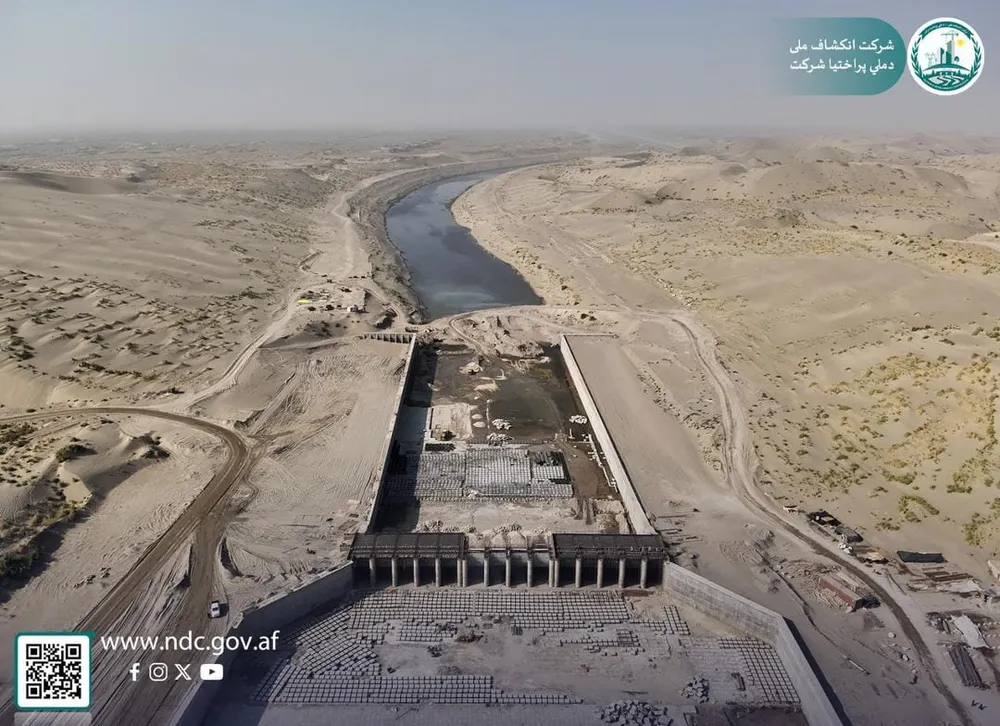
Despite terrible hardship, there are initiatives for development. For example, in Afghanistan, Iran’s neighbor to the east, where thousands of Afghans have moved back to their homeland from working in Iran, because of the regional warfare and chaos. In the spirit of the extended Oasis Plan, Afghanistan is doing all possible for upgrading its agriculture. Its Qush Tepa Canal for irrigation in the north is proceeding. This weekend, the Ibn Sina Research and Development Organization (ISRAND) is holding a virtual international event to confer on best measures for improving farmers’ skills in Afghanistan.
The Extended Oasis Plan approach is the concrete expression of the principle of peace through development. Two important new statements in this regard were issued today. In Beijing, Foreign Minister Wang Yi held a press conference, speaking of China being a builder of world peace and contributor to global development, and releasing a new white paper, More Just and Equitable Global Governance: China’s Principles, Proposals and Actions.
Helga Zepp-LaRouche, founder of the Schiller Institute and Editor-in-Chief of EIR, released a new paper today, “Urgent Appeal from Pope Leo XIV: ‘Stop! Repent! Before It’s Too Late!’ The New Name for Peace Is Development!” Zepp-LaRouche’s document, which reports on the Pope’s encyclical Magnifica Humanitas, and his recent speeches in Spain, includes a call to action. Her paper is posted now on EIR.news.
This coming International Peace Coalition Friday, June 19, will be the chance to confer on this.
Zepp-LaRouche said today on her weekly Schiller Institute webcast: “Given the extraordinary importance of this encyclical, that will be a major topic [on the IPC]; how to increase the mobilization in all five continents to put the demands of this encyclical on the table of governments and institutions. Naturally, this will be on the same day the Iran deal will be signed in Switzerland, so that we will have speakers from the region on that topic. So obviously, we will re-evaluate where we are strategically after the G7 meeting in respect to Ukraine.
“So please join, because we need activists, and whatever an individual can do in times like that is absolutely decisive, because these are the moments in history where the intervention of a lot of good people who joined for a good plan can move history in a better direction and maybe reach a new paradigm where we leave the horror of solving problems through war behind us for good.”
Contents
New World Paradigm
- Mauritanian Defense Minister Seeking Security Cooperation among Sahel States (↓)
- China Issues White Paper on Global Governance (↓)
Strategic War Danger
- Poland Wants 15,000 Permanently-based U.S. Troops (↓)
- Ukrainian Drone Hit a Bus Carrying Children from Belarus to Bryansk (↓)
Collapsing Imperial System
- Brazil's Eduardo Bolsonaro Sentenced to Four Years in Jail (↓)
- Lula Da Silva Lists G7 Economic Policy Failures to G7 Leaders (↓)
- UN's Guterres Visits Haiti amidst Deteriorating Security Situation (↓)
- Is the Congress for Cultural Freedom Still Active? Saunders' Expose Re-published in Italy (↓)
- Trump Gave Iran Victory Speech at Post-G7 Press Conference (↓)
U.S. and Canada
Science and Technology
Harley Schlanger Update
Watch The Daily Update with Harley Schlanger, a short video update available every weekday morning from The LaRouche Organization.