June 23—Alan Greenspan, who played a leading role in four decades of transitions, has himself transitioned. He died on June 22, 100 years old, after a career in which he was in the forefront of the neoliberal revolution which inaugurated forty years of boom-bust cycles, threatening to unleash a new, devastating global implosion today.
After meeting Ayn Rand in the 1950s, he became an advocate of the gold standard, writing an essay in 1966, “Gold and Economic Freedom,” in which he asserted, “In the absence of the gold standard, there is no way to protect savings from confiscation through inflation. There is no safe store of value.” Five years later, on August 15, 1971, when U.S. President Richard Nixon was induced to scuttle the Bretton Woods System, with its gold-reserve policy, Greenspan shifted his view to embrace monetarism as his economic safety zone.
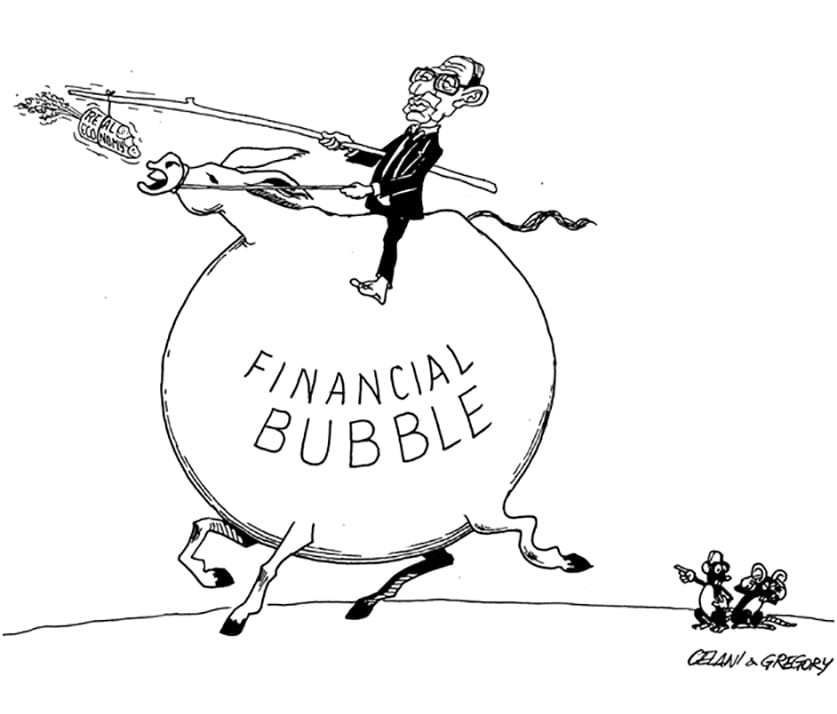
He was named the Chairman of the Council of Economic Advisors in 1974 in the Gerald Ford Administration, from which perch, serving until 1977, he advocated interest rate targeting and deflationary austerity policies, to address inflation. He became a leading spokesman for free market dogma, fitting in with the “Big Bang” Thatcherite agenda of combining austerity, and budget and tax cuts, with privatization and deregulation, which produced the boom-bust cycle of the last forty years. Cheap credit and relaxed regulations fueled the speculative boom, while bailouts were extended to the speculators when the inevitable busts hit, contracting the physical, productive economy, which was starved for credit.
The transition to the boom-bust cycle included changes in tax and regulatory policies which favored the Milken-era merger & acquisition/leveraged buyout fever, which transitioned to “financial innovation” swindles, including securitization, collateralized debt obligations (CDOs), and an explosion of derivatives trading—all of which Greenspan praised as signs of increasing democracy and openness of financial markets. The results of these changes have been at times catastrophic, as was the October 19, 1987 stock market crash, forecast with great precision by Lyndon LaRouche; the 1997 Asia crisis, and the 1998 Russian bond-market default and the collapse of Long-Term Capital Management; the popping of the 2000 dot-com bubble; and the 2007 near-melt-down of the financial system due to the blow-out of the mortgage-backed securities market, fed by the repeal of Glass-Steagall in 1999, also forecast accurately by LaRouche.
Throughout this period, Greenspan, who was Chairman of the Federal Reserve from 1987-2006, was a leading proponent of getting rid of Franklin Delano Roosevelt’s 1933 Glass-Steagall banking regulation, which Greenspan’s allies in the Congress chipped away bit by bit, until it was fully repealed in 1999 by the Financial Services Modernization Act. This was followed by the 2001 Commodities Futures Modernization Act, which opened the floodgates for unprecedented speculation, derivatives, and unpayable claims.
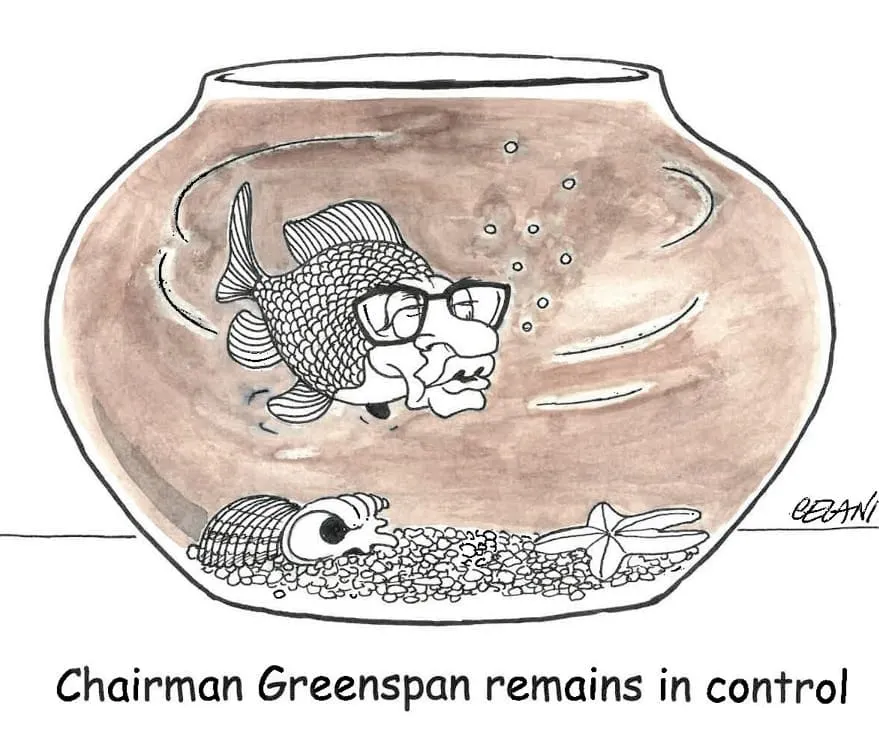
Greenspan’s idiocy was visible to anyone who understood economic science. For example, take his musings about the nature of financial bubbles. A believer in the Adam Smith–derived theory of efficient-market hypothesis, Greenspan famously pronounced that it is hard to know the difference between an asset bubble and physically-supported economic growth. In a speech in 1996, he asked how we know “when ‘irrational exuberance’ has unduly escalated asset values.” LaRouche, who sometimes referred to him as “Bubbles Greenspan,” stated that Greenspan’s record proved that he, clearly, did not know.
His often obtuse verbal utterances and ramblings convinced people that he was some kind of genius, and that it was necessary to have his “Greenspanese” pronouncements translated into English.
However, the record shows how the damage Greenspan did was far more than merely innovating Fed argot to cover malfeasance. Look more closely at his personal record on bringing about the repeal of the Glass-Steagall Act. He played a fundamental role predating his chairmanship of the Fed, although he was able to “finish it off,” so to speak, during his Fed tenure. He operated through his consulting firm, Townsend-Greenspan & Co., from 1955 to 1987, interrupted only by his 1974-1977 service as Chairman of the Council of Economic Advisors.
At key moments over the decades since the 1950s, he put out various narratives for dumping the 1933 Glass-Steagall law, and even used his various positions to act as if it were already defunct. He was chief economist for J.P. Morgan & Co. in the 1970s, and then joined the board at J. P. Morgan (1984-1987). His predominant line was that U.S. banks must be allowed more “freedom” to remain “competitive” and dominant in the financial world.
In November 1987, for example, a month after the October 19 stock market crash, Greenspan, newly confirmed as Fed Chairman, argued for the repeal of Glass-Steagall at a hearing of the House Subcommittee on Financial Institutions Supervision, Regulation and Insurance: “If we do not change or alter the regulatory structure under which banking exists, I think over the years there will be a gradual decline in position of commercial banking in the financial system.”
At the Federal Reserve he approved mergers and related activities in clear violation of the Glass-Steagall Act, before its repeal in 1999. He gave his OK in 1998 for Citicorp to merge with Travelers Group, for a bank to acquire an insurance firm.
Unfortunately, the damage he did over his career, along with his fellow City of London operatives such as Henry Kissinger and Paul Volcker, continues to threaten to unleash an economic collapse which could radically reduce global population, as Kissinger openly advocated. It were good for humanity if his economic theories were interred with his bones.