Let your mind take flight to the year 2050. Pause and allow that moment to come alive in your mind. Imagine the 10 billion—or more—human beings that make up current humanity, one quarter of them living on the African continent, and realize that for the first time in human history, poverty has ceased to exist, a relic of what is thankfully a bygone age. Life expectancy is much longer than a generation ago; advanced infrastructure systems have made water and food shortages a thing of the past; nearly limitless energy is supplied with nuclear power—both fission and fusion. What got us here, to this much more human condition?
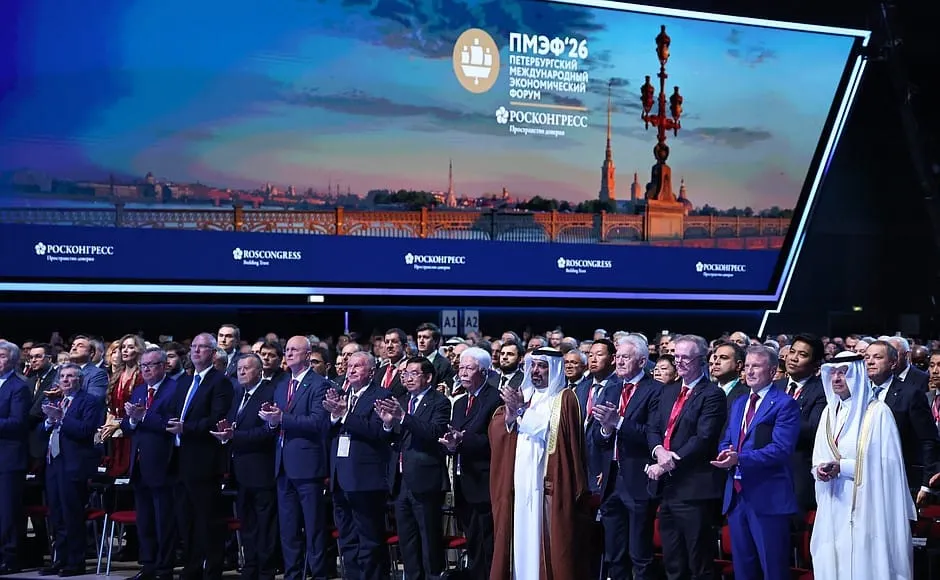
Some unwise cynics, suffering under the pessimism of a collapsing culture in the West and forgetting what it means to be human, will likely protest that this is a naïve, idealistic fantasy. However, anyone who witnessed the just-concluded St. Petersburg International Economic forum (SPIEF), at which 24,500 participants from 142 nations came together to discuss proposals for economic development in a new, emerging post-colonial paradigm, realizes that this future is already underway.
“The world [is] undergoing the largest structural transformation in decades,” Russian President Vladimir Putin told the SPIEF plenary session on June 5. “This transformation is not a transition from one phase of a cycle to another. We are witnessing a change in the paradigm of global development…”
Vice President of the People’s Republic of China Han Zheng emphasized to the gathering the great priority China is placing in the immediate period on transforming the global governance system to better serve humanity in a multipolar world. “China intends to strengthen cooperation with Russia and other countries through the Global Governance Initiative, and work together towards a world of openness, tolerance, equality, justice, and mutually beneficial cooperation.”
This is no idle statement, as China has lifted 800 million of its people out of poverty over the past four decades, and since 2013, has extended win-win cooperation for economic development to other nations through its Belt and Road Initiative.
Also percolating in discussions at SPIEF was the perspective for building the Bering Strait Tunnel, which Russian Direct Investment chief Kirill Dmitriev announced is about to move forward into the design phase, with possible Chinese collaboration.
While, in one sense, momentum toward a new era of mankind is unstoppable, there are certainly those in the Epstein-class Western elites who would like to stop it—even, and perhaps especially, if it means driving the world into the chaos of economic collapse and world war.
We see this in the continuing nuclear-tinged militarization of Europe, a de facto austerity policy for the population justified by shrieks of a looming threat of invasion from Russia; we see it in the illegal US–Israeli attack on Iran, with continuing clashes between Iranian and US forces in the Strait of Hormuz keeping the situation on a hair-trigger; we see it in the refusal of European “leaders” to give up the war in Ukraine, even down to the last Ukrainian; we also see this in the fact that on June 4, the House Armed Services Committee of the US Congress voted up a $1.15 trillion Defense Authorization Bill to feed the maw of the war-and-Wall Street imperial cancer.
The tension between these two simultaneously existing futures grows by the hour, and the confluence of two, opposing dynamics in human history erupts into a complex, seemingly chaotic array of so-called current events. Overcome the temptation to explain these events from a level lower than that on which the human species of 2050 has done away with war as a method of conflict resolution.
“For the love of truth, I invite everyone to set aside the divisive and polarizing narratives of your societal reality and history,” Pope Leo XIV told an audience of diplomats and other officials in Madrid on June 6, “so as to overcome sterile simplifications through the fruitful appreciation of complexity.” The Pope continued, “Security, which we all too often expect to find in weapons and walls, is in fact best achieved by learning to move forward alongside one another, growing together, side by side,… transforming inevitable conflicts into new beginnings.”
This is exactly the theme of Helga Zepp-LaRouche’s recent press release, “Germany’s Defeat at the UN, an Opportunity to Change; Germany Must Cooperate with the Global South!” in which she states, “Viewed from a deeper historical perspective, Germany’s failure to win a rotating seat on the UN Security Council offers an urgently needed opportunity to reorient German policy. This author has long argued that, in light of the entrenched geopolitical confrontation between NATO, on the one hand, and Russia and China on the other, the Global South needs to make its voice heard more loudly and forcefully in the international debate—and that is precisely what these states have done by rejecting Germany’s candidacy. German institutions should use the result to conduct an honest analysis of a foreign policy, that has clearly been a complete failure, and to redefine one corresponding to Germany’s true interest.”
What Zepp-LaRouche states for Germany must be taken as marching orders by citizens of goodwill across the West: Seize the window of opportunity to turn “inevitable conflicts into new beginnings,” and join the rest of humanity to bring the new future paradigm into the present.