Aug. 28—The following is an edited transcript of the opening portion of a presentation given by John Sigerson, music director of the Schiller Institute–U.S.A. and of the Schiller Institute NYC Chorus, on the Aug. 21 Friday Symposium, hosted by Diane Sare, independent candidate for U.S. President. The video is available here, and readers are encouraged to listen to the full presentation.
The discussion took place as Maestro Sigerson is preparing to conduct Beethoven’s Ninth Symphony in New York City on Sept. 11, with a 60-piece orchestra and full chorus from the Schiller Institute NYC Chorus. Information about that performance, and how to register to attend—both in-person and online—is available here.
The event in Manhattan will at the same time celebrate the 250th anniversary of the founding of the United States, and commemorate the 25th anniversary of Sept. 11, 2001, remembering those lives lost then and later, and those who responded selflessly to that terrorist attack. The Fire Department of the City of New York will conduct the honor guard for the concert.
Appropriately, Beethoven’s Ninth is being performed in many U.S. locations this 250th anniversary year. The Colorado Orchestra will do it Sept. 11 and 13 in Denver. In March, the Southeast Iowa Symphony Orchestra performed it in three cities. The National Symphony Orchestra and The Washington Chorus performed it on August 14 outside Washington, D.C., where conductor Gianandrea Noseda participated in a pre-concert lecture on the inspiring impact of the American Revolution internationally.
Diane Sare: … John, why is it relevant that we are having this discussion when we’re about to have a nuclear war?

John Sigerson: The only way that you can effectively, emotionally handle what is going on right now, is to take personal responsibility for the future of all humanity. Anything less than that won’t work. And that’s the function of art, great Classical art: that is precisely to touch that part of you that is willing to, in a certain sense, surrender your cynicism and your sense of impotence to a higher goal, which is the goal of the potential eternity of the human species as a creative species in the universe. You have to think, you have to start it from that standpoint and nothing less.
The reason why we’re putting on the concert, using Beethoven, is because Beethoven embodies precisely that principle, both in the way he thought and the way he composed; other composers, too, but Beethoven really has a special place. The Ninth Symphony, the crowning last symphony that Beethoven wrote in the early 1820s, is a perfect representation of that, because it also embodies a beautiful poem by Friedrich Schiller, who wrote it over 20 years previously, which was called the “Ode to Joy.” The only way you can approach these things, these horrible things, and not run out of the room screaming, and not just block it out, is to be able to deal with it on the appropriate level that Beethoven and Schiller do it.
The main phrase—the most simple phrase—which you’ve probably heard is, “All men become brothers under your gentle wing,” under joy’s gentle wing. And that is all men. And when Schiller was doing that, he was reflecting something that was in the Declaration of Independence as well: that all men are created equal. All men; not just Americans, everybody. The Declaration of Independence, which we’re celebrating this year as well, embodies that idea, that this is a universal idea. This is not just an idea about the United States getting rid of the British. That’s important, but much more important is setting a principle that all men are created equal. And the only way we can solve these things is not through wars, but through actually having discussions and working things out.

With that said, I want to step back a section, because it’s not just music; it’s also poetry. Diane helped me dig up a wonderful video clip of Lyndon LaRouche at his 75th birthday, which was in 1997. It was a celebration that was held at a hotel in Washington, D.C. Then later on, there was a separate, private celebration out at the farm that he had in Virginia. This was a really wonderful event. It had top singers. One of them was William Warfield, who worked very closely with the Schiller Institute up to the time of his death about a decade later. It had other people, like Sylvia Olden Lee, who was one of the top accompanists and vocal coaches of that era. Actually, I sang at that event, too. I sang the Beethoven song “Adelaide,” which is a beautiful German song.
The video clip has Lyndon’s comments, and he starts pretty loosely. He was introduced by Dennis Speed of the Schiller Institute, who had made a certain comment about people not knowing how to recite poetry anymore, because William Warfield, in addition to being a tremendous baritone, was also an incredible poetry reciter.
So, this is a clip of Lyn talking about Bill Warfield and about himself, Lyn, because he also, with all due modesty, said that he also had a certain gift for poetry.
LaRouche: Evoke Ideas in Other People
I want to make one reply to this gentleman [Speed]. Now, he was somewhat in error. I did not include Bill among those Americans who could not recite poetry. I said, particularly, there were a few of my generation….
Obviously, Bill knows poetry, and is an exponent of poetry in the best sense. I would like it if you take away today, a reflection upon what Bill exemplifies in his mastery of poetry. That is, we live in a culture which I’ve been complaining about, which is superficial. The study of beauty is how to simulate it. For poets, beauty is the joy of discovering truth, of solving a seemingly impossible paradox and finding a truthful solution to a paradox. We speak of something as being beautiful properly, because it evokes within us that sense of beauty which comes from a child solving a problem—that sort of thing.
So, people then try to find a way of simulating beauty, which is not there, and hoping they can deceive somebody into doing that. So, they pick up a poem, and they try to recite the words. Or they read the notes, and they try to perform the music from the notes. They do not realize that words can never contain an idea. Words can create a paradox, a metaphor, which challenges the mind. Words can then describe the result when the discovery of a solution has been made. But in-between, the process of discovery—[which occurs in] the mind; [the process of discovery] of the idea—cannot be put in words. It cannot be put in notes on paper. You must submit to the process of re-experiencing the discovery of the idea.
Then, if you are a great artist like Bill Warfield, then you look in the soul of the person to whom you are singing or speaking and try to force their mind, within their skin, to develop the same idea. You do not try to be pretty. You do not try to be beautiful. You try to convey an idea to a human being, not with words, but by using words like a bridge into the inside of their mind, to evoke inside their mind the undeniable existence of the idea which then exists there.
And I think that Bill demonstrated that, which is why so many people prize him as a teacher still now; he’s doing a little less work, but he’s a teacher, and people want from him the ability to do that which he has mastered in his life. I would say the time is for all of us to be artists in that sense, to get through the bonds of superficiality, to break beyond the surface; to live in the realm of ideas. Because what is needed now in an agonized world, a world that for many is tumbling apart, is to evoke from troubled people a sense of real ideas, so they can learn back not only the nature of, how do I interpret these words, how do I simulate beauty, how do I seem to be wise, how do I appear to be smart, or appear to be well-informed, but rather a sense of how do I know what to do.
And the most important thing to knowing what to do, how to do, is to be able to reach inside the mind of another person, and bring forth within that person an idea which they need. And we have to be all artists in that sense, and therefore I would like to correct in particular Dennis Speed on that point, because Bill, again today, has always exemplified what the real artist is. And what we should learn is—as Helga was assigned to do in the conference and did so well; what we have to go out and do is all be artists, each in our own way; to evoke ideas, informed ideas within other people; not throw the wrappings of a gift at them, but give them the gift itself.

Sare: That’s great.
Sigerson: Yep, that’s Lyn. He hit the nail right on the head, as usual; that when you’re approaching a great work of music like the Ninth Symphony, which is what we’re going to perform, and especially when you’re trying to conduct it, and getting all the details and so forth, it’s all the more important to keep that overview in mind in terms of what you’re doing, and not just to go down to what I might call the Toscanini principle. If you don’t know who Toscanini is, don’t worry about it, because all you need to know is that he would say, like the famous TV show [Dragnet], “Just the notes, ma’am.” It was Jack Webb, right? “Just the notes, ma’am,” and so forth.
The great conductor, Wilhelm Furtwängler, who was completely the opposite, said, “No, you can’t do the notes. You have to conduct between the notes.” He said there’s actually two types of hearing in terms of how you hear something. There is so-called nahören, which means close-in hearing, but then the most important thing, he says, is fernhören, listening from a distance. That is, you’ve got to hear with a broad perspective, and can you look at some great work or a great piece of poetry—for instance, Dante’s Commedia, the Divine Comedy—can you comprehend that entire work in an instant? Can you have that in your mind as a single “one” of an idea, even with the greatest works? That’s a challenge.
Beethoven: Music Is a Higher Language

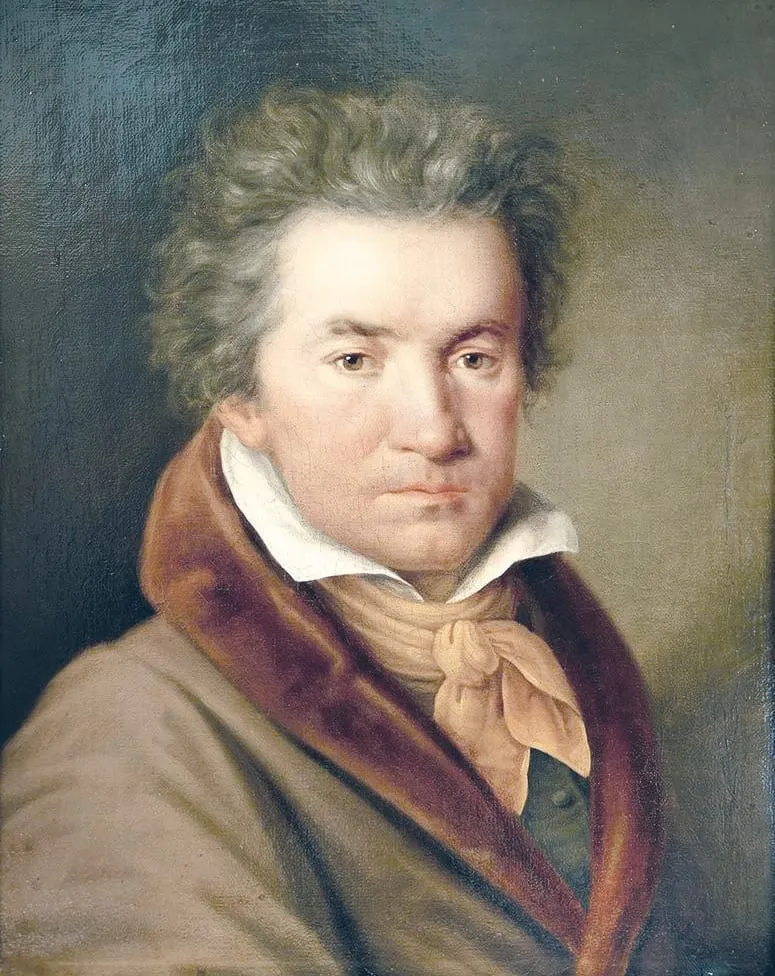
I want to just start out by quoting something that Beethoven wrote about music. He wasn’t a prolific writer, but he wrote little things here and there. And of course, at a certain point, he lost his hearing, so he couldn’t even tell what people were saying to him, except by reading the notes written to him. And think about that for a second, that here you’ve got a guy who, by the time he wrote the Ninth Symphony, was stone deaf. I mean, he really couldn’t hear anything, but he had it. He did hear it. So, he didn’t lose his hearing, actually. He just lost the physical side of it, but he actually had that. But here he says, “There is something mysterious in the effect of music, that it moves our inner self, so that it becomes a means of connection between two worlds. We feel ourselves enlarged, uplifted, rapt. What is that called other than in the domain of nature, drawn to God? Music is a higher, finer language than words. In the moments where every utterance of the uplifted soul seems too weak, where it despairs of conceiving more elegant words, there the musical art begins. From the outset, all song has this basis.”
Going back to what Lyndon LaRouche commented about this, when he first founded the organization, and founded our movement back in the 1970s, and in the early 1980s, he recruited a number of brilliant musicians, or at least promising musicians, including myself. LaRouche pointed to the song, especially the German art song, the so-called Lied, as what he called the Rosetta Stone of music. That is, because if you just look at so-called instrumental music alone, and if you just play the notes, you lose that singing character. On the other side, if you are just doing the singing, and you’re not really working through these great instrumental works, not only symphonies, but also the great piano sonatas, and string quartets, and trios, and all sorts of wonderful things that Beethoven and his friends, and his predecessors, like Mozart and Haydn were doing, and Johann Sebastian Bach, then you’re missing the idea. Because there’s a certain precision that you can get in those instrumental works that sometimes is not accessible just with the songs alone. And that’s precisely where we are with Beethoven’s Ninth.